

On This Day in Science: July 1, 1858
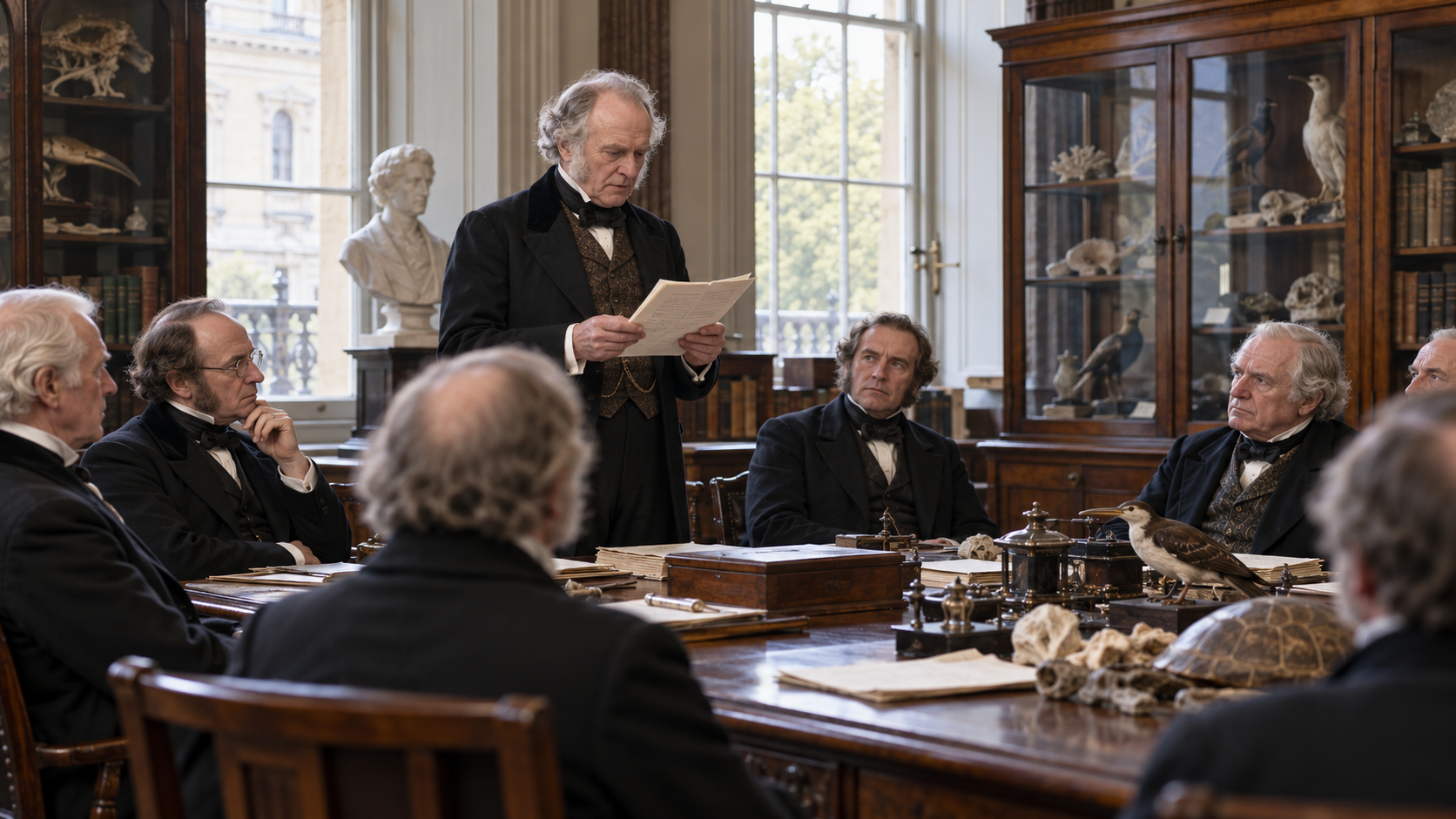
On July 1, 1858, at Burlington House in London, the Linnean Society heard papers by Charles Darwin and Alfred Russel Wallace that independently described evolution by natural selection. Neither naturalist attended. Their ideas were presented by the geologist Charles Lyell and botanist Joseph Dalton Hooker, who had assembled extracts from Darwin’s unpublished work with Wallace’s newly arrived essay.
Darwin had spent years developing an explanation for how advantageous inherited differences could become more common as organisms competed, survived, and reproduced. Wallace reached a similar mechanism while collecting in the Malay Archipelago. When his manuscript reached Darwin, the overlap created a difficult question of priority. Lyell and Hooker proposed a joint presentation that documented both lines of work.
The papers drew little immediate attention, but they established a public scientific record before Darwin’s book On the Origin of Species appeared in 1859. Wallace accepted the arrangement and remained a major contributor to evolutionary biology and biogeography, although the history of credit and the circumstances of the presentation continue to be examined.
The meeting did not instantly settle the origin of species. It marked the point at which a shared explanatory mechanism entered formal scientific discussion, open to evidence, criticism, and refinement. Modern evolutionary theory has expanded far beyond the 1858 papers through genetics, paleontology, ecology, and molecular biology. For science history, the event also shows how evidence moves from an observation or engineered test into a durable body of knowledge. Instruments supplied measurements, specialists debated interpretation, and later work refined what the first result could mean. Archives preserve the early record while new methods let researchers ask different questions of it. That continuing revision is the process through which a dated milestone remains scientifically useful. Seen across a longer timeline, scientific milestones are junctions rather than isolated beginnings. Earlier experiments, tools, and institutions made the work possible, while later teams tested limits and carried the result into new settings. What survives is a traceable chain of evidence, correction, and application that allows one moment to remain relevant as knowledge and technology continue to change. The anniversary highlights the difference between a first result and a finished understanding. A successful observation can settle one question while opening several harder ones, and even a failed objective can reshape later designs. Preserved data, specimens, photographs, and hardware allow new generations to revisit the work with better tools. Science advances through that continuity rather than stopping on a memorable date. Its calendar date is an entry point, not an endpoint. The people involved worked with the instruments, assumptions, and social conditions of their time, and later research has both extended and corrected their conclusions. Separating what was known that day from what became clear afterward protects the history from myth and shows how cumulative evidence turns an episode into lasting scientific knowledge.
Darwin developed natural selection over many years in Britain.
Wallace arrived at a similar explanation during fieldwork in Southeast Asia.
Lyell and Hooker paired Wallace's essay with extracts from Darwin's earlier writings.
The Linnean Society heard the material while both authors were absent.
The 1858 papers placed natural selection on the scientific record.
Genetics and later evidence transformed the mechanism into modern evolutionary biology.
Explore more of "On This Day ..."
Discover more events from the same date across news, politics, technology, sports, and other fields. Each link highlights significant moments that shaped history on different fronts.