

On This Day in Science: August 11, 1999
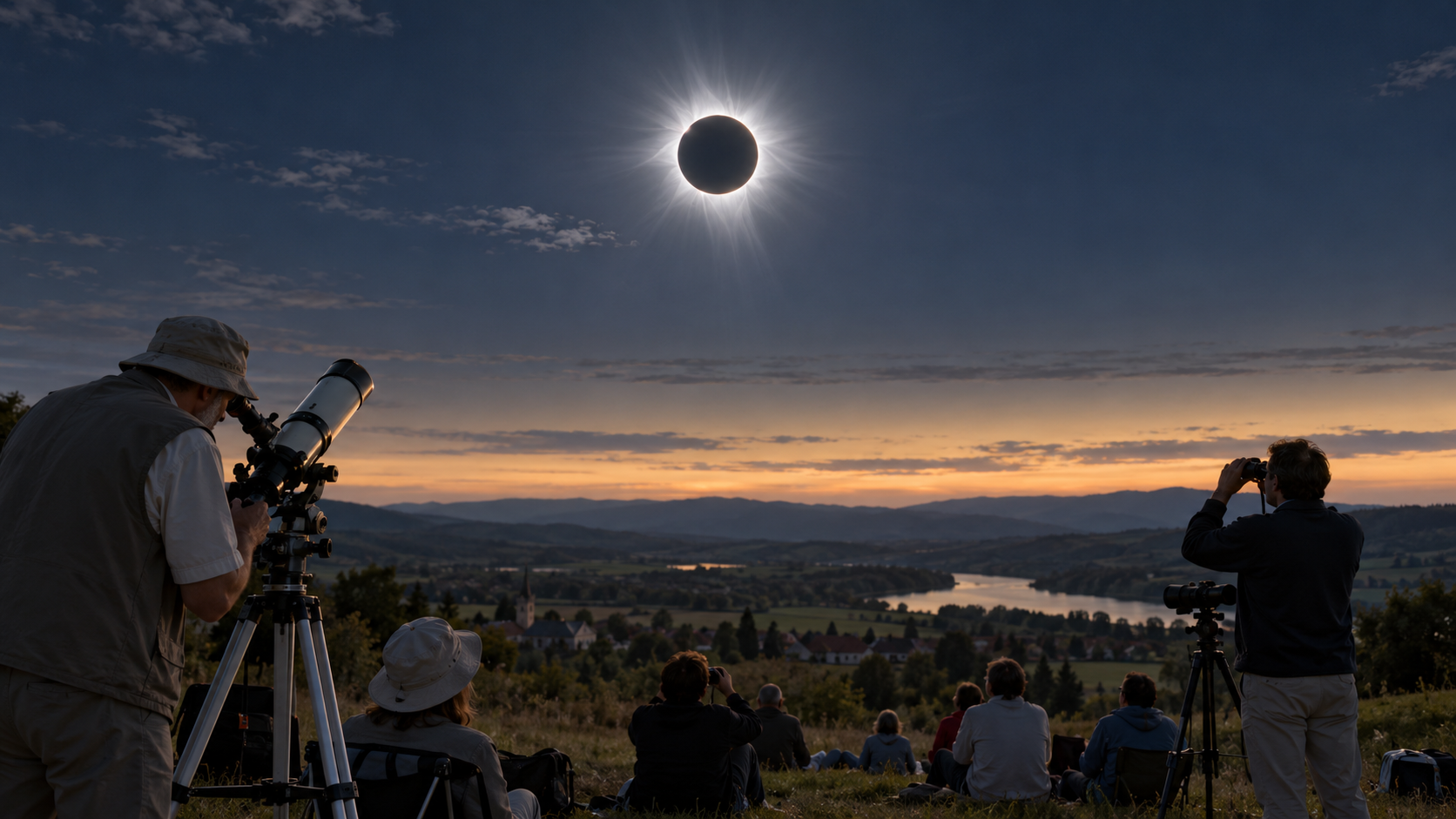
On August 11, 1999, the Moon’s shadow crossed the North Atlantic, Europe, the Middle East, and parts of Asia during the last total solar eclipse of the twentieth century. Observers inside a narrow path saw daylight fade, the solar disk disappear, and the Sun’s faint corona emerge around the dark silhouette of the Moon.
Totality reached land in southwest England and crossed France, Germany, Austria, Hungary, Romania, Turkey, and onward toward India. Clouds frustrated many viewing sites, but the event drew enormous public attention. Outside the central path, a partial eclipse was visible across a much wider region, requiring proper eye protection.
Eclipses occur because the Moon’s apparent size can closely match the Sun’s, but orbital geometry restricts totality to a moving strip. Scientists used ground stations, aircraft, and instruments to examine coronal structure, polarization, temperature, and effects on Earth’s atmosphere and radio propagation.
The eclipse combined a predictable celestial alignment with observations that are difficult at any other time. Space coronagraphs now monitor the outer solar atmosphere continuously, yet natural totality still exposes the innermost corona with exceptional contrast and provides a powerful demonstration of orbital mechanics. The anniversary highlights the difference between a first result and a finished understanding. A successful observation can settle one question while opening several harder ones, and even a failed objective can reshape later designs. Preserved data, specimens, photographs, and hardware allow new generations to revisit the work with better tools. Science advances through that continuity rather than stopping on a memorable date. Its calendar date is an entry point, not an endpoint. The people involved worked with the instruments, assumptions, and social conditions of their time, and later research has both extended and corrected their conclusions. Separating what was known that day from what became clear afterward protects the history from myth and shows how cumulative evidence turns an episode into lasting scientific knowledge. For science history, the event also shows how evidence moves from an observation or engineered test into a durable body of knowledge. Instruments supplied measurements, specialists debated interpretation, and later work refined what the first result could mean. Archives preserve the early record while new methods let researchers ask different questions of it. That continuing revision is the process through which a dated milestone remains scientifically useful. Seen across a longer timeline, scientific milestones are junctions rather than isolated beginnings. Earlier experiments, tools, and institutions made the work possible, while later teams tested limits and carried the result into new settings. What survives is a traceable chain of evidence, correction, and application that allows one moment to remain relevant as knowledge and technology continue to change.
The Moon’s umbra traced a thin path across several continents.
Locations only a short distance away experienced a partial eclipse instead.
Blocking the bright photosphere reveals faint plasma around the Sun.
Streamers and loops trace the solar magnetic field.
Millions watched while research teams deployed specialized instruments.
The same alignment served education, atmospheric studies, and solar physics.
Explore more of "On This Day ..."
Discover more events from the same date across news, politics, technology, sports, and other fields. Each link highlights significant moments that shaped history on different fronts.