

On This Day in Science: August 15, 1977
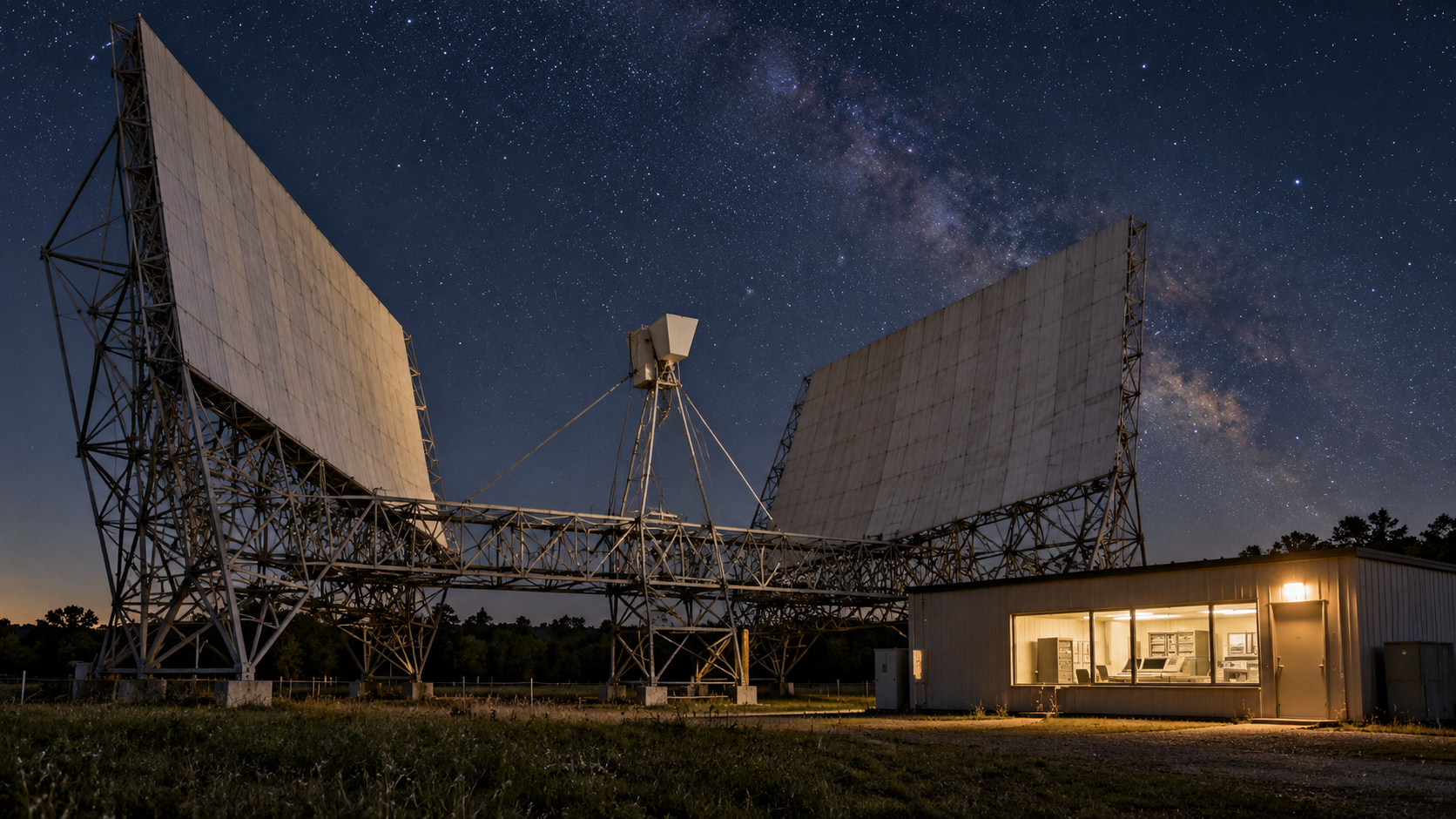
On August 15, 1977, Ohio State University’s Big Ear radio telescope detected a strong, narrowband signal during a survey for possible extraterrestrial transmissions. The signal lasted the full 72 seconds that a fixed source would take to cross one of the telescope’s beams as Earth rotated. Its intensity rose and fell in a striking pattern.
The telescope’s computer summarized strength with the characters “6EQUJ5.” Volunteer astronomer Jerry Ehman later saw the printout, circled the sequence, and wrote “Wow!” beside it. The frequency lay near the natural radio line of hydrogen, a region long considered interesting for searches because it is physically universal.
Big Ear had two feed horns that normally would encounter a persistent celestial signal several minutes apart, but the event appeared in only one. Repeated searches of the same sky region did not recover it. Proposed explanations have included terrestrial interference and natural astrophysical phenomena, yet no source has been established conclusively.
The detection is famous not because it proved intelligent life, but because it remains a disciplined example of uncertainty. A single event can be intriguing while still failing the repeatability needed for a discovery. Modern SETI projects use broader bandwidth, higher sensitivity, rapid follow-up, and interference rejection to resolve future candidates more decisively. The anniversary highlights the difference between a first result and a finished understanding. A successful observation can settle one question while opening several harder ones, and even a failed objective can reshape later designs. Preserved data, specimens, photographs, and hardware allow new generations to revisit the work with better tools. Science advances through that continuity rather than stopping on a memorable date. Its calendar date is an entry point, not an endpoint. The people involved worked with the instruments, assumptions, and social conditions of their time, and later research has both extended and corrected their conclusions. Separating what was known that day from what became clear afterward protects the history from myth and shows how cumulative evidence turns an episode into lasting scientific knowledge. For science history, the event also shows how evidence moves from an observation or engineered test into a durable body of knowledge. Instruments supplied measurements, specialists debated interpretation, and later work refined what the first result could mean. Archives preserve the early record while new methods let researchers ask different questions of it. That continuing revision is the process through which a dated milestone remains scientifically useful. Seen across a longer timeline, scientific milestones are junctions rather than isolated beginnings. Earlier experiments, tools, and institutions made the work possible, while later teams tested limits and carried the result into new settings. What survives is a traceable chain of evidence, correction, and application that allows one moment to remain relevant as knowledge and technology continue to change.
Earth’s rotation swept the telescope beam across a fixed direction in the sky.
The signal’s rise and fall matched that observing window.
The characters 6EQUJ5 represented measured intensity in successive intervals.
They were not decoded words or an alien transmission.
Follow-up observations never found the same signal again.
Without repetition, origin and meaning remain unresolved.
Explore more of "On This Day ..."
Discover more events from the same date across news, politics, technology, sports, and other fields. Each link highlights significant moments that shaped history on different fronts.