

On This Day in Science: September 8, 2004
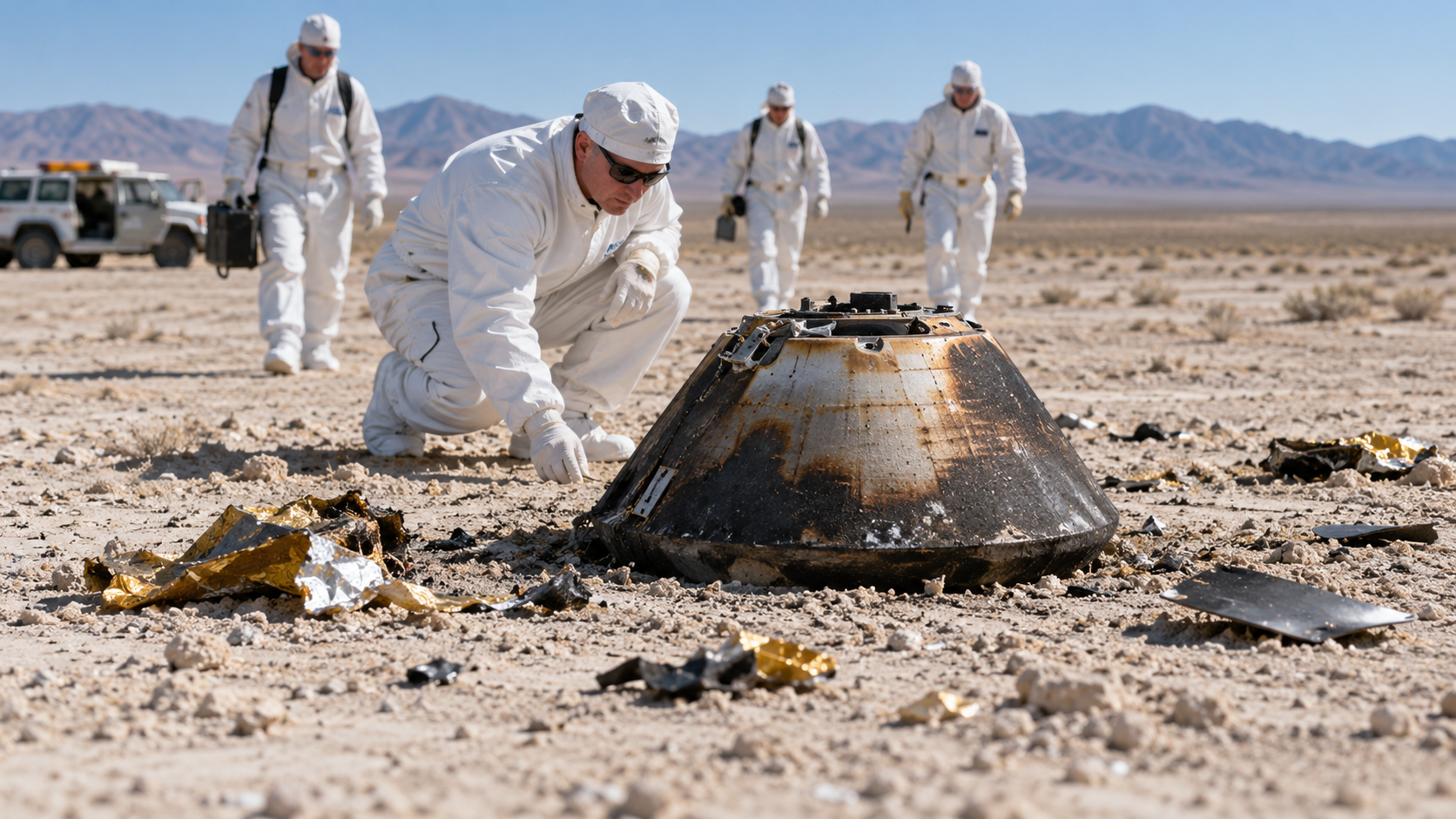
On September 8, 2004, NASA’s Genesis sample-return capsule entered Earth’s atmosphere over Utah after collecting solar-wind particles in space. Its drogue parachute failed to deploy, so the capsule struck the desert at about 311 kilometers per hour instead of being captured by helicopter. The impact shattered many delicate collector wafers and contaminated the canister with soil.
Recovery crews quickly carried the damaged hardware to a clean room. The collectors had been made from carefully selected materials, including silicon, sapphire, and diamond-like films, so scientists could distinguish solar atoms from much of the contamination. Thousands of fragments were cataloged, cleaned, and assigned to laboratories.
Despite the crash, Genesis achieved major science goals. Its samples yielded precise isotope measurements of oxygen, nitrogen, noble gases, and other elements in the solar wind. Those values provide a reference for the composition of the early solar nebula and help researchers compare the Sun with planets, meteorites, and comets.
The accident investigation traced the parachute failure to gravity-switch sensors installed in the wrong orientation. Genesis became both a lesson in systems assurance and a demonstration that rigorous curation can rescue science from badly damaged returned material. Its calendar date is an entry point, not an endpoint. The people involved worked with the instruments, assumptions, and social conditions of their time, and later research has both extended and corrected their conclusions. Separating what was known that day from what became clear afterward protects the history from myth and shows how cumulative evidence turns an episode into lasting scientific knowledge. For science history, the event also shows how evidence moves from an observation or engineered test into a durable body of knowledge. Instruments supplied measurements, specialists debated interpretation, and later work refined what the first result could mean. Archives preserve the early record while new methods let researchers ask different questions of it. That continuing revision is the process through which a dated milestone remains scientifically useful. Seen across a longer timeline, scientific milestones are junctions rather than isolated beginnings. Earlier experiments, tools, and institutions made the work possible, while later teams tested limits and carried the result into new settings. What survives is a traceable chain of evidence, correction, and application that allows one moment to remain relevant as knowledge and technology continue to change. The anniversary highlights the difference between a first result and a finished understanding. A successful observation can settle one question while opening several harder ones, and even a failed objective can reshape later designs. Preserved data, specimens, photographs, and hardware allow new generations to revisit the work with better tools. Science advances through that continuity rather than stopping on a memorable date.
The capsule followed its planned entry path, but a sensor error blocked deployment.
It hit the Utah range at nearly 200 miles per hour.
Collector materials had distinctive compositions and could be cleaned selectively.
Scientists cataloged thousands of pieces rather than abandoning the mission.
Genesis measured isotope ratios in atoms flowing from the Sun.
The samples help compare solar composition with planets and primitive bodies.
Explore more of "On This Day ..."
Discover more events from the same date across news, politics, technology, sports, and other fields. Each link highlights significant moments that shaped history on different fronts.