

On This Day in Science: September 10, 2008
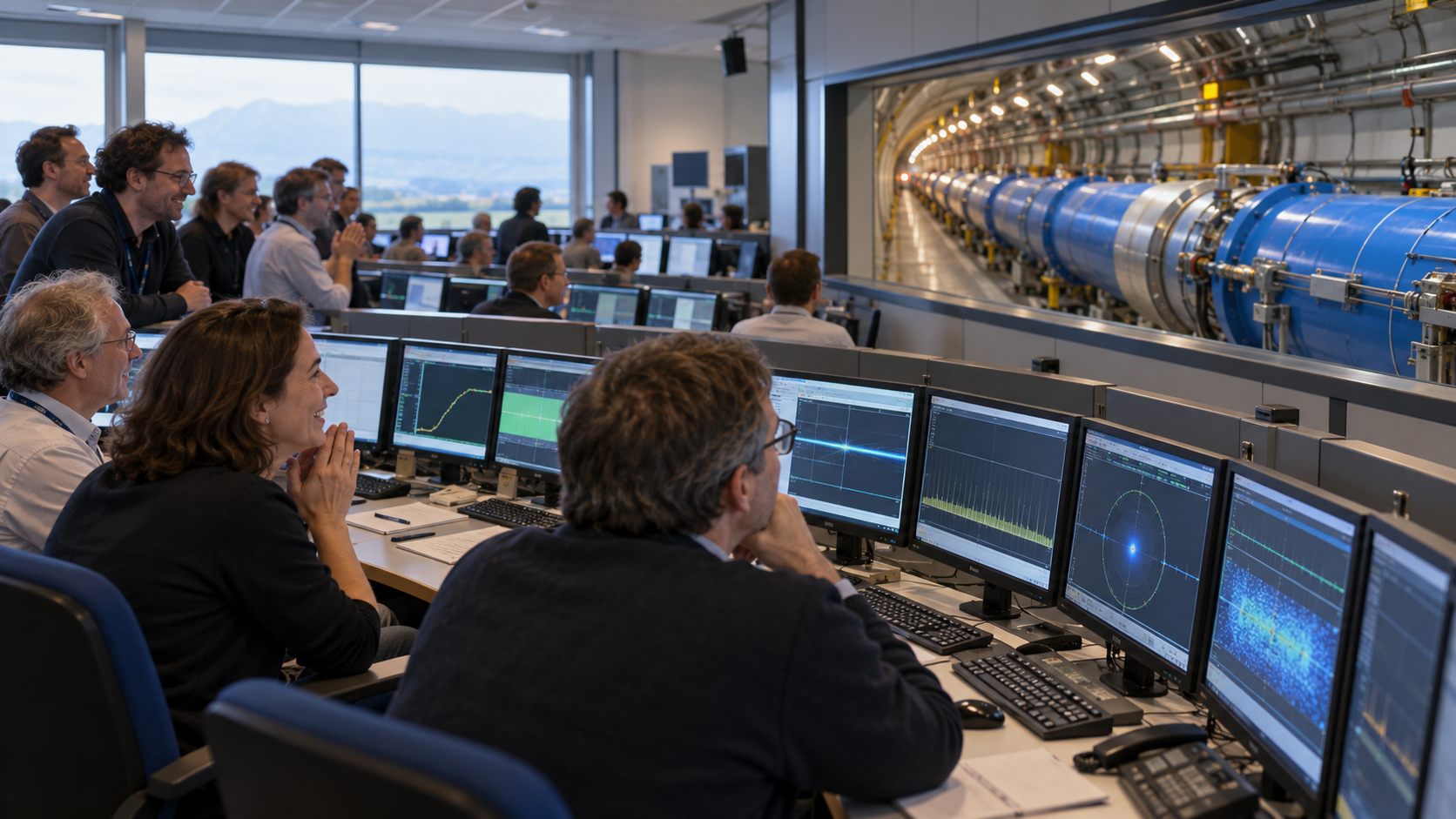
On September 10, 2008, operators at CERN guided a proton beam all the way around the 27-kilometer Large Hadron Collider for the first time. The beam traveled in stages as teams synchronized magnets, corrected its orbit, and removed temporary absorbers. A second beam was then circulated in the opposite direction, proving the basic injection and steering systems.
The LHC occupies a tunnel beneath the French-Swiss border and uses thousands of superconducting magnets cooled near absolute zero. Two counter-rotating beams are accelerated through radio-frequency cavities and brought into collision inside large detectors, where particle tracks and energy deposits reveal processes occurring at extremely small scales.
First beam was an engineering milestone, not yet a physics collision run. Nine days later an electrical fault damaged magnets and released helium, requiring extensive repairs and new protection systems. Operations resumed in 2009, and in 2012 the ATLAS and CMS experiments announced discovery of a particle consistent with the Higgs boson.
The September circulation showed that a global collaboration could operate one of the most complex scientific instruments ever built. Its later discoveries rest on precise control of vacuum, cryogenics, timing, magnets, computing, and detectors across an underground machine the size of a city. Seen across a longer timeline, scientific milestones are junctions rather than isolated beginnings. Earlier experiments, tools, and institutions made the work possible, while later teams tested limits and carried the result into new settings. What survives is a traceable chain of evidence, correction, and application that allows one moment to remain relevant as knowledge and technology continue to change. The anniversary highlights the difference between a first result and a finished understanding. A successful observation can settle one question while opening several harder ones, and even a failed objective can reshape later designs. Preserved data, specimens, photographs, and hardware allow new generations to revisit the work with better tools. Science advances through that continuity rather than stopping on a memorable date. Its calendar date is an entry point, not an endpoint. The people involved worked with the instruments, assumptions, and social conditions of their time, and later research has both extended and corrected their conclusions. Separating what was known that day from what became clear afterward protects the history from myth and shows how cumulative evidence turns an episode into lasting scientific knowledge. For science history, the event also shows how evidence moves from an observation or engineered test into a durable body of knowledge. Instruments supplied measurements, specialists debated interpretation, and later work refined what the first result could mean. Archives preserve the early record while new methods let researchers ask different questions of it. That continuing revision is the process through which a dated milestone remains scientifically useful.
Operators threaded protons through the ring one section at a time.
Beam monitors confirmed the first complete orbit before the opposite direction was tested.
Superconducting magnets bend and focus particles moving near light speed.
Radio-frequency cavities add energy while detectors wait at selected collision points.
First beam validated injection and steering but did not start full-energy physics.
Repairs and commissioning came before the discoveries for which the LHC became known.
Explore more of "On This Day ..."
Discover more events from the same date across news, politics, technology, sports, and other fields. Each link highlights significant moments that shaped history on different fronts.