

On This Day in Science: September 15, 1835
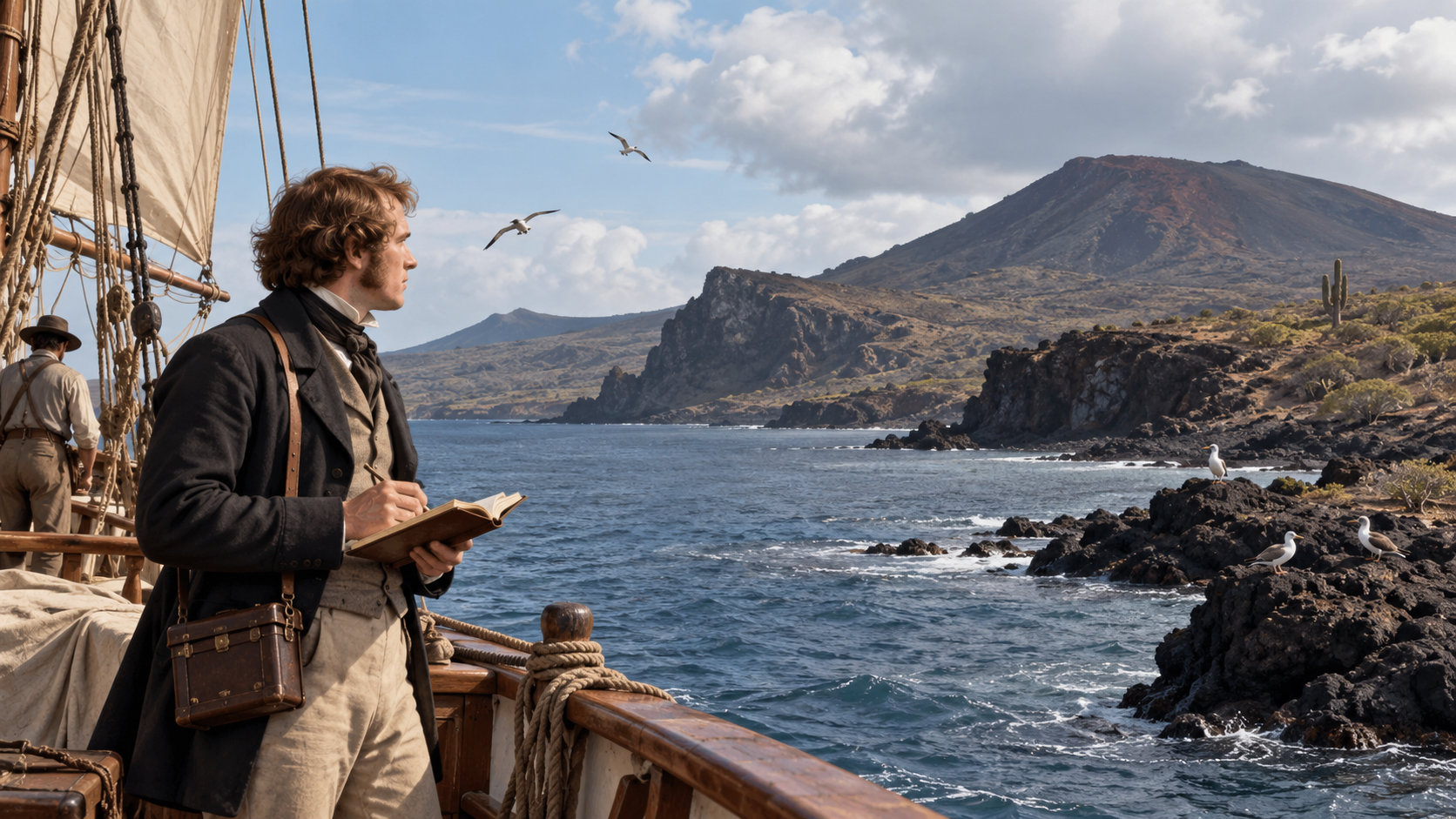
On September 15, 1835, HMS Beagle sailed into the waters of the Galápagos archipelago with Charles Darwin aboard as a young naturalist and gentleman companion to Captain Robert FitzRoy. The survey vessel approached Chatham Island, now San Cristóbal, after crossing the eastern Pacific from Peru. Darwin first went ashore the following day.
Over five weeks in the islands, the Beagle surveyed coastlines while Darwin collected rocks, plants, birds, reptiles, and other specimens. He examined volcanic terrain and noted differences among island organisms, although some collections were not labeled by island as carefully as later interpretation would require.
The visit did not cause an instant theory of evolution. Darwin’s understanding developed after the voyage as specialists identified his specimens and as he compared geographic patterns with evidence from fossils, breeding, geology, and ecology. Galápagos mockingbirds were especially important early clues; the celebrated finches became more prominent in later retellings.
The arrival marks the beginning of a field episode that fed a much longer intellectual process. It illustrates how careful collecting, location records, expert collaboration, and reflection can turn local observations into questions about species, variation, and the history of life. The anniversary highlights the difference between a first result and a finished understanding. A successful observation can settle one question while opening several harder ones, and even a failed objective can reshape later designs. Preserved data, specimens, photographs, and hardware allow new generations to revisit the work with better tools. Science advances through that continuity rather than stopping on a memorable date. Its calendar date is an entry point, not an endpoint. The people involved worked with the instruments, assumptions, and social conditions of their time, and later research has both extended and corrected their conclusions. Separating what was known that day from what became clear afterward protects the history from myth and shows how cumulative evidence turns an episode into lasting scientific knowledge. For science history, the event also shows how evidence moves from an observation or engineered test into a durable body of knowledge. Instruments supplied measurements, specialists debated interpretation, and later work refined what the first result could mean. Archives preserve the early record while new methods let researchers ask different questions of it. That continuing revision is the process through which a dated milestone remains scientifically useful. Seen across a longer timeline, scientific milestones are junctions rather than isolated beginnings. Earlier experiments, tools, and institutions made the work possible, while later teams tested limits and carried the result into new settings. What survives is a traceable chain of evidence, correction, and application that allows one moment to remain relevant as knowledge and technology continue to change.
The Beagle entered Galápagos waters on September 15 after sailing from Peru.
Its official charting work gave Darwin access to several islands and habitats.
Darwin gathered rocks, plants, birds, reptiles, and marine organisms.
Comparisons made after the voyage gave many observations their evolutionary meaning.
The islands influenced Darwin, but natural selection did not appear in one sudden revelation.
Years of evidence and argument connected the visit to his mature theory.
Explore more of "On This Day ..."
Discover more events from the same date across news, politics, technology, sports, and other fields. Each link highlights significant moments that shaped history on different fronts.