

On This Day in Science: September 18, 1977
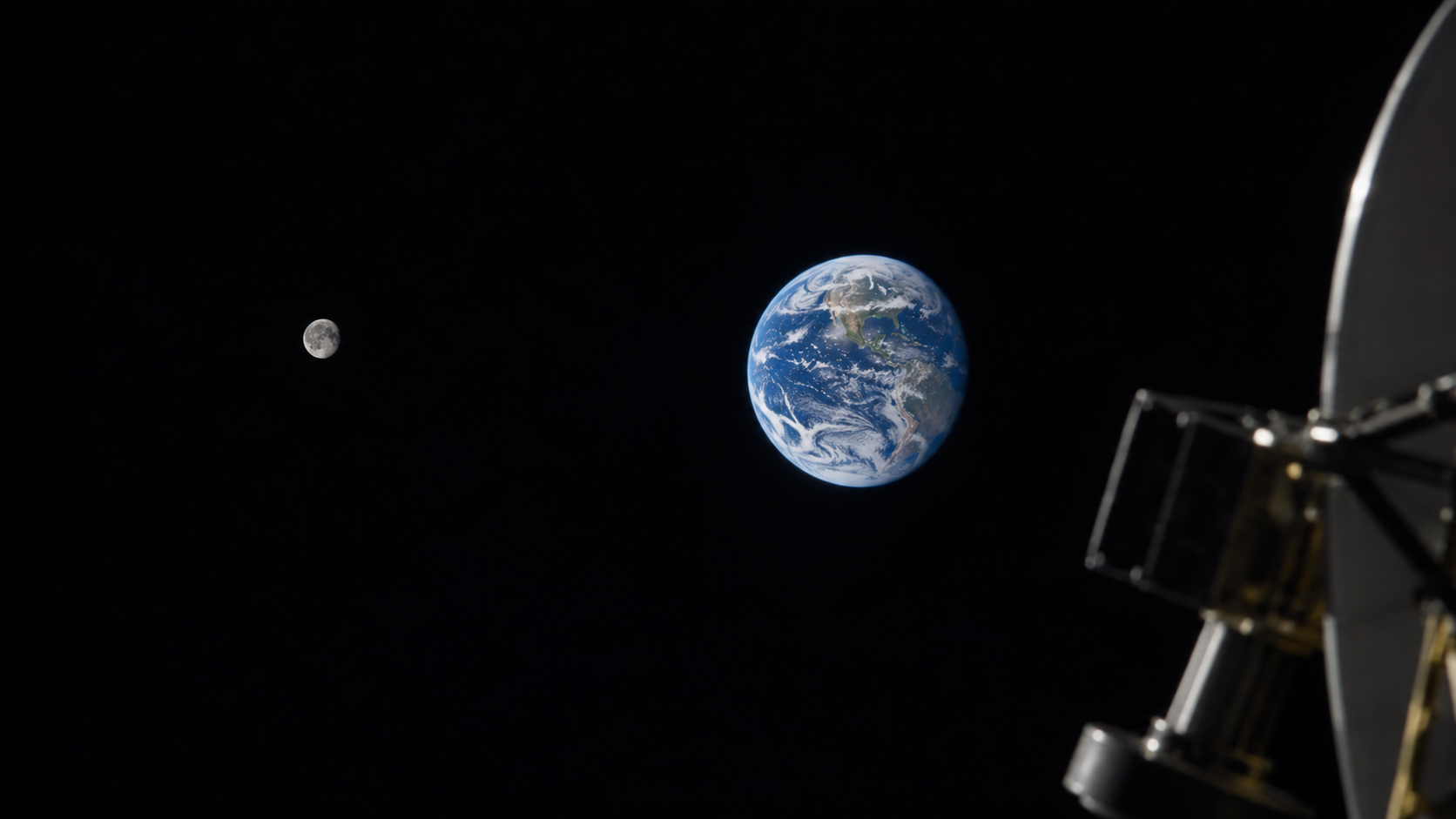
On September 18, 1977, Voyager 1 took the first photograph to show the complete Earth and Moon together in a single frame. The spacecraft was about 11.7 million kilometers from Earth, less than two weeks after launch, when its narrow-angle camera recorded the pair against the darkness of space.
Earth was much brighter than the Moon, so image specialists combined separately processed exposures to make both visible in the published view. The result preserved their correct relative positions and offered a distant perspective impossible from near-Earth orbit. North is not oriented in the familiar map direction because the camera followed spacecraft geometry rather than a terrestrial horizon.
The photograph was partly a camera test during Voyager’s outbound cruise to Jupiter and Saturn. It helped verify imaging performance while creating a new kind of planetary portrait: Earth was no longer the platform from which every picture began, but one world paired with its satellite in a wider celestial scene.
Later missions produced more distant and more detailed Earth-Moon images, yet Voyager’s frame remains historically important. It anticipated the mission’s 1990 family portrait of the planets and its small image of Earth known as the Pale Blue Dot. Seen across a longer timeline, scientific milestones are junctions rather than isolated beginnings. Earlier experiments, tools, and institutions made the work possible, while later teams tested limits and carried the result into new settings. What survives is a traceable chain of evidence, correction, and application that allows one moment to remain relevant as knowledge and technology continue to change. The anniversary highlights the difference between a first result and a finished understanding. A successful observation can settle one question while opening several harder ones, and even a failed objective can reshape later designs. Preserved data, specimens, photographs, and hardware allow new generations to revisit the work with better tools. Science advances through that continuity rather than stopping on a memorable date. Its calendar date is an entry point, not an endpoint. The people involved worked with the instruments, assumptions, and social conditions of their time, and later research has both extended and corrected their conclusions. Separating what was known that day from what became clear afterward protects the history from myth and shows how cumulative evidence turns an episode into lasting scientific knowledge. For science history, the event also shows how evidence moves from an observation or engineered test into a durable body of knowledge. Instruments supplied measurements, specialists debated interpretation, and later work refined what the first result could mean. Archives preserve the early record while new methods let researchers ask different questions of it. That continuing revision is the process through which a dated milestone remains scientifically useful.
Voyager's camera captured the full disks of Earth and Moon together.
The great distance turned the familiar sky relationship into a planetary system portrait.
Earth reflected far more light than the smaller, darker Moon.
Separate processing made both bodies legible while preserving their geometry.
The observation helped check the camera early in Voyager's journey.
It also changed how audiences could picture their home world in space.
Explore more of "On This Day ..."
Discover more events from the same date across news, politics, technology, sports, and other fields. Each link highlights significant moments that shaped history on different fronts.