

How Hailstones Grow in Storms Explainer
Hail forms in deep thunderstorms with strong updrafts and abundant supercooled liquid water. Supercooled drops remain liquid below the usual freezing point until they strike an ice particle. A small frozen drop, graupel particle, or piece of ice acts as a hail embryo and begins collecting these droplets in a cold part of the cloud.
The updraft carries and suspends the embryo while collisions add water. If arriving droplets freeze almost instantly, trapped air bubbles make cloudy ice, called dry growth. When collection is rapid enough to leave a liquid film before freezing, denser clear ice forms through wet growth. Changes along the path can produce alternating layers, though a ring is not a simple record of one trip around the storm.
A hailstone does not need to cycle neatly up and down many times. Three-dimensional storm flow can keep it in a growth region, move it across the updraft, or recirculate it. Its path depends on size, drag, wind, and changing storm structure. Stronger updrafts can support larger stones, but available supercooled water and time are also essential.
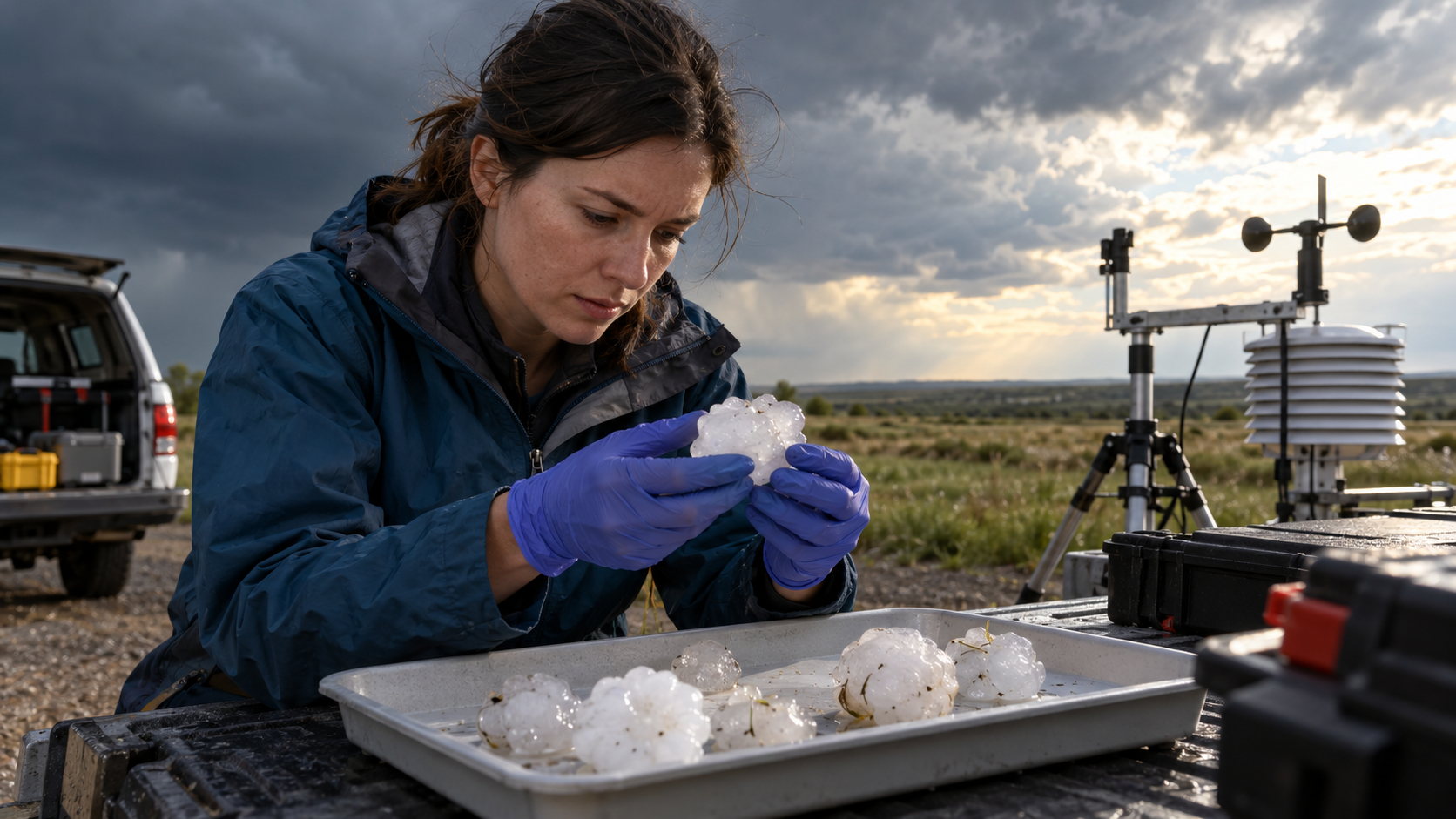
Growth ends when the updraft can no longer support the stone, the hail leaves the favorable region, or the storm weakens. During descent, warm air melts the surface and collisions may chip or reshape it. A large stone measured on the ground was generally larger aloft. Irregular lobes can form as water flows and freezes unevenly.
Weather radar detects hail indirectly from the way particles reflect and polarize radio waves. Dual-polarization measurements, environmental temperature profiles, storm structure, and reports improve estimates, but radar does not measure every stone’s exact size at the ground. Hail shafts can be narrow, and wind can carry falling stones away from the strongest radar signature.
Researchers use disdrometers, cameras, radar, soundings, aircraft data, and collected stones to study hail. Forecasting remains difficult because small changes in updraft and liquid water alter growth. Understanding the process improves warnings, building and crop risk models, and evaluation of how storm environments may change without assuming every intense thunderstorm will produce large hail.
Strong thunderstorm updrafts provide cold regions and sustained particle support.
Supercooled droplets freeze onto an ice embryo and add mass.
Dry growth makes bubbly ice; wet growth can make clearer, denser ice.
Hail paths are three-dimensional and need not follow tidy repeated loops.
Falling stones melt, chip, and drift before reaching the surface.
Radar estimates hail from scattering patterns rather than measuring every stone.
Explore more "Explainers"
Discover additional explainers across politics, science, business, technology, and other fields. Each explainer breaks down a complex idea into clear, everyday language—helping you better understand how major concepts, systems, and debates shape the world around us.