

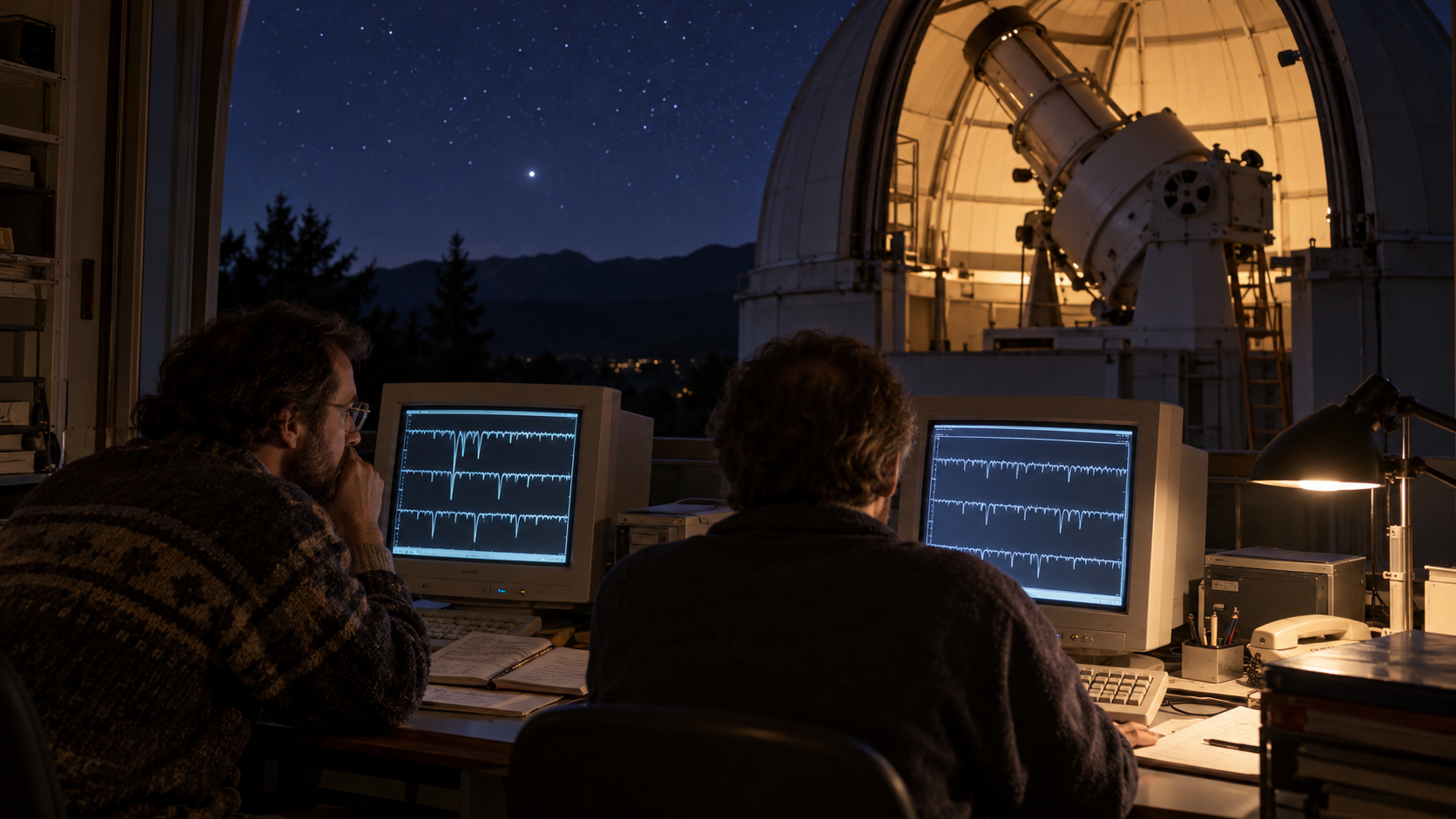
On This Day in Science: October 6, 1995
On October 6, 1995, astronomers Michel Mayor and Didier Queloz announced the discovery of a planet orbiting 51 Pegasi, a Sun-like star about fifty light-years away. Their measurements had been made with the ELODIE spectrograph at the Haute-Provence Observatory in France.
The instrument detected tiny, regular shifts in the star’s spectrum caused by its motion toward and away from Earth. That radial-velocity signal repeated every 4.23 days, implying a planet at least about half Jupiter’s mass orbiting extremely close to its star.
Such a “hot Jupiter” surprised astronomers because giant planets were expected to form much farther out. Independent observations soon confirmed the signal. Earlier planets had been found around a pulsar, but 51 Pegasi b became the first confirmed planet around a main-sequence star similar to the Sun.
The announcement helped transform exoplanet research into a major observational field. Thousands of planets are now known through radial velocity, transits, imaging, microlensing, and timing, while the unexpected orbit of 51 Pegasi b forced theories of planet formation to include large-scale migration. Modern interpretations benefit from evidence that the original participants did not possess. New instruments and analytical methods can recover additional detail, while historical scholarship clarifies questions of credit, context, and consequence. Holding the original achievement and those later corrections together produces a more accurate account than either celebration or dismissal alone. The anniversary also illustrates how a scientific milestone becomes useful through records that later researchers can inspect. Instruments, notebooks, images, specimens, and engineering reports preserve more than a celebratory date: they show what was actually measured, what remained uncertain, and how conclusions changed as better methods became available. Placed in a longer timeline, the event was a junction rather than a finished answer. Earlier discoveries and technical work made it possible, while later teams tested its limits and applied the result in new settings. That traceable sequence of evidence and revision is what turns one day into a durable part of scientific history. The episode also separates a first demonstration from mature understanding. A successful observation or flight can settle one question while exposing harder problems in reliability, interpretation, safety, and scale. Preserved data allow later generations to revisit the achievement without confusing what was known on the date with what became clear afterward. Its calendar date is an entry point rather than an endpoint. The people involved worked with the tools, assumptions, institutions, and social conditions of their time. Later research has extended some conclusions and corrected others, showing how science advances by keeping evidence open to comparison instead of treating a memorable event as final.
ELODIE measured periodic Doppler shifts in the spectrum of 51 Pegasi.
The star's motion revealed an unseen companion through gravity rather than direct imaging.
A giant planet completed an orbit in just over four days.
Its location challenged simple models based only on the architecture of our Solar System.
Confirmation showed that ordinary stars could host detectable planets.
Surveys rapidly expanded in precision, scale, and variety of methods.
Explore more of "On This Day ..."
Discover more events from the same date across news, politics, technology, sports, and other fields. Each link highlights significant moments that shaped history on different fronts.