

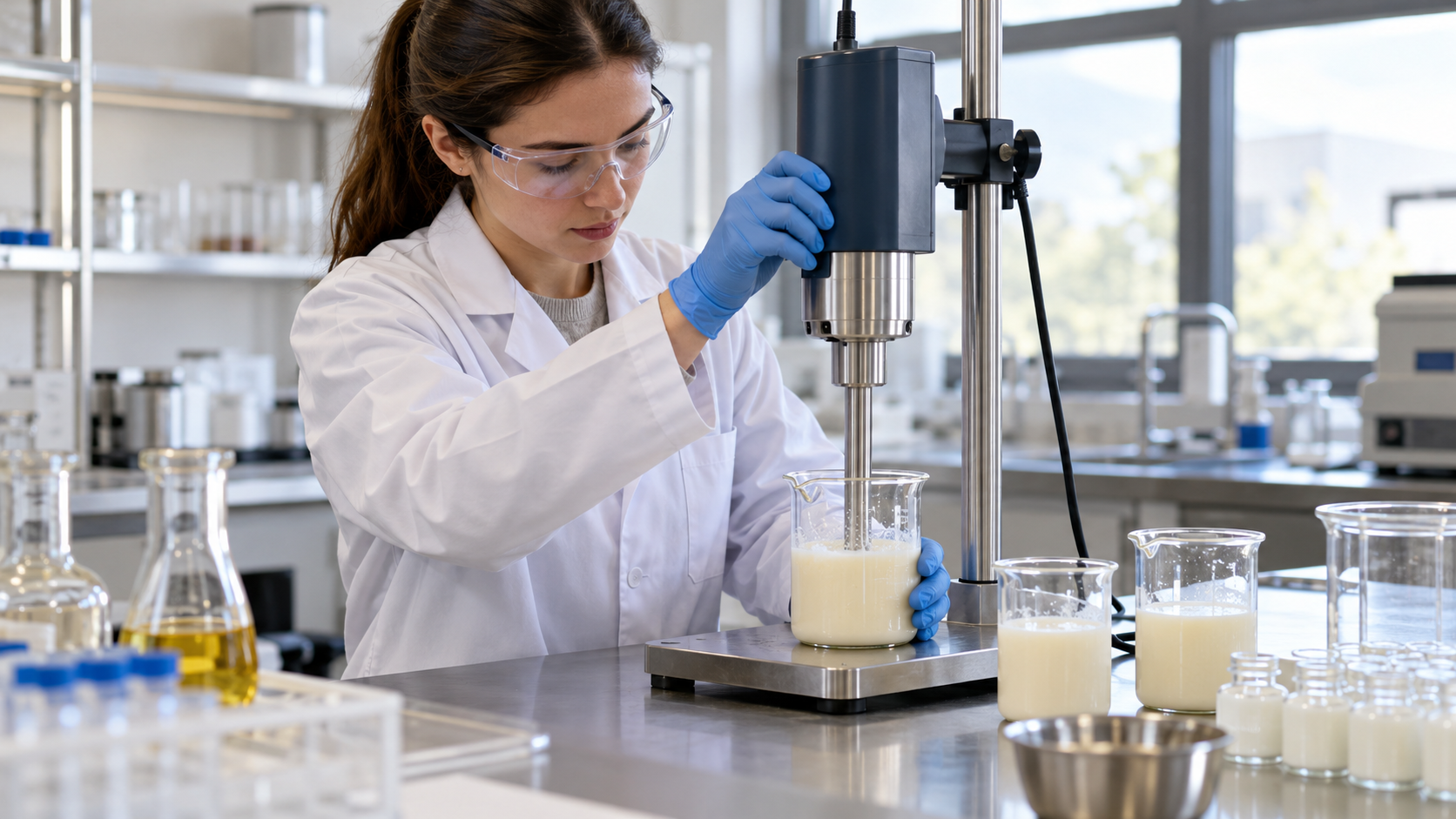
How Emulsions Keep Oil and Water Mixed Explainer
Oil and water separate because contact between their molecules is energetically unfavorable. An emulsion temporarily distributes one liquid as small droplets throughout the other. Oil-in-water systems include milk and many sauces; water-in-oil systems include butter and some creams. The continuous phase determines how the material flows and what it can dissolve.
Mixing supplies energy to stretch and break one liquid into droplets. A whisk, rotor-stator mixer, high-pressure homogenizer, or ultrasound can create new interface. Smaller droplets require more total interfacial area, so an unprotected mixture tends to reduce that area by letting droplets merge until visible layers return.
Emulsifiers are amphiphilic molecules with regions attracted to water and regions attracted to oil. They accumulate at droplet surfaces, lower interfacial tension, and form a protective film. Electrical charge or bulky molecular chains can keep droplets from approaching closely enough to coalesce. Proteins, phospholipids, soaps, and small surfactants stabilize in different ways.
Stability does not mean the system has reached its lowest-energy equilibrium. Droplets can cream upward or sediment downward because their density differs from the continuous liquid. They can flocculate into clusters, fuse by coalescence, or change size through Ostwald ripening as material diffuses from smaller to larger droplets. Thickening the continuous phase slows some motion.
Temperature, salt, acidity, droplet concentration, and processing history change performance. Heating may unfold protein emulsifiers; freezing can squeeze droplets together; ions can screen electrostatic repulsion. An emulsion may invert from oil-in-water to water-in-oil when composition or surfactant preference changes, producing a sudden shift in texture and conductivity.
Scientists measure droplet-size distributions, microscopy, rheology, separation rates, and interfacial properties over time. A sample that looks uniform for an hour may fail over months. Emulsion design matters in foods, cosmetics, medicines, paints, and petroleum processing because desired texture, release, appearance, and shelf life all emerge from the same droplet-scale physics.
Mechanical energy breaks one liquid into droplets within another.
Creating small droplets increases interfacial area and stored free energy.
Amphiphilic emulsifiers coat droplets and slow their close approach.
Creaming, flocculation, coalescence, and ripening are different failure routes.
Viscosity, temperature, salt, pH, and processing alter stability.
Emulsions are usually kinetically stable rather than true equilibrium mixtures.
Explore more "Explainers"
Discover additional explainers across politics, science, business, technology, and other fields. Each explainer breaks down a complex idea into clear, everyday language—helping you better understand how major concepts, systems, and debates shape the world around us.