

How Zeolites Separate Molecules Explainer
Zeolites are crystalline aluminosilicate materials whose frameworks contain interconnected pores and cavities of repeatable size. Those channels can hold water, gases, and ions, making the solid act as a molecular sieve, adsorbent, ion exchanger, or catalyst support. The useful explanation follows energy and charge while respecting the material properties at each boundary.
Silicon and aluminum atoms link through oxygen in a rigid three-dimensional network. Substituting aluminum creates negative framework charge, which is balanced by mobile cations such as sodium or calcium that can later be exchanged for other ions. Geometry and composition set the available pathways, so small design changes can alter the response.
A molecule can enter only if its effective size and shape fit a pore opening. Inside, electrostatic forces, polarity, and dispersion interactions determine how strongly it is adsorbed, so two small molecules may still separate because one binds preferentially. The process continues only while a driving difference overcomes losses, resistance, or competing motion.
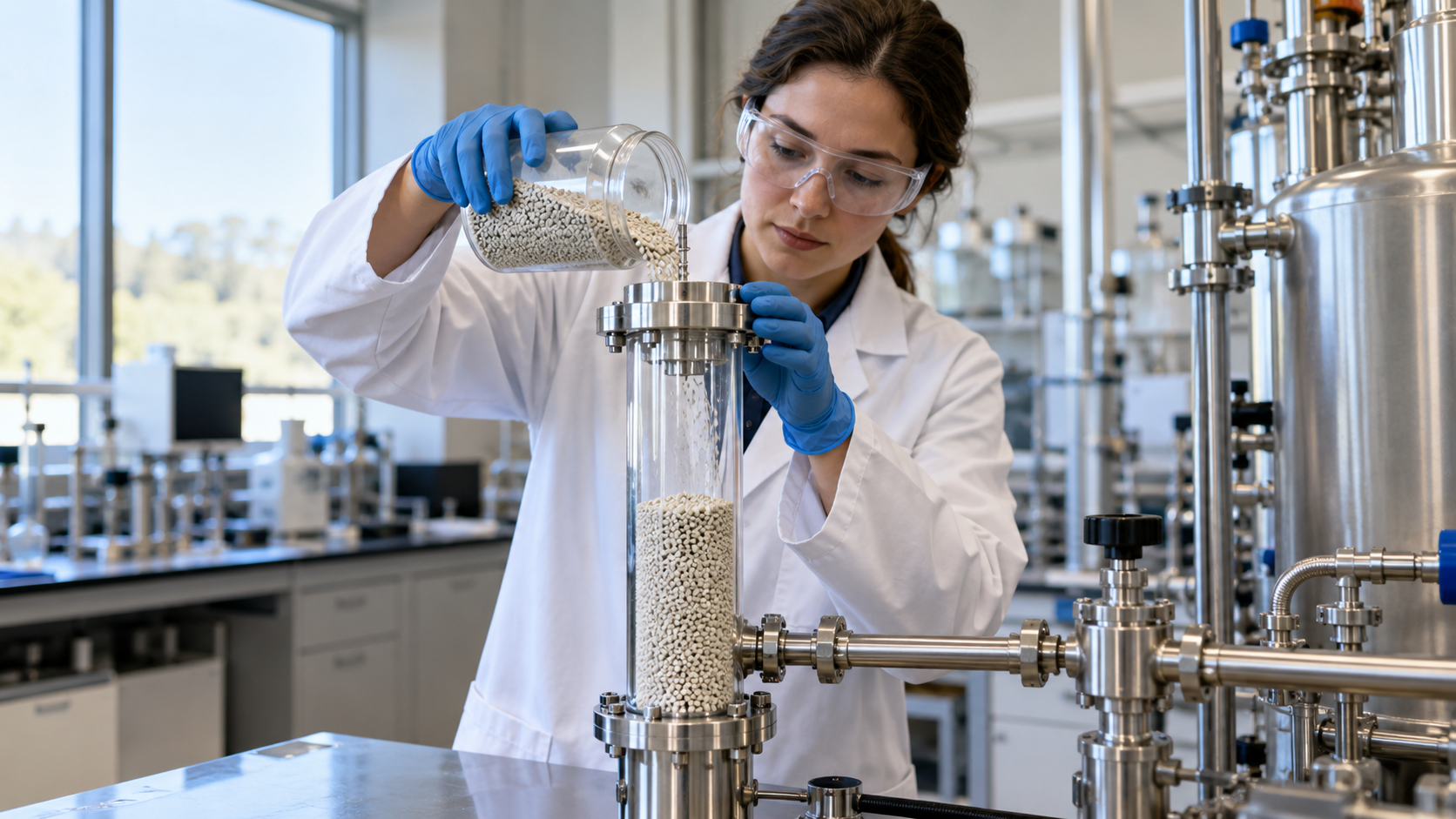
During a separation cycle, a gas or liquid mixture passes through zeolite particles. Favored species accumulate while others leave first; changing pressure, temperature, purge gas, or composition then releases the adsorbed material and regenerates the bed. Real devices add interfaces and imperfections that idealized diagrams usually leave out.
Researchers characterize crystal structure, pore volume, adsorption isotherms, diffusion rates, and selectivity under realistic mixtures. Water or contaminants may compete for sites, and particles need binders and suitable size to avoid excessive pressure drop. Scientists test the model by changing one condition and measuring the predicted optical, thermal, or electrical signal.
Natural and synthetic zeolites are used for water softening, gas drying, oxygen concentration, pollution control, and petroleum catalysis. Their selectivity is powerful but not absolute, and performance depends on framework type, exchanged ions, operating conditions, and regeneration strategy. The core physics is dependable, but efficiency and scale depend on engineering details and operating conditions.
A crystalline framework creates uniform channels and cavities.
Aluminum substitution gives the framework exchangeable charge-balancing ions.
Pore openings exclude molecules that are too large or poorly shaped.
Chemical interactions determine which fitting molecules adsorb most strongly.
Pressure or temperature swings release captured material for reuse.
Moisture, contaminants, and diffusion can change real separation performance.
Explore more "Explainers"
Discover additional explainers across politics, science, business, technology, and other fields. Each explainer breaks down a complex idea into clear, everyday language—helping you better understand how major concepts, systems, and debates shape the world around us.