

How Plasma Forms and Conducts Electricity Explainer
Plasma is a state of matter containing free electrons and ions along with neutral particles. It forms when heating, radiation, or a strong electric field gives electrons enough energy to escape atoms or molecules faster than charges recombine. The useful explanation follows energy and charge while respecting the material properties at each boundary.
Even a small ionized fraction can make a gas electrically active because electrons accelerate readily in an electric field. Their collisions can ionize more particles, excite atoms that later emit light, or transfer energy to the gas and surrounding surfaces. Geometry and composition set the available pathways, so small design changes can alter the response.
Positive and negative charges usually balance over larger distances, yet local separations create electric fields. Because many charged particles respond together, plasma supports waves, currents, sheaths, and instabilities that do not occur in an ordinary neutral gas. The process continues only while a driving difference overcomes losses, resistance, or competing motion.
Magnetic fields bend moving charges into spirals and can guide or confine the plasma. Collisions, density, temperature, and field strength determine whether particles follow magnetic lines closely or move more like a resistive conducting fluid. Real devices add interfaces and imperfections that idealized diagrams usually leave out.
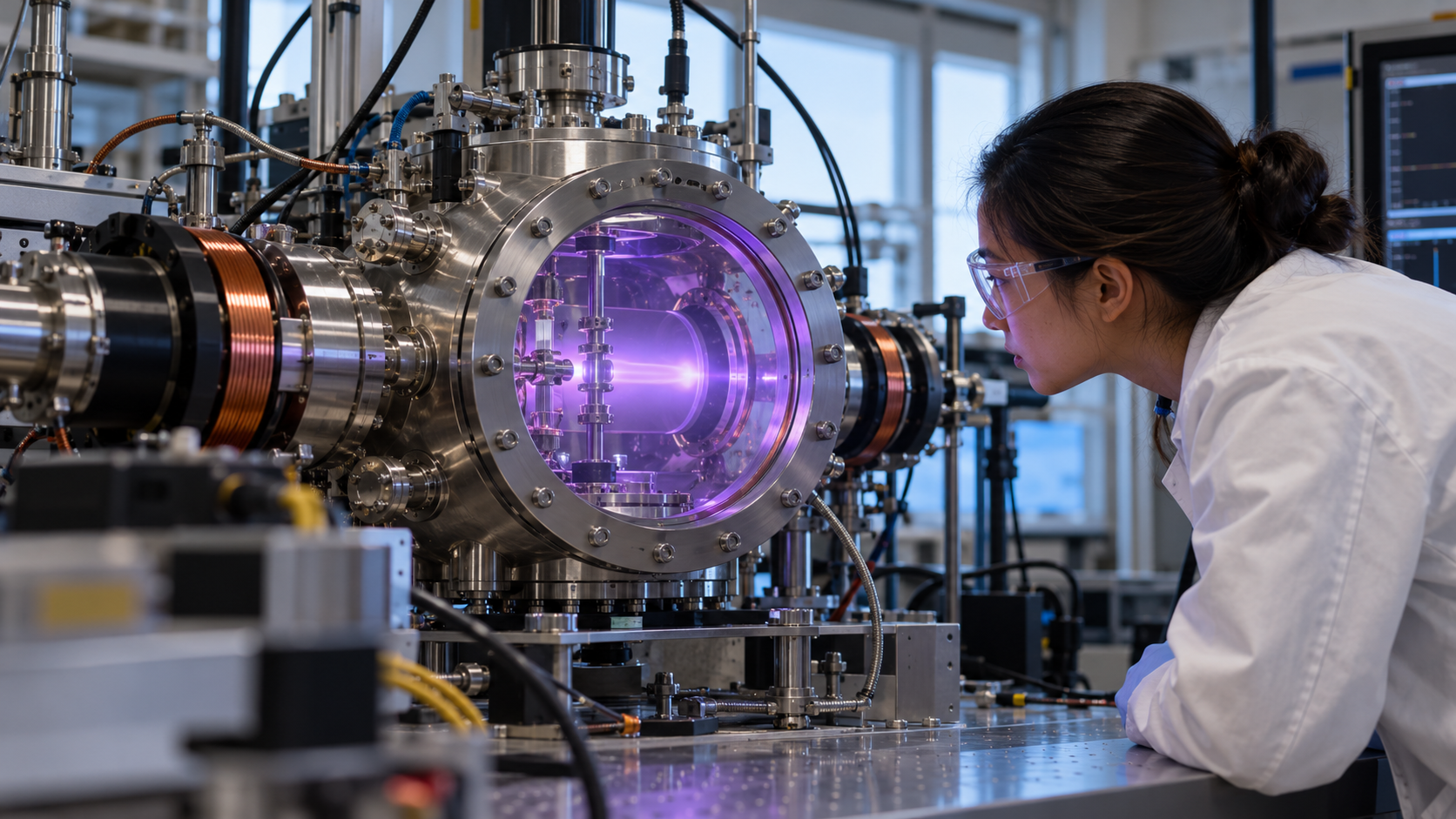
Laboratory probes, spectroscopy, imaging, and microwave measurements reveal electron density, temperature, composition, and motion. A bright glow alone is not enough to define the state because color depends on particular excited atoms and viewing conditions. Scientists test the model by changing one condition and measuring the predicted optical, thermal, or electrical signal.
Plasmas fill stars, the solar wind, lightning channels, fluorescent lamps, and industrial reactors. Their high conductivity does not mean zero resistance, and controlling heat, erosion, turbulence, and instabilities remains essential in fusion and manufacturing systems. The core physics is dependable, but efficiency and scale depend on engineering details and operating conditions.
Ionization separates some electrons from atoms or molecules.
Free charges respond strongly to electric fields.
Collisions can sustain ionization and produce light.
Collective charge motion creates waves, currents, and sheaths.
Magnetic fields guide charged-particle trajectories.
Density, temperature, and collisions determine plasma behavior.
Explore more "Explainers"
Discover additional explainers across politics, science, business, technology, and other fields. Each explainer breaks down a complex idea into clear, everyday language—helping you better understand how major concepts, systems, and debates shape the world around us.