

How Peatlands Store Carbon Explainer
Peatlands are wetlands where partly decomposed plant material accumulates faster than it breaks down. Plants remove carbon dioxide through photosynthesis, and some of that carbon remains in layers of peat instead of quickly returning to the atmosphere. The mechanism links local conditions to larger circulation, chemistry, or geologic structure.
Persistent water saturation fills soil pores and restricts oxygen. Cool temperatures, acidity, nutrient conditions, and resistant plant tissues can slow decomposer activity further, allowing mosses, roots, and litter to accumulate over long periods. Water, heat, rock, and air move along gradients, but terrain and timing shape the route.
New vegetation grows at the surface while older material is buried beneath it. The peat column records changing plants, water levels, fire, and climate, but accumulation rates differ among bogs, fens, tropical peat swamps, and permafrost peatlands. Feedbacks can strengthen or weaken the process, which is why similar settings do not produce identical outcomes.
Peatlands can still release carbon dioxide and methane through respiration and anaerobic decomposition. Their climate influence depends on the balance among plant uptake, carbon burial, methane production, dissolved losses, fire, and disturbance over different timescales. Observations must cover enough space and time to distinguish a persistent pattern from a brief event.
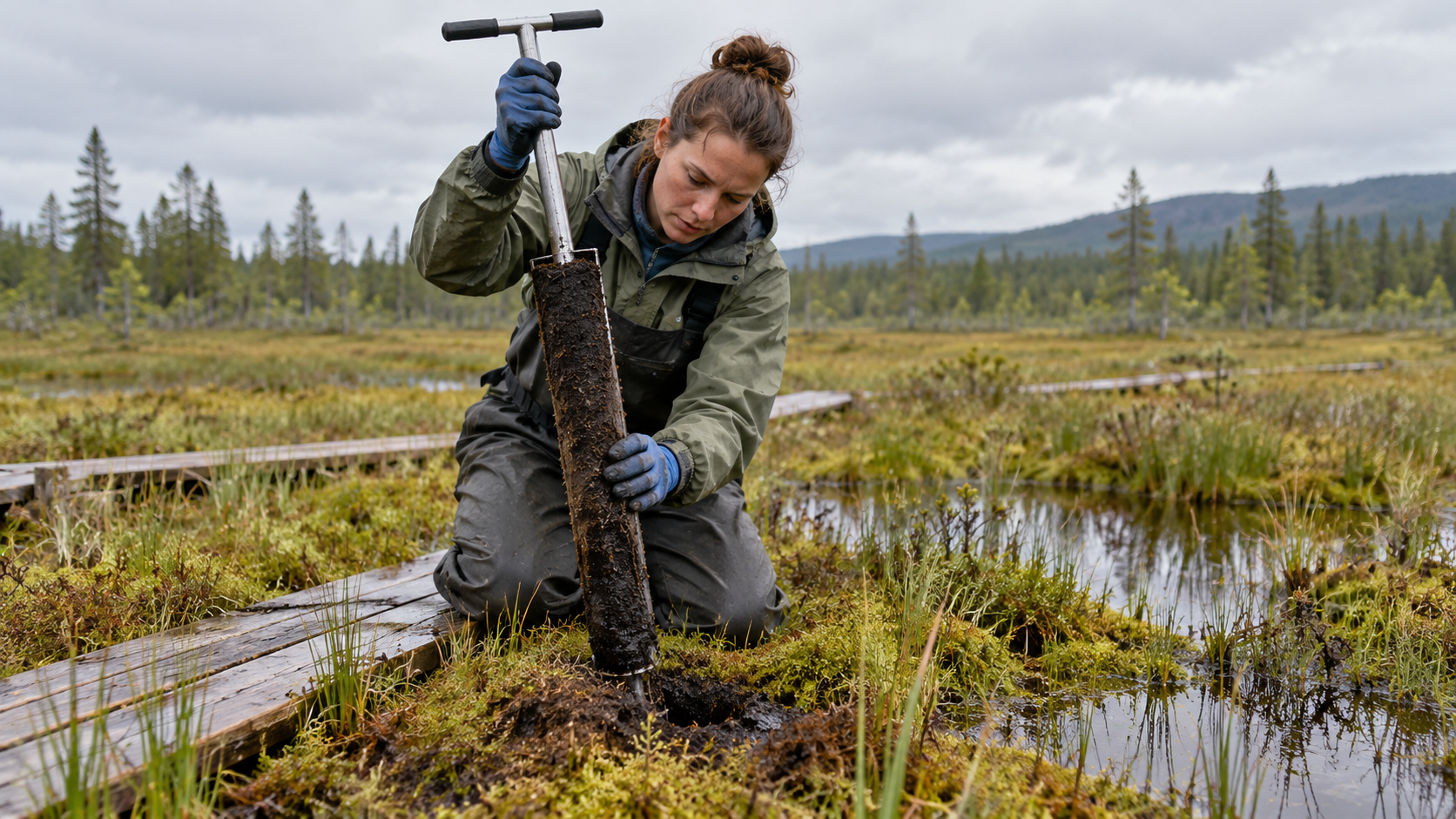
Scientists measure gas exchange with chambers and towers, map water and vegetation, date peat layers, and analyze cores. Long-term records are essential because a wetland may emit one greenhouse gas while continuing to store a much larger carbon stock. Researchers combine field instruments, remote sensing, samples, and models because no single view captures every stage.
Drainage exposes peat to oxygen, accelerating decomposition and increasing fire risk; extraction and land conversion can also remove stored material. Rewetting can reduce some losses, but recovery is gradual and methane responses vary by site. The explanation is strongest when those independent lines of evidence agree within measured uncertainty.
Plants capture atmospheric carbon through photosynthesis.
Waterlogging limits oxygen and slows microbial decomposition.
Partly decayed material accumulates as peat.
Burial preserves carbon in growing soil layers.
Methane and carbon-dioxide fluxes continue despite long-term storage.
Drainage and fire can rapidly mobilize stored carbon.
Explore more "Explainers"
Discover additional explainers across politics, science, business, technology, and other fields. Each explainer breaks down a complex idea into clear, everyday language—helping you better understand how major concepts, systems, and debates shape the world around us.