

Big Bend Border Work Can Resume After Supreme Court Ruling
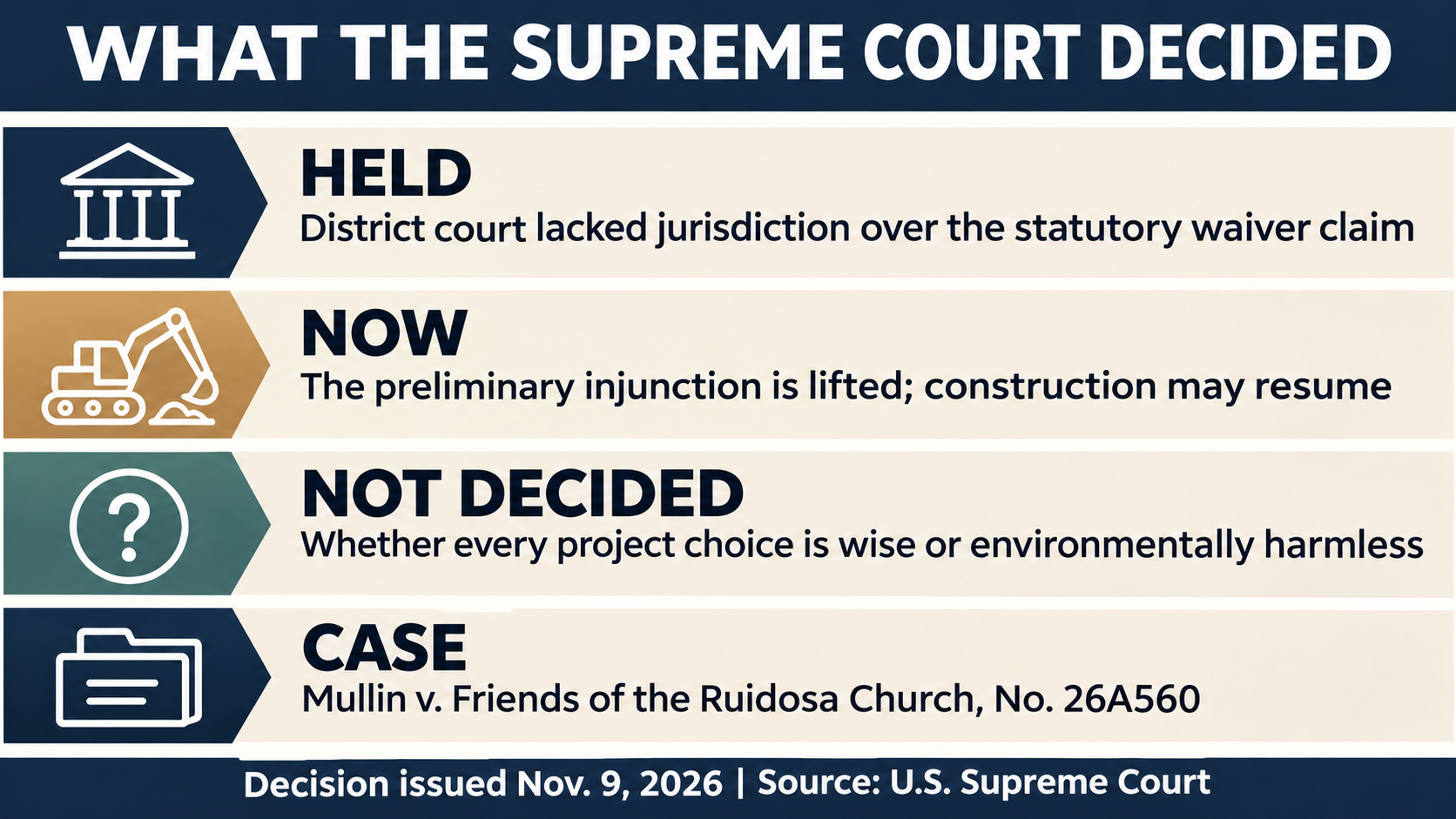
The Supreme Court on Nov. 9 cleared the way for the Trump administration to resume border-barrier construction in the Big Bend region of West Texas, removing a federal injunction that had stopped ground-disturbing work across the sector. The Court’s unsigned decision in Mullin v. Friends of the Ruidosa Church turned on jurisdiction: the justices said the district court could not hear a statutory challenge to the homeland security secretary’s decision to waive legal requirements for the project. The ruling permits construction to move forward, but it does not decide whether the project is environmentally sound, cost-effective or the best security strategy for the region.
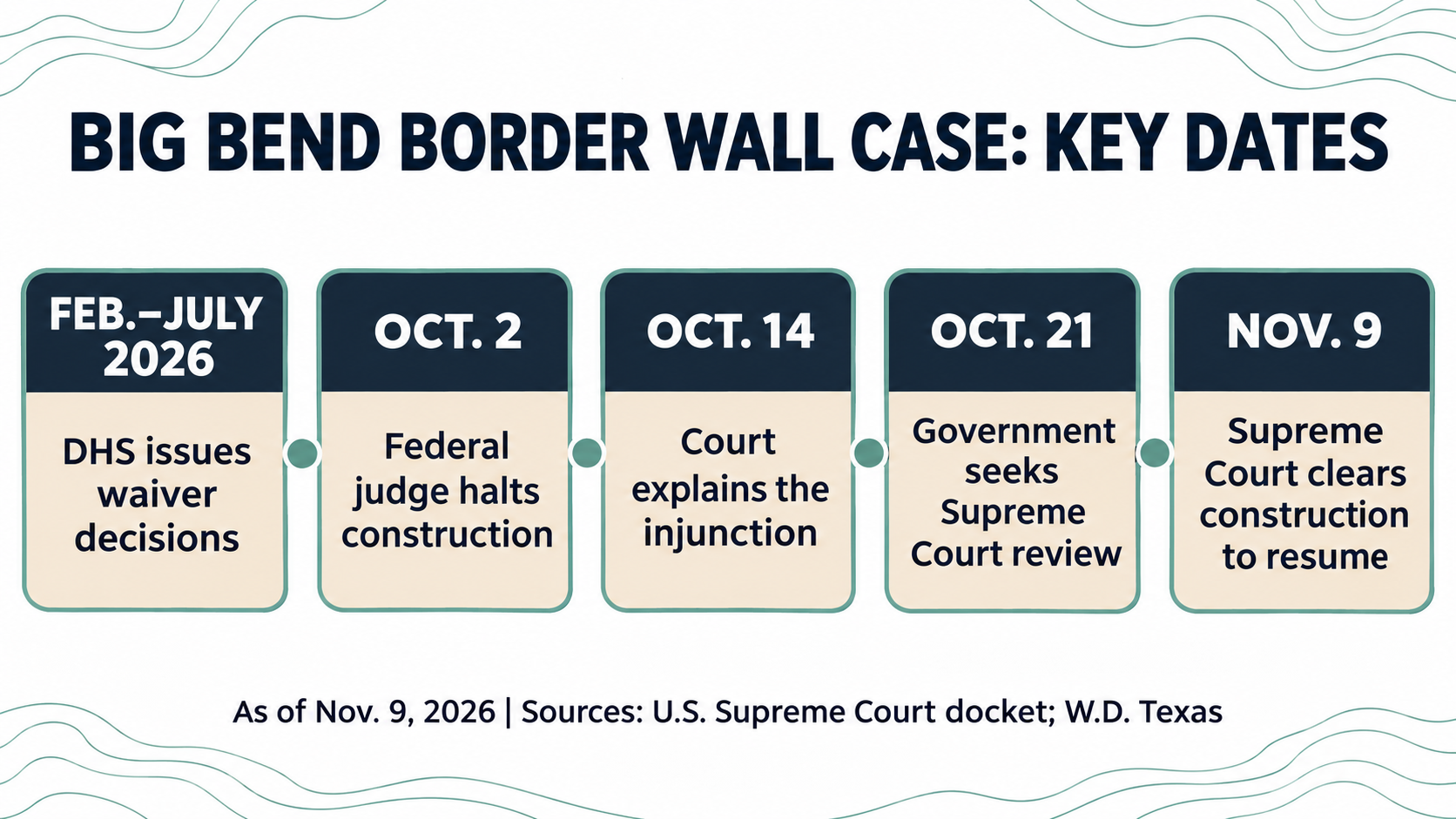
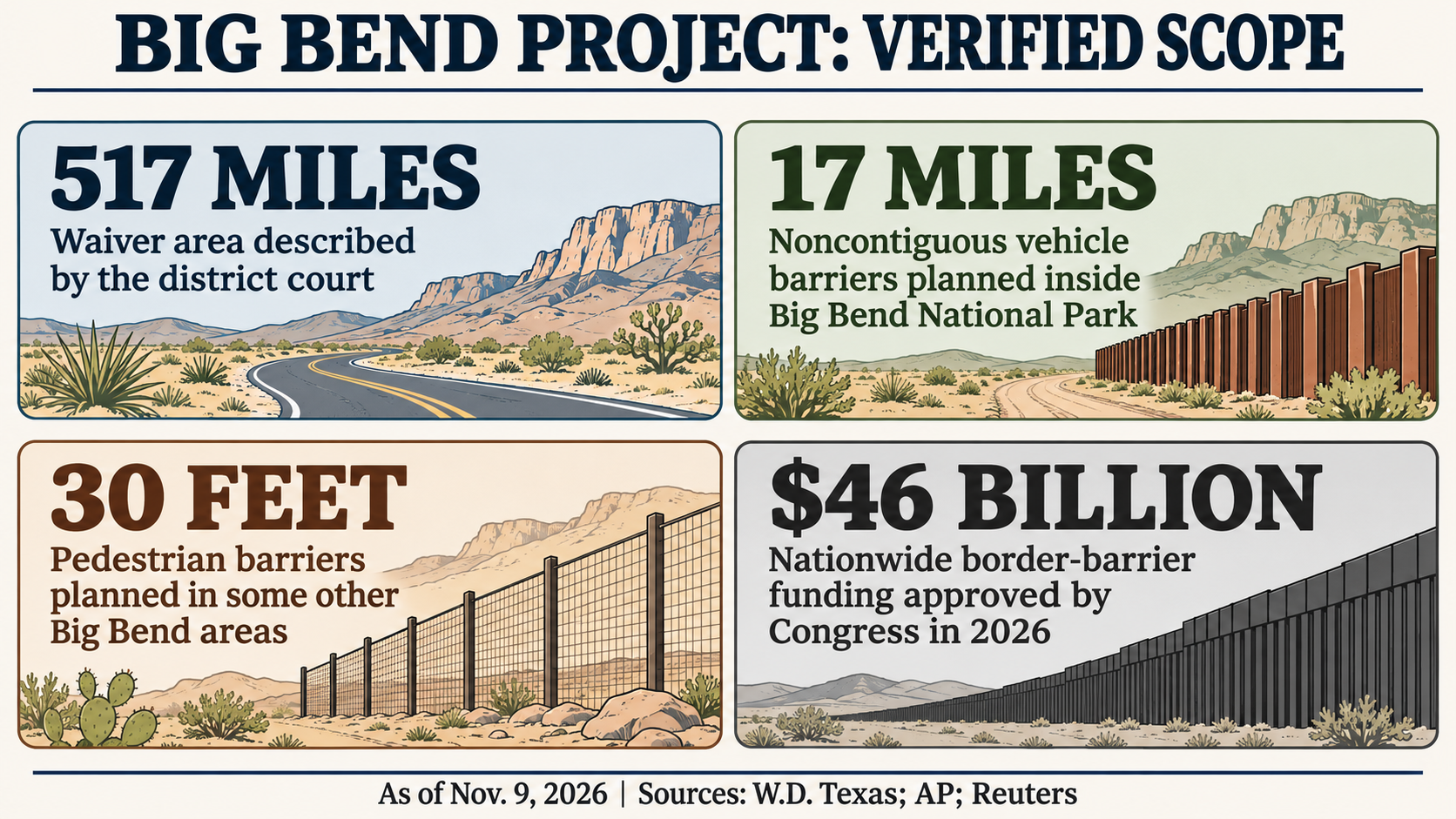
The dispute concerns a set of Department of Homeland Security waiver decisions issued between February and July 2026. The secretary relied on Section 102 of the Illegal Immigration Reform and Immigrant Responsibility Act, as expanded by the REAL ID Act, to set aside laws that otherwise would apply to border-barrier construction. The Western District of Texas described the affected Big Bend waiver area as a 517-mile stretch covering national and state parkland, other public land and private property in six counties. Many of the displaced requirements concern environmental review, historic preservation, public lands and related permitting.
What the Supreme Court actually held
The Court’s central conclusion was narrow but consequential. Federal law generally strips lower courts of jurisdiction over claims arising from the homeland security secretary’s border-barrier waiver decisions, while preserving review of constitutional claims. The challengers argued that the secretary exceeded the authority Congress granted and invoked the major-questions doctrine, a principle courts use when an agency claims unusually broad power over an issue of major economic or political significance. The Supreme Court said using that doctrine did not transform the challengers’ statutory claim into a constitutional claim. Because the claim remained statutory, the district court lacked jurisdiction to adjudicate it.
That conclusion displaced the Oct. 2 preliminary injunction and the district court’s Oct. 14 memorandum explaining it. District Judge Kathleen Cardone had found that the plaintiffs were likely to succeed on their argument that DHS exceeded the scope of its waiver authority, and she prohibited border-barrier construction or ground-disturbing activity in the Big Bend Sector unless the government complied with the otherwise applicable laws. The Supreme Court did not weigh the district judge’s factual findings about local conditions against the administration’s evidence. It instead concluded that the lower court was not authorized to decide the statutory theory on which the injunction rested.
The decision was issued per curiam, meaning no individual justice was listed as the author. Justice Ketanji Brown Jackson was the only justice to publicly note a dissent, according to contemporaneous reporting. The practical effect is immediate: the injunction no longer blocks the federal government from resuming the covered work. The Court’s ruling does not itself order contractors to begin on a particular date, identify which segment must be built first or resolve every other lawsuit involving Big Bend land, religious interests, property access or park administration.
The project and the place
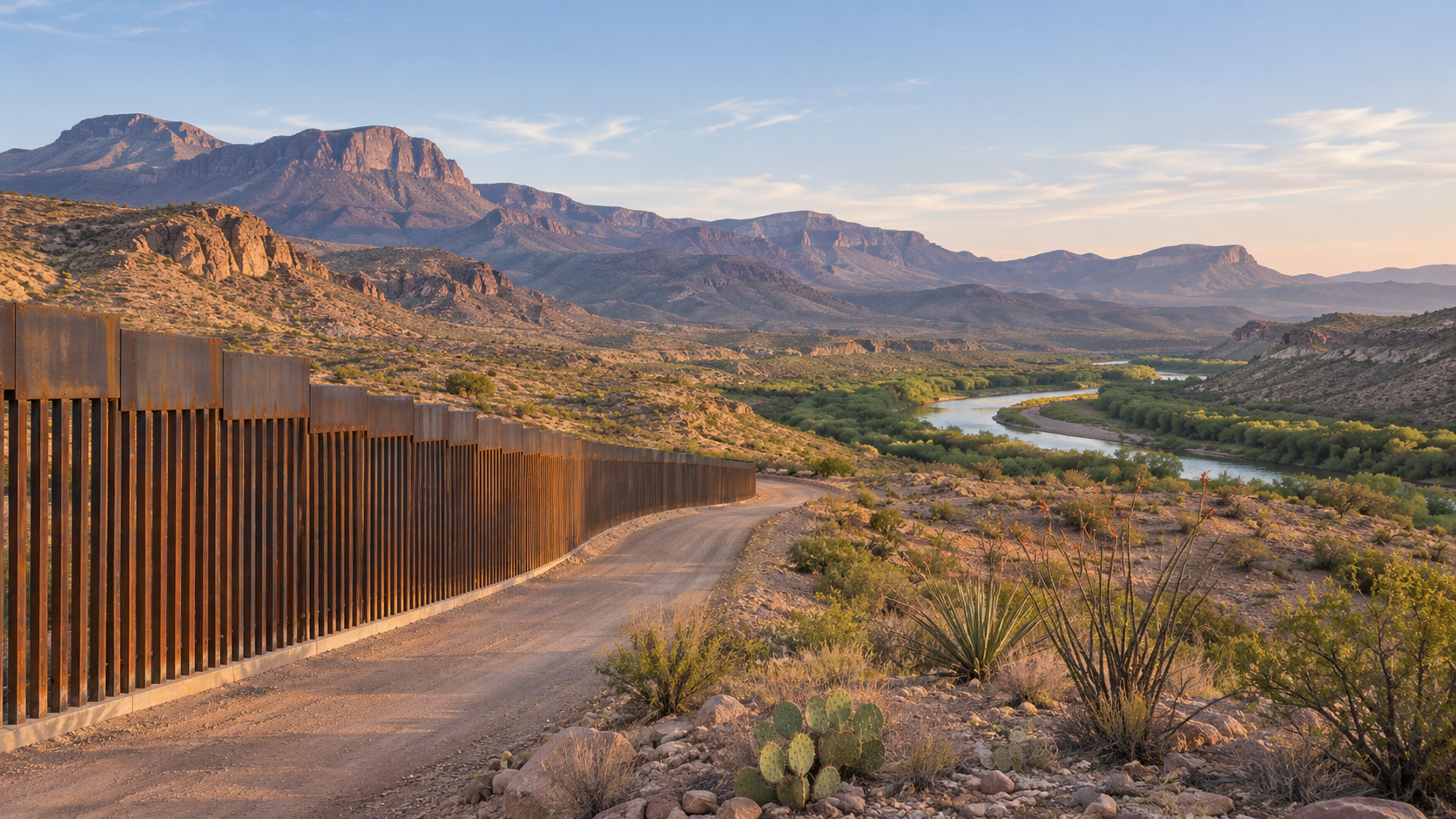
Big Bend is not a single parcel. The Border Patrol sector spans a remote part of the Rio Grande and includes Big Bend National Park, Big Bend Ranch State Park, ranches, communities and privately owned land. Reuters reported that the administration expects most construction in the sector to occur on private property. Inside the national park, the government described a plan for roughly 17 miles of noncontiguous vehicle barriers rather than the 30-foot pedestrian barriers planned for some other portions of the region. Related work can include roads, drainage, erosion control, cameras, lighting and other security infrastructure.
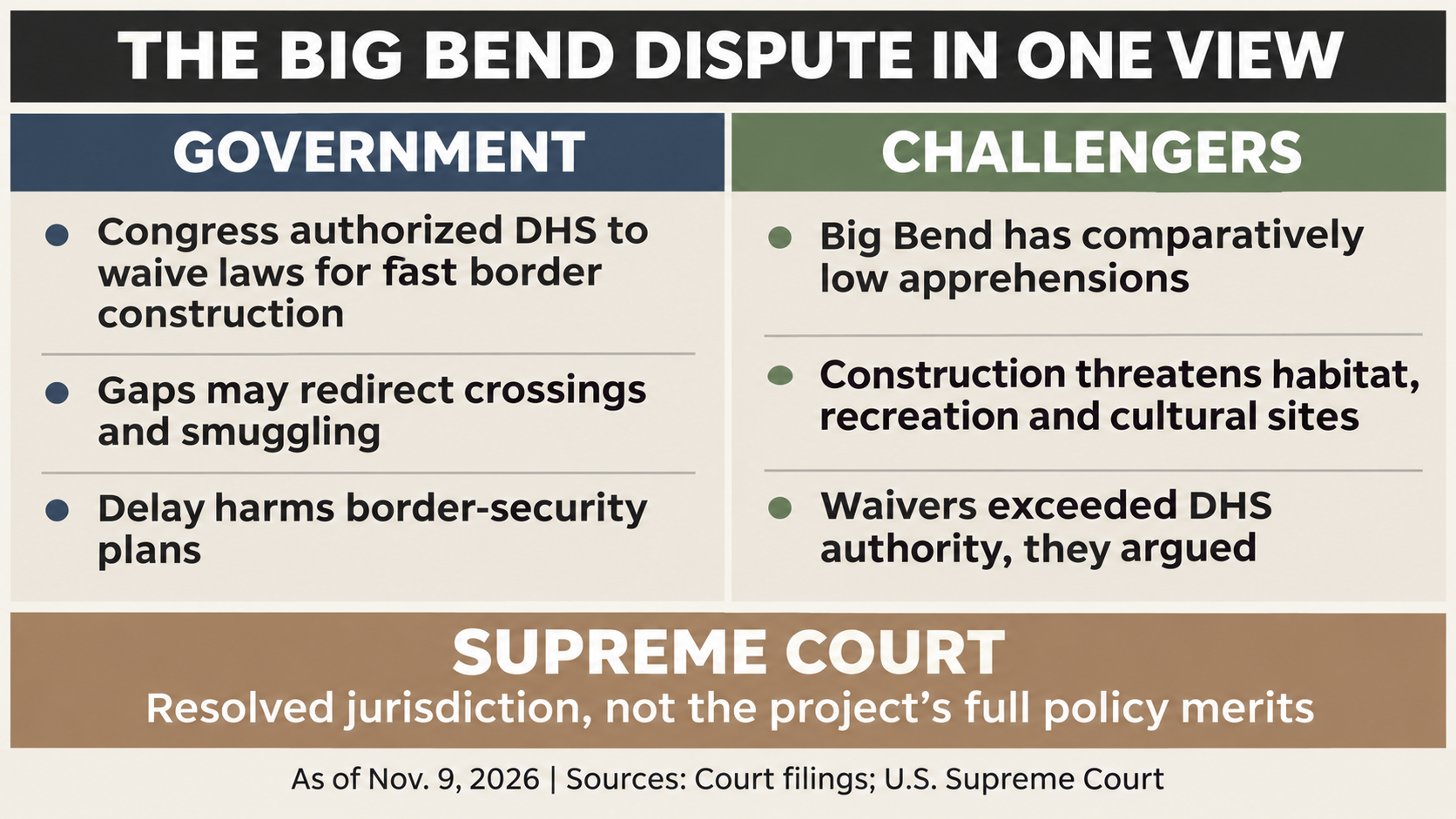
The geography is central to the disagreement. Local officials, conservationists, landowners and residents from both parties have argued that the area’s mountains, canyons and river corridor already shape movement, and that extensive physical barriers could damage habitat, tourism, ranching, archaeological resources and the visual character on which the regional economy depends. The plaintiffs in this case include the Center for Biological Diversity, Friends of the Ruidosa Church and river guide and landowner Danny William Miller Jr. Their filings described potential injuries to wildlife, recreation, private land and a historic adobe church near the Rio Grande.
The administration answers that Big Bend still experiences unlawful crossings and drug trafficking, even if apprehensions there are lower than in busier border sectors. In its Supreme Court application, the government cited more than 89,000 apprehensions in the sector from 2021 through 2025 and argued that leaving a long gap could redirect crossings and smuggling toward less-fortified terrain. Federal lawyers also emphasized that Congress expressly gave the secretary authority to waive legal requirements when necessary to build border infrastructure quickly. Their position is that delays frustrate a national security program funded and authorized by Congress.
What the numbers do—and do not—show
Several figures describe different things and should not be merged. The district court’s 517-mile figure concerns the geographic reach of waiver decisions, not a promise to construct one continuous 517-mile wall. The 17-mile figure concerns noncontiguous vehicle barriers inside Big Bend National Park. The 30-foot figure describes pedestrian barriers planned in some other areas, not throughout the park. Congress’s $46 billion appropriation supports border-barrier work nationally, not a $46 billion Big Bend-only project. Customs and Border Protection’s reported pace of about 12 miles of barrier per week also describes work across the border rather than the speed of this specific project.
Crossing statistics require similar care. A count of apprehensions measures encounters recorded by the government, not every attempted crossing, and it can reflect enforcement resources as well as migration patterns. The administration argues that historical traffic does not capture the future risk that people or smugglers will move toward an unfortified gap. Opponents respond that comparatively low activity is a reason to rely more heavily on personnel and surveillance rather than building extensive physical barriers through sensitive terrain. The Supreme Court did not choose between those operational judgments in the Nov. 9 decision.
Why the jurisdiction issue matters beyond Big Bend
The ruling reinforces a procedural limit Congress placed on challenges to border-wall waivers. A party cannot obtain lower-court review merely by pairing a dispute over the meaning of a statute with a doctrine that has constitutional roots. That distinction may make it harder to stop projects through claims that the secretary misunderstood the reach of the delegated waiver power. Constitutional claims remain textually preserved by the statute, but litigants must plead and support an actual constitutional violation rather than relabeling a disagreement about statutory authority.
For the executive branch, the decision preserves speed and central control over a large construction program. For challengers, it narrows the route to preconstruction review at the point when environmental or cultural damage may still be preventable. The tension is built into the law: Congress chose to reduce litigation delays for border infrastructure, while ordinary environmental and historic-preservation laws are designed to require analysis and public process before irreversible work occurs. The Court’s ruling applies the jurisdictional choice Congress made without resolving whether Congress should revise that choice.
What happens next
DHS and Customs and Border Protection can now resume work that was blocked by the preliminary injunction, subject to contracting schedules, land access, engineering decisions and any constraints arising from other valid court orders. The government has not established in the available record exactly when each Big Bend segment will restart. Readers should distinguish the legal ability to proceed from completed construction. A lifted injunction removes one barrier; it does not mean every planned mile has been built or that every dispute has ended.
The plaintiffs and other Big Bend challengers can continue evaluating constitutional, property-specific or other claims that fall outside the Supreme Court’s jurisdictional holding, though each theory will face its own threshold and merits questions. Separate litigation involving tribal, religious, archaeological and landowner interests has developed around related work. The Nov. 9 decision does not automatically resolve those cases. It does, however, signal that a broad statutory challenge to the secretary’s waiver authority cannot be used in a lower court to recreate the injunction the Supreme Court removed.
The clearest near-term indicators will be agency construction notices, contractor activity, land-access steps and new court filings. Policymakers may also revisit whether the existing waiver statute draws the right balance between rapid border construction and advance review. For now, the verified result is narrower than the larger political argument: the Supreme Court held that the district court lacked jurisdiction over this statutory waiver claim, and Big Bend border work may resume while the consequences of that ruling unfold on the ground.
Left View: Big Bend Ruling Puts Oversight Behind Construction Speed
The Supreme Court’s Nov. 9 decision allowing border construction to resume in Texas’s Big Bend region gives the Trump administration a major operational victory, but it also exposes a difficult accountability problem. The Court held that a federal district judge lacked jurisdiction to hear the challengers’ statutory claim against the homeland security secretary’s waiver decisions. That ruling removes an injunction that had paused ground-disturbing work across a 517-mile waiver area. For progressives and many local opponents, the immediate concern is not simply that a barrier will be built. It is that environmental, cultural and community protections may be displaced before a court can examine whether the executive branch used Congress’s delegation within lawful bounds.
The Court did not find that the project is harmless, economical or necessary in every location. It did not reject the district court’s evidence about comparatively low migrant activity, sensitive habitat, recreation or local reliance on the landscape. Instead, the unsigned opinion said the lower court was not permitted to decide the statutory theory supporting the injunction. The challengers’ use of the major-questions doctrine did not convert a dispute over DHS’s legal authority into the kind of constitutional claim that federal law allows a district court to hear. Justice Ketanji Brown Jackson was the only justice to publicly note a dissent, according to contemporaneous reporting.
Review comes after the bulldozers
The practical sequence matters. Environmental and historic-preservation laws generally require agencies to study effects, consult affected communities and consider alternatives before construction. DHS’s waiver authority can set those requirements aside to accelerate border infrastructure. When lower courts are also denied jurisdiction over statutory challenges, people who claim irreversible harm may have fewer opportunities to obtain review before roads are graded, vegetation is cleared or cultural sites are disturbed. The Supreme Court’s jurisdictional reasoning can be legally faithful to the statute and still leave a serious public-policy question: whether the statute places too much weight on speed and too little on preventable harm.
Big Bend makes that concern concrete. The region includes national and state parkland, ranches, small communities and private property along one of the most distinctive desert river corridors in the country. The plaintiffs include a conservation organization, a group working to preserve the historic Ruidosa church and a river guide and landowner. Related litigation has raised concerns from people associated with Indigenous cultural sites, religious observance, archaeological resources and recreation. Those interests are not abstract obstacles to a federal program. They are the ways residents use, remember and depend on the land.
The administration’s plan is not a single uniform wall. Reuters reported that the national park is slated for about 17 miles of noncontiguous vehicle barriers rather than the 30-foot pedestrian barriers planned elsewhere in the region. Related infrastructure can include roads, drainage, cameras, lights and erosion controls. That distinction matters, but it does not eliminate the effects of construction. A vehicle barrier and patrol road can fragment habitat, alter drainage, change views and bring heavy equipment near fragile resources even when a towering pedestrian barrier is not installed.
Local opposition does not fit a simple partisan script
Big Bend resistance has been bipartisan. Conservation groups and civil-rights advocates have opposed the waivers, but local officials, landowners and Texas Republicans have also questioned whether large physical barriers fit a remote area with relatively low apprehensions. That coalition complicates the national argument that opposition is merely a refusal to support border security. Many critics accept the need for enforcement while favoring personnel, mobile surveillance, sensors and targeted infrastructure over a standardized construction program across ecologically and economically sensitive terrain.
The local economy gives that argument additional weight. Tourism, river recreation, ranching and the region’s scenic identity are not incidental benefits. They support jobs and property values in communities far from major urban centers. Construction choices that degrade a landscape can redistribute costs toward residents who receive little control over federal procurement and scheduling. A progressive account should therefore treat the dispute as both environmental and distributional: the federal government obtains speed, contractors obtain work and national politicians obtain a visible symbol, while local communities bear much of the physical risk.
None of that proves the administration’s security concerns are fictional. The government cited more than 89,000 apprehensions in the Big Bend Sector between 2021 and 2025, drug seizures and the possibility that people or smugglers will shift toward gaps as other sectors become more fortified. Border policy must consider future displacement, not only yesterday’s traffic. The strongest counterargument is that Congress deliberately gave DHS broad waiver power because prolonged permitting and litigation can prevent the government from responding to changing routes. A serious critique must answer that operational concern rather than treating every physical barrier as inherently illegitimate.
Congress created the accountability gap
The Court’s decision also redirects responsibility toward Congress. Section 102 of the Illegal Immigration Reform and Immigrant Responsibility Act, expanded by the REAL ID Act, gives the homeland security secretary unusually broad power to waive legal requirements for border construction and sharply limits lower-court review. The justices did not invent that structure on Nov. 9. Lawmakers built it. If Congress believes that modern projects require more environmental consultation, stronger protection for cultural sites or a clearer showing that an area needs physical barriers, it can amend the statute.
That possibility will become more important when a Democratic-controlled Congress takes office in January. Oversight committees can seek project plans, contracts, cost estimates, ecological assessments and communications with local governments even when courts cannot hear the same statutory theory. Appropriators can condition future funding, demand geographic reporting or direct agencies to compare physical barriers with technology and personnel. Legislation could preserve emergency authority while restoring targeted review for national parks, historic properties or private land. Those steps would not erase the president’s responsibility to secure the border; they would make the tradeoffs more visible and accountable.
The $46 billion Congress approved for nationwide border-barrier work should receive particular scrutiny. That figure is not the price of the Big Bend project alone, and the district court’s 517-mile waiver area is not the same as 517 miles of continuous construction. Clear reporting must keep those categories separate. It should also ask what agencies measure: miles completed, crossings deterred, apprehensions displaced, maintenance obligations, environmental mitigation and local economic effects. Without comparable outcomes, a large appropriation can become a measure of activity rather than effectiveness.
A narrow holding with broad consequences
The majority’s jurisdictional line may appear technical, but it determines when people can ask a judge to stop potentially irreversible work. The major-questions doctrine has often been used to limit agency power when Congress has not spoken clearly. Here, the Court said invoking that doctrine did not create a constitutional claim and therefore could not open the courthouse door that Congress closed. Critics will see an asymmetry: the doctrine can restrain regulatory programs in some settings, yet it cannot be used in a lower court to test an expansive waiver of environmental laws here.
Supporters of the decision respond that jurisdiction is not optional. Courts cannot reach a desirable result by recasting a statutory dispute, and Congress expressly reserved only constitutional claims for lower-court review. That rule protects democratic choices too: elected lawmakers, not judges, defined the secretary’s power and the available route for challenging it. The answer to a harsh statute is legislation, they argue, not a jurisdictional workaround. That is a substantial counterpoint, especially because the Court’s ruling did not prevent every conceivable constitutional or property-based claim.
The immediate outcome remains clear. DHS can resume work that the injunction blocked, subject to contracts, engineering, land access and any separate valid court orders. The unresolved question is whether political oversight can move quickly enough to matter before construction changes the ground. For a left-leaning perspective, that is the central test of the ruling: not whether border enforcement should exist, but whether communities and public lands receive meaningful review before federal speed becomes irreversible fact.

Explore Related Streets
Discover interconnected perspectives across the Knowledge Streets —each Street brings its own lens to the political landscape.

Politics Street
Politics Street covers campaigns, elections, legislation, and the shifting dynamics shaping power in America and beyond.

Government Streets
Policy, budgets, agencies, and oversight across federal, state, and local government—plain-English explainers and timely analysis.

Defense Street
Daily defense posture, procurement, readiness, strategy, and technology—curated updates for leaders and curious citizens.

Left Streets
Progressive politics, policy ideas, movement priorities, and media framing—news and analysis from the left lane.

Right Streets
Conservative politics, policy priorities, movement debates, and media framing—news and analysis from the right lane.

Citizen Streets
How government affects everyday life—services, rights, civic tools, and practical guides to participate with confidence.
More in Politics
Explore our other Politics related sites:
Politics Street
Government Streets
Constitution Street
Defense Street
Left Streets
Right Streets
Citizen Streets
News Street Network

