WHO Models 1.6 Million Fewer Annual Deaths From Six Climate-Health Actions Ahead of COP31
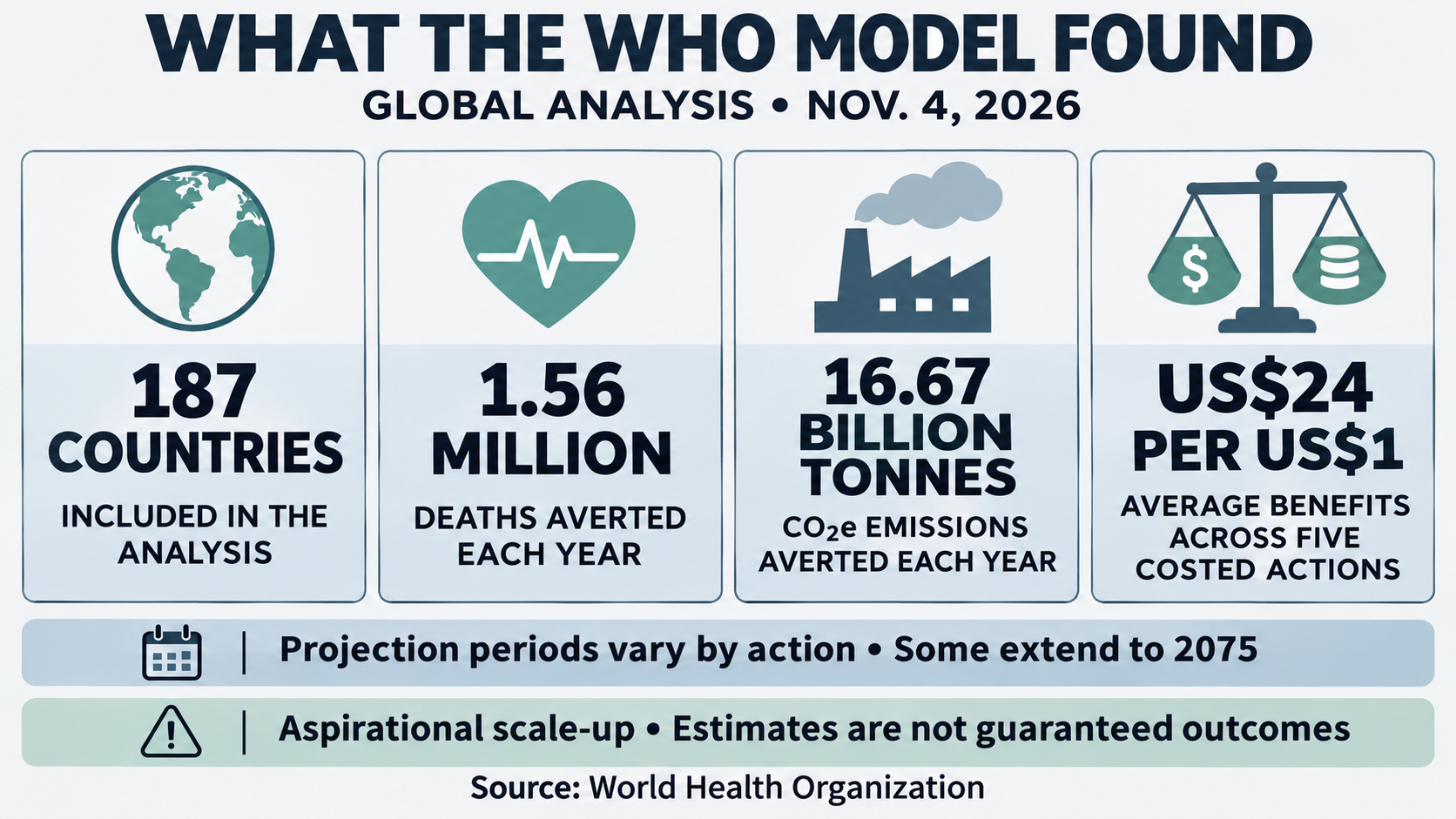
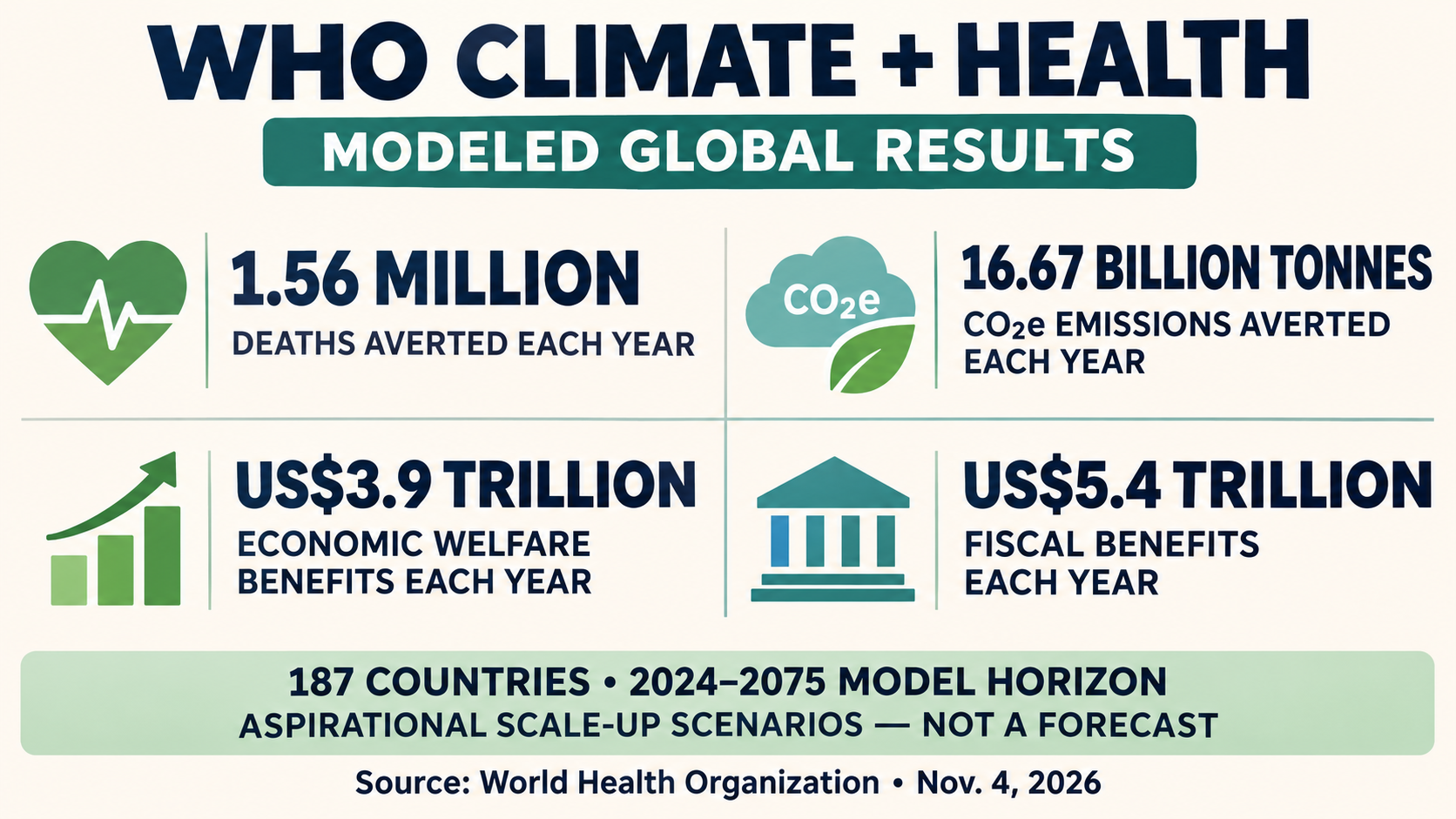
A World Health Organization technical analysis released Nov. 4 estimates that six climate-and-health actions, if scaled across 187 countries, could avert 1.56 million deaths and 16.67 billion tonnes of carbon-dioxide-equivalent emissions in a typical year. The model also assigns about US$3.92 trillion in annual economic-welfare benefits and US$5.44 trillion in fiscal benefits to the combined measures.
Those totals are modeled scenarios, not a forecast or a promise. The report assumes ambitious implementation, uses projection periods that vary by intervention and extends some calculations to 2075. Its practical value is less the precision of any single headline number than the comparison of prevention strategies that address heat, unsafe water, poor sanitation, household air pollution and fossil-fuel price distortions.
Six actions in the model
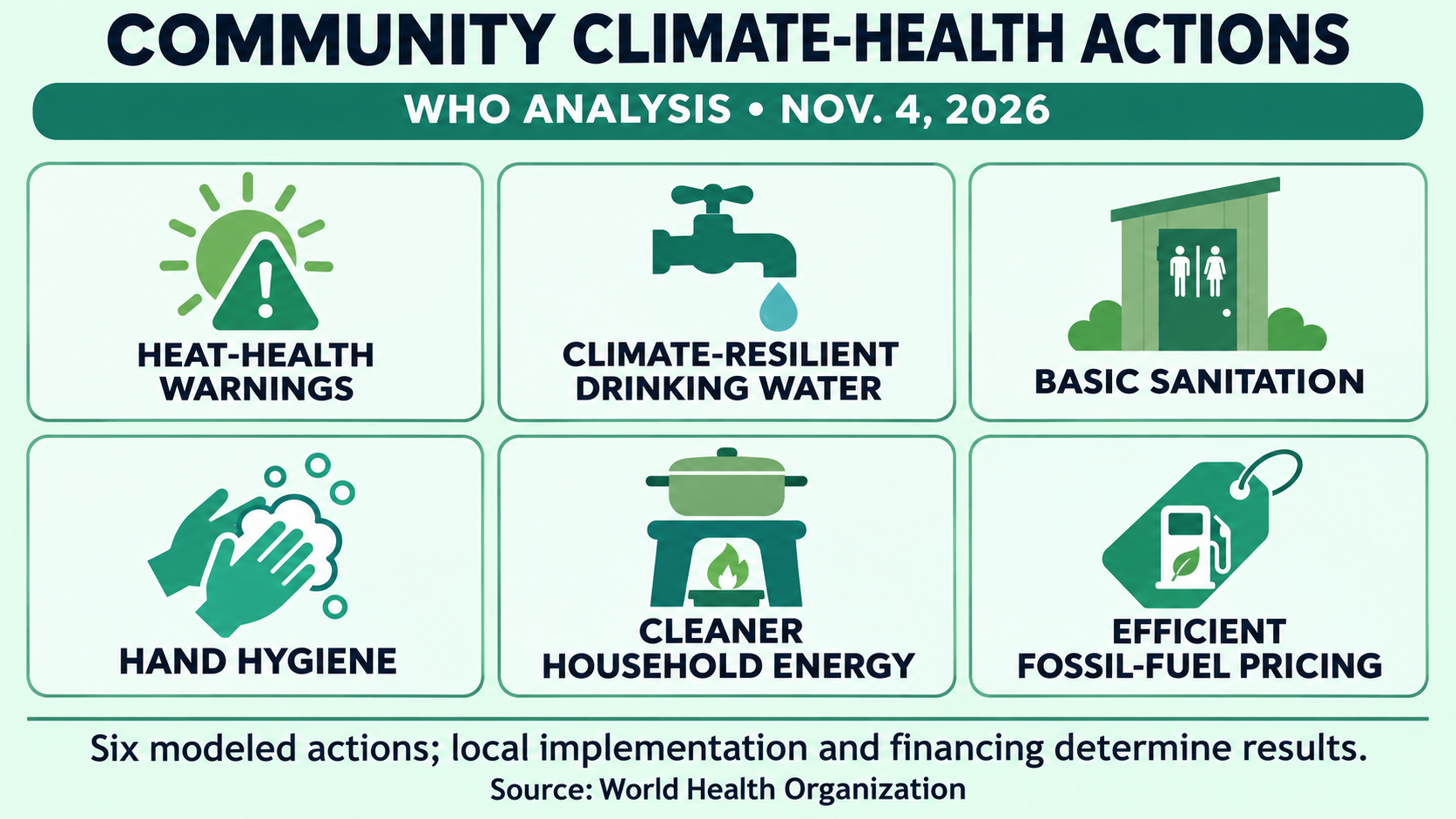
The analysis groups the policy package into six areas: heat-health warning systems; climate-resilient safely managed drinking water; climate-resilient basic sanitation; climate-resilient hand-hygiene services; cleaner household energy; and fiscal policies that more efficiently price fossil fuels.
Five of the actions were evaluated with both benefits and estimated costs. Across those five, WHO’s summary reports an average benefit of roughly US$24 for every US$1 invested. Heat-health warning systems produced the largest ratio, about US$835 in benefits per dollar in the central estimate, although sensitivity tests produced a wide range. The study treated fossil-fuel pricing differently: it estimated health, climate and fiscal benefits but did not assign a comparable implementation cost or benefit-cost ratio.
Where the largest modeled gains come from
Efficient fossil-fuel pricing accounts for most of the aggregate numbers: about 1.2 million avoided deaths, 16.35 billion tonnes of avoided emissions, US$3.04 trillion in welfare benefits and US$5.44 trillion in fiscal benefits each year. The five directly costed health measures together account for about 360,000 avoided deaths, 320 million tonnes of avoided emissions and US$879 billion in benefits against approximately US$35 billion in costs.
The fiscal estimate should not be read as a fund already available for health programs. It represents modeled public-finance effects associated with pricing reform. Likewise, the economic-welfare figure uses valuation methods, including the value of statistical life, to compare policy effects; it is not a cash payment.
Why the timing matters
The release comes days before COP31 opens in Antalya, Türkiye, where climate negotiations are scheduled for Nov. 9–20. WHO has designated the opening day as Health Day and is supporting the voluntary Antalya Initiative for Health Resilience. The organization says its health pavilion will host more than 60 events across the conference’s 12 thematic days.
The report gives negotiators a quantified case for connecting emissions policy with public-health spending. It also arrives as governments face a persistent implementation gap: global temperatures are near 1.4 degrees Celsius above the preindustrial baseline, while current policies still point toward substantially higher warming.
Important limitations
WHO describes the scenarios as aspirational scale-up pathways. Some interventions were modeled separately rather than as an integrated package, so overlaps or synergies may not be fully captured. Evidence is stronger for some measures than for others, and long-range estimates are sensitive to discount rates, baseline assumptions, coverage targets and local capacity.
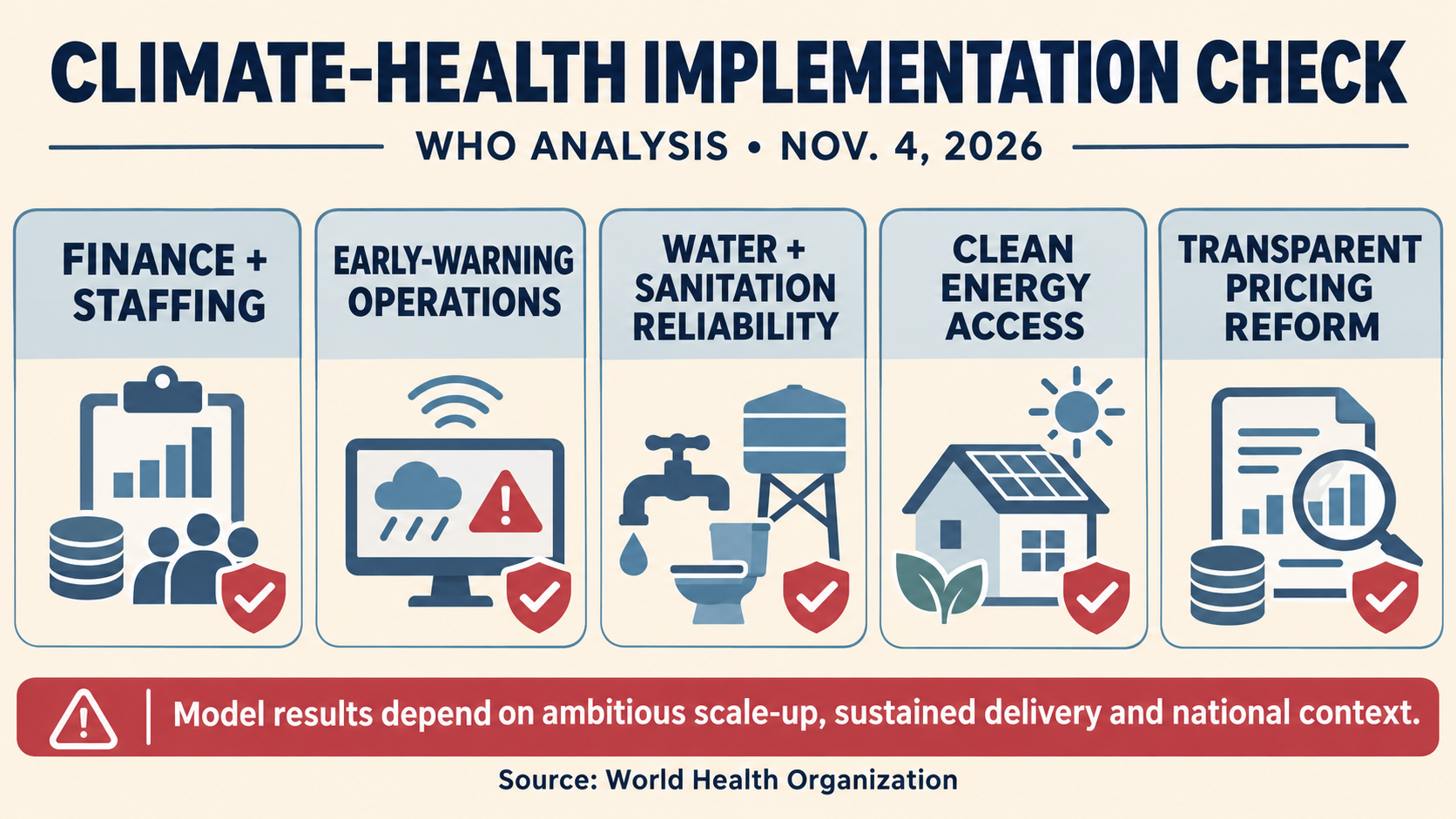
Results also depend on execution. A warning system only works when forecasts reach residents and health services can respond. Water and sanitation investments require maintenance, monitoring and reliable power. Cleaner household energy requires affordable equipment and fuel. Pricing reforms require transparent design and protections for households facing higher near-term costs.
What happens next
COP31 will test whether countries turn the health argument into finance, national plans and measurable programs. Useful follow-up indicators include population coverage of heat alerts, access to safely managed water and sanitation, household reliance on polluting fuels, air-quality trends, and whether revenue or savings from pricing reforms are tracked publicly.
The study’s central message is directional rather than predictive: many climate policies can produce immediate health gains while reducing emissions. The size of those gains will depend on how quickly governments fund, operate and independently evaluate the six actions.
What Six Climate-Health Actions Could Mean for Communities
The World Health Organization’s new global analysis puts unusually large numbers behind a familiar local reality: climate policy reaches people through clinics, water systems, household energy and emergency communications. Under ambitious scale-up scenarios, WHO estimates six actions could avert 1.56 million deaths worldwide each year.
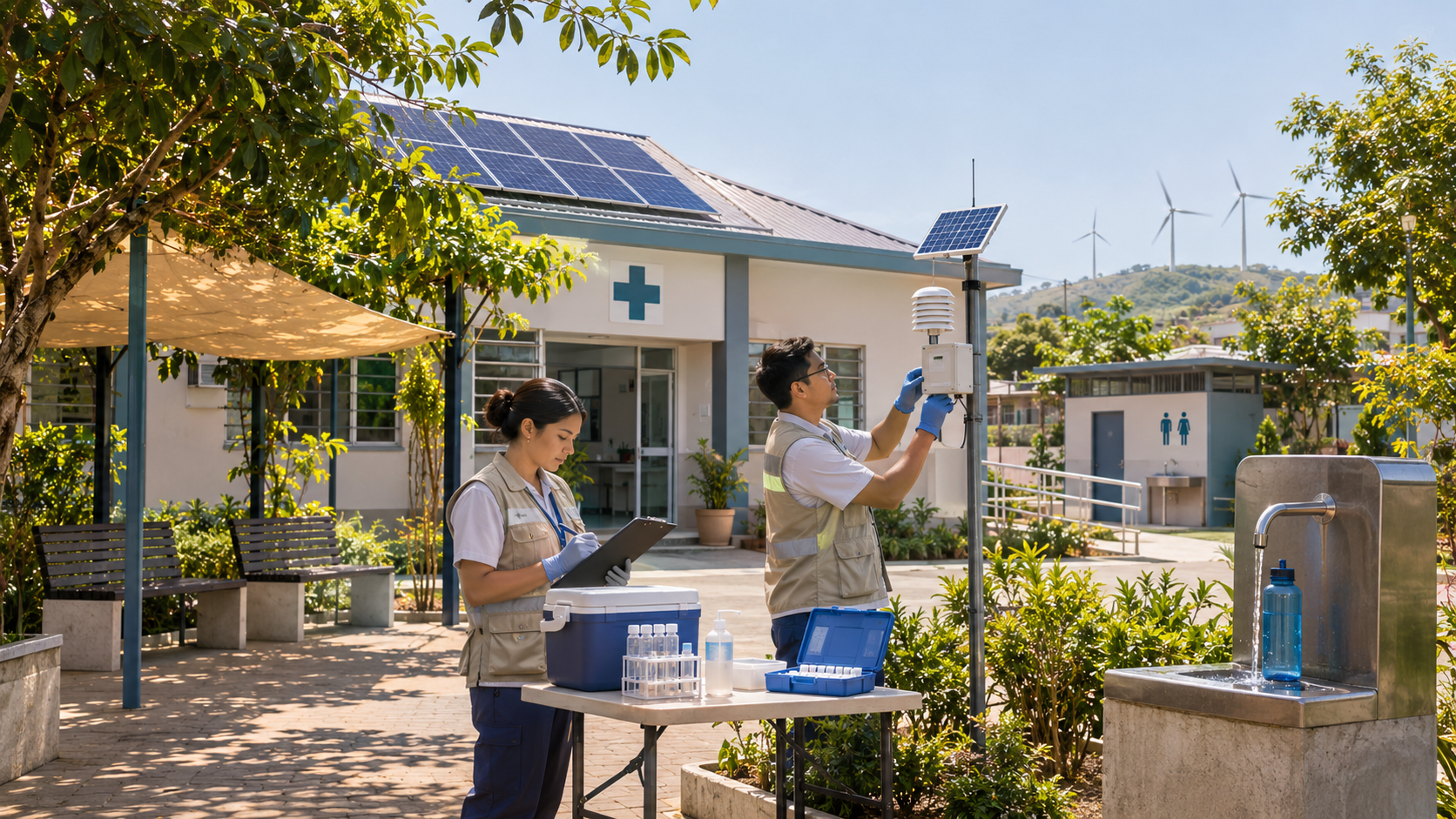
For residents, the most meaningful question is not whether a global model produces one exact total. It is whether a heat alert arrives before dangerous temperatures, whether a water system keeps working during a flood or drought, and whether families can cook and heat their homes without breathing harmful smoke.
Heat warnings that lead to action
Heat-health warning systems are among the least expensive measures in the analysis and have the highest modeled benefit-cost ratio. But an alert alone is not protection. Communities need cooling locations, transportation, outreach to older adults and outdoor workers, language-accessible messages, power continuity and clear thresholds for schools, employers and health agencies.
Local leaders can make the system visible by publishing response plans before heat season and reporting afterward on alert coverage, emergency visits and outages. Trusted messengers — community health workers, neighborhood groups, faith organizations and employers — often determine whether guidance reaches people at greatest risk.
Water, sanitation and hygiene as climate infrastructure
WHO evaluates climate-resilient drinking water, basic sanitation and hand-hygiene services as separate actions because each prevents a different chain of illness. Floods can contaminate wells and treatment plants; drought can reduce supply and concentrate pollutants; storm damage can interrupt pumping and sewage treatment.
For households, resilience means more than building new equipment. It includes routine testing, backup power, repair crews, spare parts, transparent boil-water notices and affordable service. Investments that ignore long-term maintenance can produce impressive construction totals without dependable protection.
Cleaner household energy
Replacing smoky stoves and polluting fuels can reduce indoor air pollution while cutting climate-warming emissions. The health benefits can be especially important for women, children and others who spend more time near cooking areas. Affordability is crucial: a cleaner appliance does not help if fuel or electricity costs force a household back to a dirtier option.
Who may benefit most
The WHO analysis indicates that low- and middle-income countries may receive proportionally larger gains because many communities face greater exposure and have wider gaps in water, sanitation, energy and health protection. That potential does not erase financing constraints. It strengthens the case for grants, concessional finance, debt-sensitive planning and local participation in project design.
Equity should be measured within countries as well. National averages can hide rural communities without reliable water, informal settlements with extreme heat exposure, or people with disabilities who cannot use standard emergency routes and messages.
Pricing reform and household safeguards
Fossil-fuel pricing produces most of the report’s modeled emissions, health and fiscal gains. It can also raise near-term costs for transportation, electricity or cooking if poorly designed. A community-centered policy would explain the change, disclose where revenue goes and pair reforms with targeted rebates, public transit, efficiency upgrades or clean-energy access.
The fiscal benefit in the study is a modeled result, not money that has already been collected. Residents should expect governments to publish distributional analyses and audited revenue reports rather than relying on a global estimate.
A practical local checklist
Communities can ask five questions: Who receives heat alerts and who is missed? Which water and sanitation facilities have backup plans? Can households afford cleaner energy after subsidies end? How are frontline workers trained and protected? And where can the public see budgets, performance data and independent evaluations?
The global totals are attention-getting, but the human outcome is local. Success will be visible in fewer heat emergencies, safer water after extreme weather, cleaner air inside homes and public systems that residents trust before a crisis begins.
Climate Resilience Depends on Systems Countries Can Finance and Operate
The WHO’s Nov. 4 analysis frames six climate-health actions as a large global opportunity: 1.56 million deaths and 16.67 billion tonnes of carbon-dioxide-equivalent emissions potentially avoided each year under ambitious scale-up. From a security perspective, the report is also a test of state capacity. Warning networks, water utilities, sanitation systems, household-energy transitions and fiscal reforms must continue working during shocks.
Headline benefit figures can support investment decisions, but they do not remove operational risk. Long projection periods, uneven evidence and different modeling methods mean governments should treat the estimates as decision support and validate programs with current national data.
Early warning is an end-to-end capability
A heat warning system depends on forecasting, communications, health surveillance, emergency staffing and public response. Failure at any link can turn a technically accurate forecast into an ineffective intervention. Governments should test redundancy across power, telecommunications and data systems and should publish after-action findings following major heat events.
Metrics should include more than alerts issued. They should track delivery to high-risk populations, response times, hospital load, worker protections and the availability of cooling locations. Cross-border data sharing also matters where heat, smoke or power disruptions affect neighboring states.
Water and sanitation are continuity systems
Climate-resilient water, sanitation and hygiene services reduce disease risk, but they also support hospitals, schools, food supply chains and emergency shelters. Security planning should identify single points of failure such as exposed treatment plants, one-source electricity, fragile chemical supplies or understaffed laboratories.
Capital spending must be matched by operating budgets. Procurement transparency, maintenance schedules and independent water-quality monitoring reduce the risk that resilience funds produce assets that cannot be sustained.
Household energy and transition risk
Cleaner household energy can reduce illness and emissions while improving energy security. Rapid transitions can fail if equipment, fuel, grids or service technicians are unavailable. Planners should assess affordability, supply-chain concentration and backup options, especially for rural areas and communities facing frequent outages.
Fossil-fuel pricing requires governance
The WHO model attributes most of its aggregate benefit to efficiently pricing fossil fuels. Such reforms can improve fiscal balances and reduce pollution, but they are politically and economically sensitive. Abrupt price changes without household protections can weaken trust, intensify inflation pressure and trigger unrest.
Risk controls include staged implementation, targeted support, public revenue tracking, anti-corruption safeguards and periodic distributional reviews. The report’s US$5.44 trillion fiscal figure is a modeled global benefit, not guaranteed revenue for any particular government.
Use the model without overstating it
The study uses aspirational coverage assumptions and, for some actions, models interventions independently. Benefit estimates rely on baseline data, discounting and the monetary value assigned to avoided mortality. Some calculations extend decades into the future, increasing uncertainty.
Decision-makers should publish national assumptions, sensitivity ranges and conflicts of interest; compare projected results with observed outcomes; and adjust programs when benefits do not appear. Independent audit and open performance dashboards are essential when projects are financed through climate funds or development lending.
COP31’s implementation test
COP31 in Antalya is scheduled for Nov. 9–20, with health on the opening day and the voluntary Antalya Initiative for Health Resilience on the agenda. The security question is whether commitments produce durable institutions, not simply announcements.
Countries can reduce risk by linking climate plans to health budgets, workforce development, utility standards and emergency exercises. International finance should account for operating costs and debt capacity, not only construction. The strongest outcome would be a pipeline of programs with responsible agencies, milestones and transparent evaluation.
The report makes a compelling case that prevention can yield large co-benefits. Its numbers become credible public-security gains only when institutions can finance, deliver and verify the work over time.

Explore Related Streets
Discover interconnected perspectives across the Knowledge Streets —each Street brings its own lens to the news landscape.

Robot Streets
Robot Streets explores AI systems, humanoid machines, automation breakthroughs, and how robotics is reshaping work, industry, daily life, and the global economy.

AI Streets
AI Streets explores artificial intelligence breakthroughs, everyday tools, emerging risks, practical guides, and how AI reshapes business, creativity, work, and society.

AI Home Street
AI Home Street explores how smart tech transforms everyday living—security, cleaning, cooking, automation, voice assistants, and practical tools that make modern homes easier and more connected.

AIMakeMyDay
Your daily boost of AI-powered ideas—fun prompts, creative tools, and smart shortcuts designed to entertain, inspire, and make everyday life easier.

Nova Streets
Nova Streets explores everyday software from a user’s point of view—productivity tools, creative apps, business platforms, and more. We break things down with clear, hands-on insights, no jargon, and practical guidance that helps beginners and pros make smarter software choices..

AI Business Street
AI Business Street reports on automation, productivity tools, AI startups, enterprise adoption, market disruption, regulations, and how artificial intelligence is reshaping the global economy.
More in News





Explore our other News related sites:
AIMakeMyDay
AI Business Street
AI Education Street
AI Health Street
AI Home Street
AI Streets
Politics Street
Government Streets
Constitution Street
Defense Street
News Street Network