FULL STORY - THREE VIEWS
House Faces Impeachment Test as Hegseth Defends His Record
Defense Secretary Pete Hegseth publicly rejected a House impeachment effort on Nov. 10, one day after Republican Rep. Thomas Massie of Kentucky formally gave notice of a privileged resolution containing eight articles of impeachment. The measure accuses Hegseth of abusing his office in connection with military operations in Iran, Venezuela and Yemen, strikes on alleged drug-smuggling boats, the protection of civilians and action involving Sen. Mark Kelly’s speech. Those are allegations presented by Massie, not findings by the House or a court.
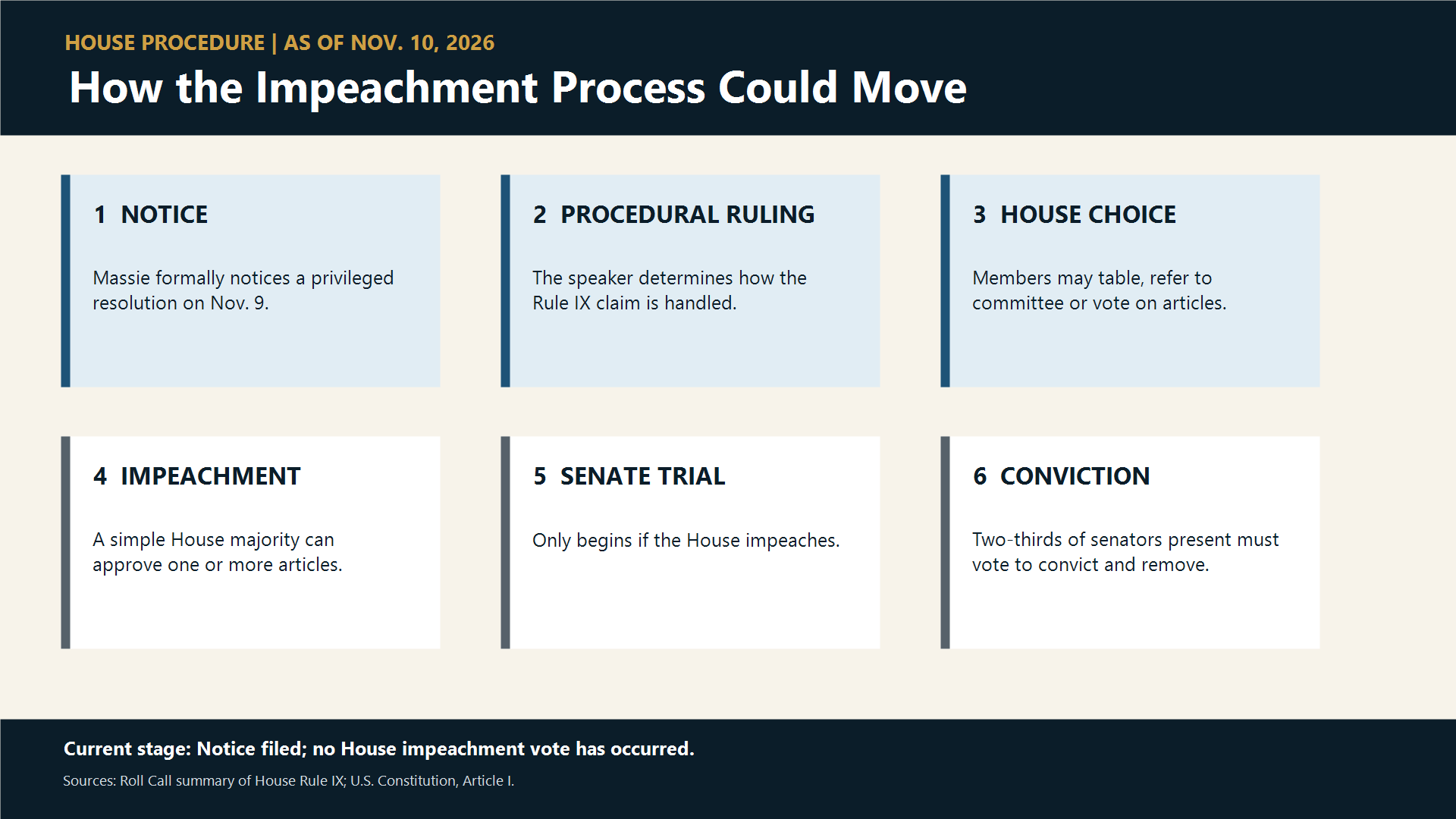
The immediate development is procedural. Massie read the 34-page resolution on the House floor on Nov. 9 under Rule IX, which covers questions of the privileges of the House. That move can force chamber action within two legislative days if the resolution is accepted as privileged. The House could vote on the articles themselves, table the resolution or refer it to a committee. No impeachment vote had occurred as of the morning of Nov. 10, and Hegseth remains in office.
At his first Pentagon news conference in six months, Hegseth described the effort as a political dispute over lawful military policy rather than conduct that meets the constitutional standard for impeachment. President Donald Trump has defended him and attacked Massie. House Democratic leader Hakeem Jeffries has said he supports the resolution, while Massie has said some Republicans may join it. The actual level of support will not be known until members vote.
What the eight articles allege
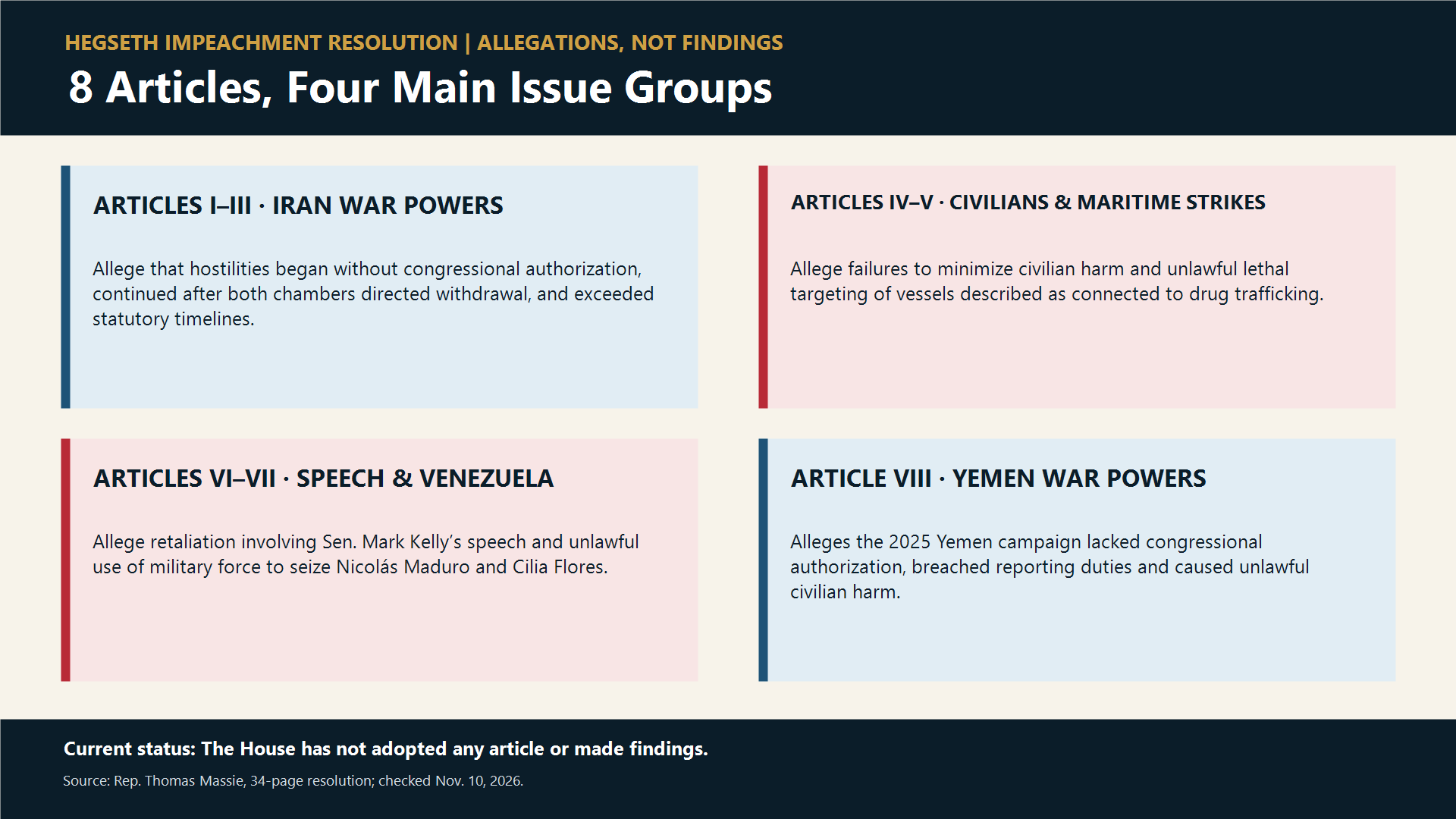
The first three articles focus on the Iran war and the War Powers Resolution of 1973. Article I argues that the administration began hostilities without a declaration of war, specific statutory authorization or an attack on the United States. Article II says the administration continued operations after both chambers approved a concurrent resolution directing the removal of U.S. forces from unauthorized hostilities. Article III argues that operations continued beyond the statute’s 60-day period and any possible 30-day withdrawal period.
Those claims rest on a contested constitutional and statutory question that has persisted across administrations: how far a president may use military force without advance authorization from Congress, and how the War Powers Resolution applies when the executive branch asserts independent commander-in-chief authority. Massie’s resolution presents one side of that dispute as grounds for impeachment. Hegseth and the administration say the operations were lawful. A House vote would be a political and constitutional judgment, not a criminal trial or a judicial ruling on the statute.
Article IV accuses Hegseth of disregarding legal obligations intended to minimize civilian casualties, pointing to a strike on a school in Iran. Article V concerns lethal strikes on vessels described by the administration as connected to drug trafficking and alleges unlawful targeting, denial of quarter and failures involving survivors. Article VI accuses Hegseth of using Defense Department authority to retaliate against Sen. Kelly for speech about unlawful military orders.
Article VII concerns the U.S. operation that seized Venezuelan leader Nicolás Maduro and Cilia Flores, alleging that Hegseth used military force without sufficient constitutional or legal authority. Article VIII concerns the 2025 U.S. campaign against the Houthis in Yemen, alleging violations of congressional war powers and reporting requirements as well as harm to civilians. The resolution combines legal arguments with disputed factual claims about targeting, authority and responsibility. Members can accept, reject or avoid those claims through procedural motions.
Why the resolution is moving now
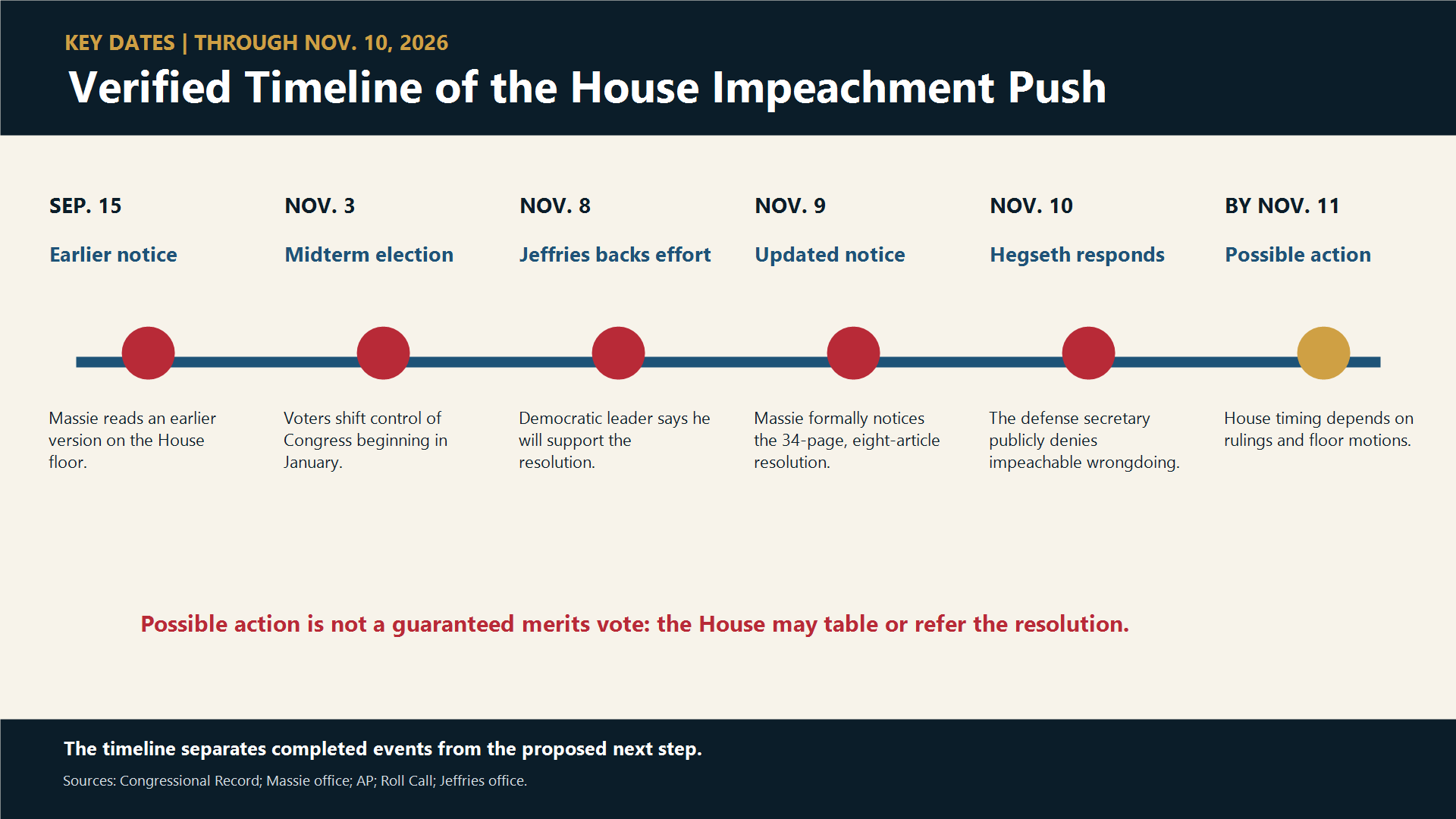
Massie first announced a version of the effort in September, but the House left Washington without voting before the midterm election. He returned with an updated resolution after voters elected Democratic majorities for the Congress that convenes in January. The current House remains under Republican control during the lame-duck session, creating a short period in which outgoing lawmakers and members who will return must decide whether to act before power changes hands.
The political environment changed sharply after the election. Opposition to the Iran war and its economic effects was a prominent issue during the campaign, and some Republican lawmakers criticized the administration’s handling of the conflict. Jeffries said Nov. 8 that he would vote for the resolution and expected strong Democratic support. That does not guarantee adoption. The current House still has a Republican majority, party leaders oppose the effort, attendance can affect the tally and members may choose a motion to table or refer rather than an up-or-down vote on all eight articles.
Massie also lost his Republican primary earlier in 2026 and will leave Congress in January. That reduces the political cost of breaking with Trump but does not change his authority as a sitting representative. Hegseth’s supporters have used Massie’s defeat to portray the effort as retaliation by an outgoing lawmaker. Supporters of the resolution answer that a member’s remaining term carries the same constitutional powers until it ends. Neither argument resolves whether the alleged conduct warrants impeachment.
What a House vote could do
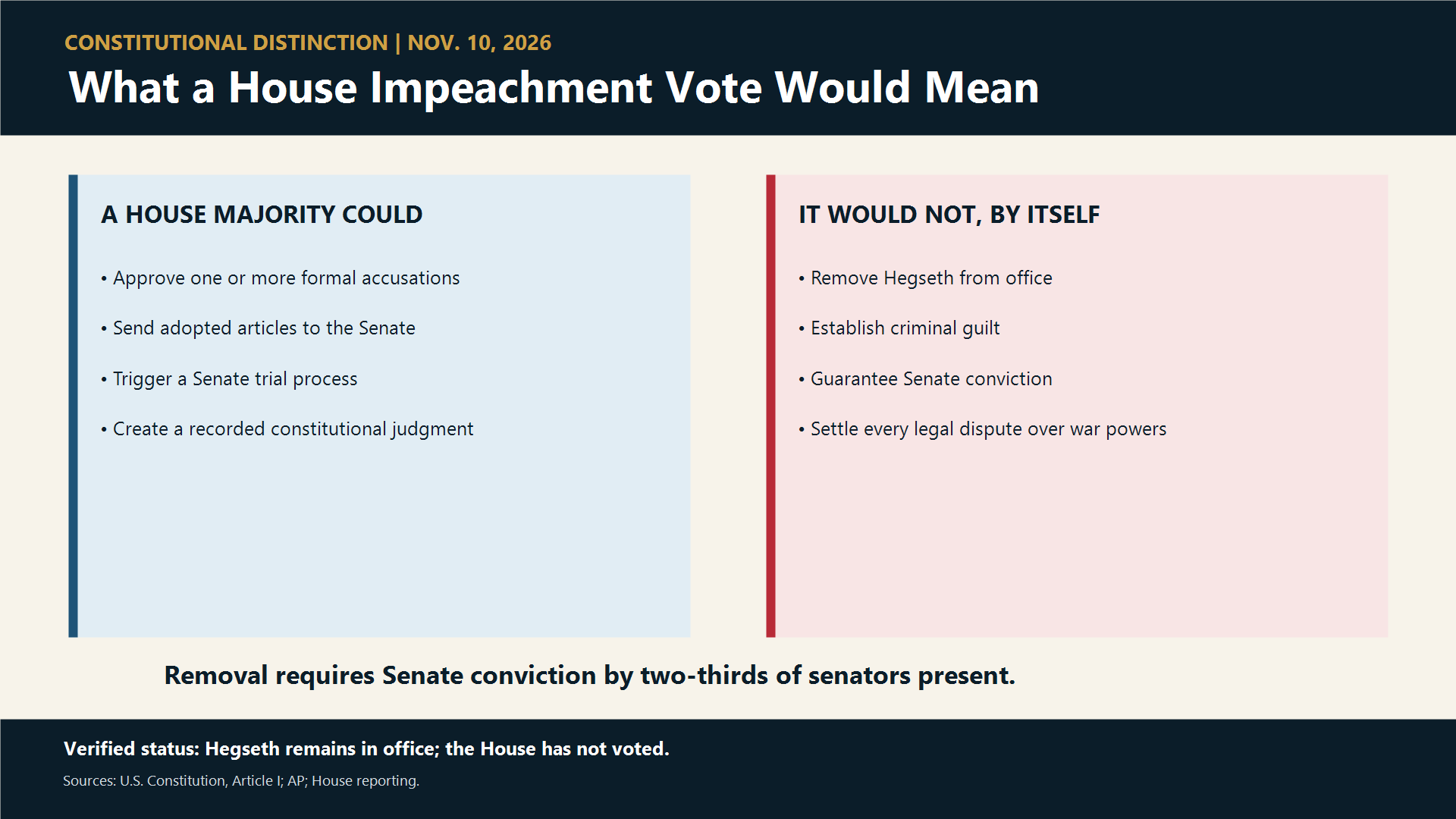
The Constitution gives the House the sole power of impeachment. In practice, impeachment requires approval by a simple majority of members voting. It functions like a formal accusation. It does not remove an official from office, determine criminal liability or by itself bar future service. If the House adopts one or more articles, the matter moves to the Senate for a trial.
The Senate has the sole power to try impeachments. Conviction requires two-thirds of senators present. Upon conviction, the immediate constitutional judgment is removal from office; the Senate may also vote separately on disqualification from future federal office. An acquittal would leave Hegseth in office, although Congress could continue investigations or use other powers. If the House tables or refers the resolution, no Senate trial begins.
The unusual target adds another layer. Cabinet officers are civil officers who may be impeached, but Congress has rarely pursued impeachment of a Cabinet secretary and has never removed one through a Senate conviction. Recent impeachment fights have focused mainly on presidents and judges. That history does not prevent action against a defense secretary, but it means lawmakers have little modern precedent for handling the case.
Impeachment also differs from legislation. The president cannot veto an impeachment resolution, and the process does not require the two chambers to pass identical text as they would with a bill. The House decides whether to accuse; the Senate decides whether to convict. Courts have generally treated many impeachment procedures as matters committed to Congress, leaving lawmakers with substantial responsibility for defining the constitutional phrase “high crimes and misdemeanors.”
The core war-powers dispute
At the center of the resolution is the recurring tension between Congress’s power to declare war and the president’s role as commander in chief. The War Powers Resolution requires reporting to Congress after forces enter hostilities and creates timelines for ending unauthorized operations. Presidents of both parties have disputed parts of the law or interpreted their Article II powers broadly, while lawmakers have often struggled to enforce the statute when majorities disagree about a conflict.
Massie’s resolution says the Iran operation lacked the legal predicates identified by the statute and continued after Congress directed withdrawal. The administration has maintained that its military actions were lawful and necessary. Hegseth framed the impeachment effort as an attack on the military’s missions and argued that policy disagreements do not amount to impeachable conduct. Critics respond that the question is not whether Congress dislikes a policy but whether an executive official disregarded legal limits and legislative commands.
That disagreement is likely to shape the vote more than every individual factual allegation. A member could believe the Iran war was unwise yet reject impeachment, or support the war while insisting Congress’s role was violated. Others may judge the civilian-casualty, maritime-strike or speech-retaliation allegations independently. Because the resolution contains eight separate articles, the House could consider them individually rather than treating the document as a single all-or-nothing charge.
What remains uncertain
The first uncertainty is what form House action will take. A motion to table would test whether members want to dispose of the resolution without deciding the merits. Referral to the Judiciary or Armed Services Committee would delay a final judgment and could create an investigative record. Direct votes would show which allegations, if any, command a majority. Leadership controls much of the floor schedule, but privileged status limits its ability to ignore the matter indefinitely.
The second uncertainty is timing. Roll Call reported that action could occur by Wednesday, Nov. 11, but the exact sequence depends on the speaker’s ruling and the motions offered. If the House impeaches before the current Congress adjourns, the Senate would have to determine when and how to conduct a trial. A change in party control in January could affect strategy, but it would not lower the constitutional two-thirds threshold for conviction.
The third uncertainty is the evidentiary record. Massie’s resolution cites statutes, congressional votes, official communications and reporting about military operations. Hegseth denies wrongdoing. A rapid privileged vote would give members less time than a committee investigation to test disputed claims, call witnesses or obtain classified material. That tradeoff—speed and accountability versus investigation and due process—is central to the debate over how the House should proceed.
For now, the verified status is limited but consequential: eight articles have been formally noticed, Hegseth has answered them publicly, and the House must decide whether to dismiss, investigate or vote on the accusations. He has not been impeached or removed. The next reliable evidence will be the speaker’s procedural ruling, the text of any floor motion and the official House roll call.
Left View: Congress Must Test Executive War Powers, Not Just Debate Them
The impeachment effort against Defense Secretary Pete Hegseth presents the House with a question larger than one Cabinet official: whether Congress will enforce its own constitutional authority after months of military operations undertaken without a new authorization for war. Republican Rep. Thomas Massie’s eight-article resolution is politically unusual, but the underlying accountability problem is familiar. Presidents of both parties have expanded military action while lawmakers complain, pass nonbinding measures and avoid responsibility for ending conflicts.
Massie formally noticed the 34-page resolution on Nov. 9, using House rules that can produce action within two legislative days. Hegseth rejected the effort the next morning, describing it as a policy dispute rather than impeachable misconduct. The House has not adopted any allegation, and Hegseth remains in office. Those procedural facts matter. So does the substance: three articles accuse the administration of violating distinct provisions of the War Powers Resolution in the Iran conflict, and other articles raise civilian protection, lethal maritime strikes, retaliation against a senator, Venezuela and Yemen.
War powers are democratic safeguards
A progressive case for serious consideration begins with democratic control over war. Decisions to initiate or prolong hostilities carry the highest public costs: deaths, injuries, displacement, military risk and economic disruption. The Constitution gives Congress powers to declare war, fund the armed forces and regulate military conduct because such choices should not belong to one person or a small executive circle. The president directs military operations, but command authority is not a blank check to decide alone when the nation enters a sustained conflict.
The War Powers Resolution was enacted in 1973 over President Richard Nixon’s veto to create reporting and termination rules. Its effectiveness has always depended on Congress being willing to act. Massie’s resolution says the Iran war began without statutory authorization, continued beyond the 60-day clock and persisted after both chambers directed withdrawal. The administration disputes that legal conclusion and says its operations were lawful. If lawmakers believe those statutory limits mean anything, they should address the claim with evidence rather than treating military policy as automatically beyond impeachment.
Accountability is not the same as opposition to service members. Hegseth argued that impeachment undermines troops and their missions. That framing risks collapsing civilian oversight into disloyalty. Service members follow a constitutional chain of command, and civilian leaders are responsible for ensuring orders and missions have lawful authority. Scrutinizing the secretary’s decisions protects the military from being used without public authorization; it does not condemn personnel who carried out assigned duties.
Civilian harm deserves an evidentiary record
Article IV focuses on a strike on a school in Iran and alleges failures to minimize civilian casualties. Article V challenges lethal attacks on vessels described as connected to drug trafficking, including claims about survivors and rescue duties. Article VIII alleges civilian harm and war-powers violations in Yemen. These are grave accusations, but a privileged resolution is not proof. The responsible progressive position is to demand a transparent record, not to convert allegations into findings before witnesses, operational documents and legal analyses are tested.
That is also the strongest argument for committee referral rather than a rushed vote on all eight articles. The Judiciary and Armed Services committees can seek targeting policies, civilian-casualty assessments, rules of engagement and the legal memoranda used to justify the operations. Classified material can be reviewed under secure procedures while public reports explain as much as possible. Families harmed by military action, service members and the public all deserve more than competing press conferences.
Speed nevertheless has a legitimate purpose. Executive officials can run out the clock, and this Congress is approaching its end. A referral designed only to bury the resolution would repeat the pattern that weakened war-powers oversight. The House should set a firm schedule, identify the evidence needed and return to the floor. Members can reject unsupported articles while still acting on allegations the record sustains.
Retaliation and institutional dissent
Article VI accuses Hegseth of using Defense Department authority against Sen. Mark Kelly after Kelly discussed service members’ duty to reject unlawful orders. The facts and legal context require careful review, but the issue reaches beyond one senator. Civilian control works only when lawmakers can question military policy without executive punishment. Retaliation against congressional speech would threaten the separation of powers and could discourage oversight by members who have military experience or committee responsibilities.
At the same time, no senator has unlimited immunity from every consequence of public statements, and the Defense Department has legitimate interests in discipline, operational security and the integrity of military advice. The key questions are what Hegseth ordered, what authority he claimed, what conduct he targeted and whether the action was a lawful response or political intimidation. A developed record can distinguish those possibilities.
A bipartisan opening, not a bipartisan verdict
The resolution was introduced by a Republican who frequently opposes U.S. military intervention, while Democratic leader Hakeem Jeffries says he supports it. That alignment gives the effort a bipartisan origin, but it does not make every allegation correct. Nor should Democrats support impeachment merely because a Republican administration suffered large election losses. The constitutional case must stand apart from electoral revenge.
The lame-duck timing makes discipline especially important. Voters elected Democratic majorities for the next Congress, but the current House remains Republican-led until January. Members who lost their seats still possess full authority. Their freedom from future electoral pressure may allow independent judgment, or it may reduce accountability. Recorded votes and clear explanations are the best answer to that concern.
Democrats also should resist treating impeachment as a substitute for legislation. Congress can vote on authorizations for military force, restrict appropriations, require reporting, protect whistleblowers and conduct oversight. Impeachment addresses alleged abuse by an individual official; it does not repair vague statutes or decades of legislative avoidance. Even if the resolution fails, members should state whether the Iran operation has authorization and what limits govern future action.
Due process strengthens accountability
A fair process is not a favor to Hegseth. It is what makes any judgment credible. The House should publish the final text, separate the eight articles for voting, disclose the principal evidence, allow a response and avoid presenting disputed claims as settled. Hegseth’s public denial is part of the record, but a press briefing is not a substitute for sworn testimony or document production.
If the House adopts one or more articles, impeachment would be an accusation, not removal. The Senate would hold a trial, and conviction would require two-thirds of senators present. That high threshold ensures that removal cannot rest on a narrow partisan majority. If the House tables the resolution, however, members should not pretend that a procedural motion resolves the underlying legal questions.
Congress should also protect career officials who preserve records and give lawful testimony. Civilian-casualty reviews, operational logs and legal opinions may involve classified material, but classification cannot become a blanket excuse for withholding the basis of a constitutional judgment. Inspectors general and committee staff can separate legitimately sensitive details from information needed for public accountability.
The left’s strongest interest is not in maximizing the number of impeachments. It is in restoring democratic control over decisions that cause war, civilian harm and the use of state power against dissent. Massie’s resolution may contain claims that do not survive scrutiny. Congress should find out. A prompt, evidence-based process would respect the troops, the public and the Constitution more than either automatic acquittal or instant conviction.
Right View: Impeachment Demands Proof, Not a Lame-Duck Political Shortcut
Republican Rep. Thomas Massie’s effort to impeach Defense Secretary Pete Hegseth forces conservatives to weigh two commitments that should not be casually traded against each other: constitutional limits on executive war-making and a stable chain of command during continuing international danger. The House should take the allegations seriously, but it should not confuse a fast procedural path with the careful proof required to remove a Cabinet official.
Massie gave formal notice on Nov. 9 of a 34-page resolution containing eight articles. The document accuses Hegseth of violating the War Powers Resolution in Iran, ignoring civilian-protection obligations, conducting unlawful maritime strikes, retaliating against Sen. Mark Kelly, misusing force in Venezuela and directing an unauthorized campaign in Yemen. Hegseth denies wrongdoing and argued Nov. 10 that lawmakers are trying to turn policy disagreements into impeachable offenses. The House has made no findings and has not impeached him.
Congress must defend its own powers
A conservative defense of executive authority does not require surrendering Congress’s Article I responsibilities. The Constitution divides military power because the founders distrusted concentrated authority. Congress decides whether to authorize and fund sustained war; the president commands forces and must be able to respond to attacks and urgent threats. The difficult question is where limited executive action becomes a war that requires affirmative legislative approval.
The War Powers Resolution attempts to answer part of that question through reporting and withdrawal deadlines. Every modern administration has objected to aspects of the law or interpreted presidential authority expansively. That history does not nullify the statute. It does mean that a serious impeachment case must confront decades of contested practice and show why Hegseth’s conduct crossed a constitutional line rather than merely continuing an institutional dispute Congress has tolerated.
Massie’s first three articles argue that the Iran campaign lacked authorization, exceeded statutory timelines and continued after Congress directed withdrawal. Those claims deserve a direct legal response from the administration. Congress also should explain why it has not enacted or rejected a tailored authorization for the use of military force. Lawmakers weaken their own case when they avoid a clear vote on war policy and later rely on impeachment to settle what legislation should have addressed.
Eight articles require eight evidentiary judgments
The resolution combines war-powers arguments with claims about targeting decisions, civilian casualties, maritime operations, senatorial speech, Venezuela and Yemen. Bundling them creates political momentum but risks obscuring different legal standards and factual records. A member may conclude that the Iran clock expired while rejecting the accusation involving Kelly, or may defend operations against drug-smuggling vessels while questioning the Venezuela mission.
The House should therefore avoid one sweeping verdict. Each article should receive its own vote if the measure reaches the floor. Members should have access to the legal opinions, operational timelines and relevant classified material. Hegseth should be permitted to answer through counsel or committee testimony. Impeachment is a political process, but constitutional fairness requires more than a sponsor’s assertions and a defendant’s press conference.
Separate votes would also clarify the precedent being created. A member who believes the Iran campaign violated a statutory deadline should not be forced to endorse unrelated allegations about Venezuela or speech retaliation. Narrow findings produce a more useful constitutional record and reduce the incentive to turn every disputed executive action into a catchall charge.
Claims about civilian harm are particularly serious. The United States must distinguish military targets, take feasible precautions and investigate credible reports of error. Yet lawmakers should not determine targeting responsibility from newspaper summaries alone. Operational decisions may involve commanders, intelligence assessments, allies and time-sensitive threats. Responsibility can still reach civilian leadership, but the chain must be established rather than assumed.
Military effectiveness and civilian control
Hegseth says the impeachment effort undermines troops. That defense can be overstated; civilian leaders do not become immune because they oversee military operations. Still, Congress should consider how a compressed proceeding affects command stability and allies’ confidence. Removal of a defense secretary is not ordinary oversight, especially when forces remain deployed and adversaries are testing American resolve.
The answer is neither deference nor spectacle. Congress can protect operational security while reviewing legal authority. Closed hearings, secure document access and narrowly written public findings are familiar tools. If the evidence shows deliberate disregard of law, institutional stability favors accountability. If the evidence shows disputed but good-faith legal judgments within longstanding executive practice, impeachment would be a dangerous escalation of political disagreement.
Article VI, involving Sen. Kelly’s speech, raises a separate conservative concern. The executive branch should not use military authority to punish a legislator for protected oversight. At the same time, statements about unlawful orders can affect discipline if they are vague or detached from actual commands. Congress must identify the specific Defense Department action and legal basis before declaring retaliation.
Lame-duck timing increases the burden of care
The resolution arrives after voters shifted control of Congress and while many members are preparing to leave. The current House has full legal authority, but prudence matters. An outgoing majority should be reluctant to initiate a Senate trial without a developed record, just as an incoming majority should not prejudge guilt for political advantage.
Massie’s own political position complicates perceptions. He lost a Republican primary after repeated clashes with Trump and will leave office in January. That does not invalidate his constitutional argument; independence from party pressure can be valuable. It does mean the House should rely on verifiable evidence rather than his motives, predictions or personal conflict with the president.
Democratic leader Hakeem Jeffries has declared support, and some Democrats expect strong backing from their conference. Republican leaders oppose the effort. Those positions show the political stakes, not the merits. Members who vote to table should explain whether they reject the charges or simply want committee review. Members who vote to impeach should identify which conduct satisfies the constitutional standard.
Impeachment is not a substitute for strategy
The United States needs a coherent policy for Iran, maritime security, Venezuela and the Houthis. Congress has tools beyond impeachment: appropriations restrictions, authorizations for military force, oversight hearings, reporting mandates and confirmation leverage. A chamber that invokes war powers only when a politically vulnerable official becomes a target is not exercising durable constitutional responsibility.
If the House impeaches, the Senate would conduct a trial and conviction would require two-thirds of senators present. That threshold is intentionally demanding. A Cabinet officer should not be removed because a simple majority dislikes military strategy. Conviction should require a persuasive showing of serious abuse, disregard of law or breach of public trust.
Conservatives should reject both automatic loyalty and automatic punishment. Hegseth is entitled to a fair examination, not immunity. Massie is entitled to raise constitutional objections, not uncritical acceptance. Referral with a fixed deadline, document production and separate findings could give Congress the record it needs without burying the issue.
The House’s next action will reveal whether this is a genuine constitutional inquiry or a symbolic vote shaped by election shock. The right standard is straightforward: defend Congress’s war powers, protect the chain of command, test every allegation and reserve impeachment for misconduct the evidence can sustain. Anything less would weaken the institution either by tolerating executive overreach or by turning removal into an ordinary political weapon.
IMPACT AND IMPLICATIONS
- Military leadership — A rapid impeachment fight could increase uncertainty at the Pentagon while U.S. forces remain active overseas.
- Congressional authority — The vote will test whether lawmakers enforce war-powers limits through impeachment or prefer legislation and oversight.
- Civilian accountability — The allegations could prompt demands for targeting records, legal opinions and classified briefings even if impeachment fails.
- Lame-duck Congress — Outgoing members retain full voting power, but the approaching transfer of control intensifies disputes about timing and legitimacy.
- Future administrations — The precedent could influence how Congress responds when presidents use force without a new authorization.
FACT CHECK
- Claim: Hegseth was removed on Nov. 9. Evidence: False. Massie noticed a resolution; no House impeachment or Senate conviction occurred.
- Claim: A House vote alone can remove a Cabinet secretary. Evidence: False. The Senate must convict by two-thirds of members present.
- Claim: All eight articles concern Iran. Evidence: False. The document also addresses Venezuela, Yemen, maritime strikes, civilian protection and alleged retaliation.
- Claim: Privileged status proves the allegations. Evidence: False. It governs floor priority, not the truth or legal sufficiency of the charges.
EDITORS INSIGHT
- Procedure versus judgment — A quick route to the floor limits delay, but it does not replace the evidence needed for a credible constitutional decision.
- Policy versus misconduct — The central dispute is whether contested military decisions were lawful policy choices or deliberate disregard of legal limits.
- One resolution, several records — The eight articles involve different operations and authorities; members need not reach the same conclusion on each.
- Impeachment versus legislation — Removal can punish an official, but only durable statutes and congressional votes can clarify future war powers.
SOURCES
- Associated Press — Hegseth’s Nov. 10 response, political context and current House status
- Massie impeachment resolution — Official 34-page text containing eight articles and supporting allegations
- Rep. Thomas Massie — Nov. 9 formal notice and timing of the House action
- Roll Call — Rule IX process, possible House motions and expected timing
- Reuters factbox — Independent summary of the eight allegations and Hegseth’s denial
- House Democratic Leader — Jeffries’ stated support and expectations for Democratic action
- Congressional Record — Earlier floor notice and text of the war-powers allegations
QUOTE OF THE DAY
EXPLAINER OF THE DAY
Explore Related Streets
Discover interconnected perspectives across the Knowledge Streets —each Street brings its own lens to the political landscape.
Politics Street
Politics Street covers campaigns, elections, legislation, and the shifting dynamics shaping power in America and beyond.
Government Streets
Policy, budgets, agencies, and oversight across federal, state, and local government—plain-English explainers and timely analysis.
Defense Street
Daily defense posture, procurement, readiness, strategy, and technology—curated updates for leaders and curious citizens.
Left Streets
Progressive politics, policy ideas, movement priorities, and media framing—news and analysis from the left lane.
Right Streets
Conservative politics, policy priorities, movement debates, and media framing—news and analysis from the right lane.
Citizen Streets
How government affects everyday life—services, rights, civic tools, and practical guides to participate with confidence.
Defense Secretary Pete Hegseth has answered a House resolution accusing him of eight impeachable offenses tied to Iran, Venezuela, Yemen, maritime strikes, civilian protection and action involving a senator’s speech. Republican Rep. Thomas Massie formally noticed the measure Nov. 9, but the House has not voted and Hegseth remains in office.
Featured image: AI-generated editorial illustration; not a photograph of the reported Pentagon briefing or House proceeding.KEY TAKEAWAYS
- Rep. Thomas Massie formally noticed eight articles of impeachment against Defense Secretary Pete Hegseth on Nov. 9.
- The allegations concern Iran, Venezuela, Yemen, maritime strikes, civilian protection and action involving Sen. Mark Kelly’s speech.
- Hegseth denies wrongdoing and says the dispute concerns lawful military policy, not impeachable conduct.
- The House has not voted, made findings or removed Hegseth from office.
- House leaders may seek to table, refer or directly vote on the privileged resolution.
- A House majority can impeach, but only a two-thirds Senate vote can convict and remove.
- The next verified step will be a procedural ruling, floor motion or official roll call.
More in Politics
QUICK FACTS & NUMBERS
- 8 articles — Allegations in Massie’s resolution
- 34 pages — Updated impeachment document
- Nov. 9 — Formal House notice
- 2 legislative days — Privileged-action window
- Simple majority — House impeachment threshold
- Two-thirds present — Senate conviction threshold
TIMELINE — HOW WE GOT HERE
- Sept. 15, 2026 — Massie reads an earlier version of the impeachment case on the House floor
- Nov. 3, 2026 — Midterm voters shift control of Congress beginning in January
- Nov. 8, 2026 — Democratic leader Hakeem Jeffries says he will support the resolution
- Nov. 9, 2026 — Massie formally notices an updated 34-page privileged resolution
- Nov. 10, 2026 — Hegseth publicly rejects the allegations at a Pentagon briefing
- By Nov. 11 — House action could occur, depending on the speaker’s ruling and floor motions
Explore our other Politics related sites:
Politics Street
Government Streets
Constitution Street
Defense Street
Left Streets
Right Streets
Citizen Streets
News Street Network
REACTIONS & BUZZ
- Pete Hegseth — Says the effort turns policy disagreements into an attack on lawful military operations
- Thomas Massie — Argues the alleged conduct violates congressional war powers and warrants impeachment
- President Donald Trump — Defends Hegseth and attacks Massie’s motives
- Hakeem Jeffries — Says he supports the resolution and expects strong Democratic backing
- House Republican leaders — Oppose the effort and may seek a procedural route to dispose of it
FREQUENTLY ASKED QUESTIONS
- Has Pete Hegseth already been impeached? No. A resolution has been noticed, but the House has not approved any article.
- Why can the resolution move quickly? Massie invoked a privileged House procedure that generally requires action within two legislative days.
- What choices does the House have? Members may table the measure, refer it to committee or vote on one or more articles.
- Would House impeachment remove Hegseth? No. Removal requires a Senate trial and conviction by two-thirds of senators present.
- Are the eight charges established facts? No. They are allegations supported by Massie’s legal and factual claims, which Hegseth disputes.
DID YOU KNOW?
- The Constitution gives the House the sole power to impeach and the Senate the sole power to try impeachments.
- A privileged resolution receives procedural priority, but priority does not require members to approve its substance.
- The president cannot veto an impeachment resolution because impeachment is not ordinary legislation.
- Congress has rarely impeached Cabinet officials and has never removed one through Senate conviction.