

Van Hollen Challenges Schumer for Control of Senate Democratic Agenda
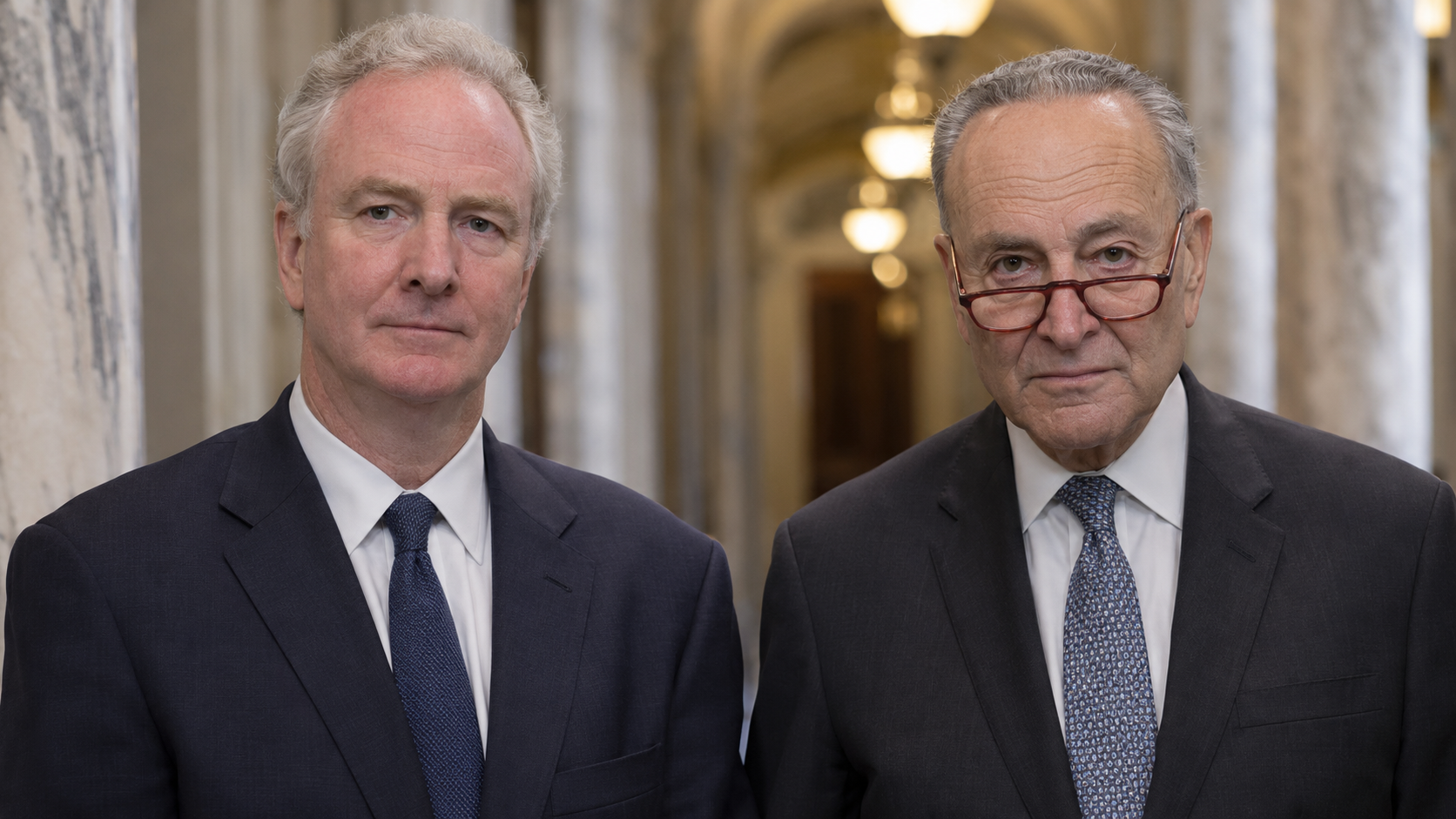
Sen. Chris Van Hollen of Maryland announced on Nov. 12 that he will challenge Sen. Chuck Schumer of New York for leadership of the Senate Democratic Conference. Schumer has led Senate Democrats since 2017 and said after Van Hollen’s announcement that he believes he has enough votes to retain the post. The election is expected in early December, before the new Congress begins.
The contest is unusual because Senate party leadership races are typically settled without a competitive ballot. According to the Associated Press, it is the first contested race for Senate Democratic leader in decades. The vote will occur behind closed doors, and members are not required to reveal how they voted. That means public endorsements provide information but do not establish a final count.
Van Hollen, 67, entered the Senate in 2017 after serving in the House of Representatives. His congressional résumé includes service in House Democratic leadership and chairmanships of both the Democratic Congressional Campaign Committee and the Democratic Senatorial Campaign Committee. Schumer, 75, has served in the Senate since 1999 and became Democratic leader after Harry Reid retired.
How the vote works
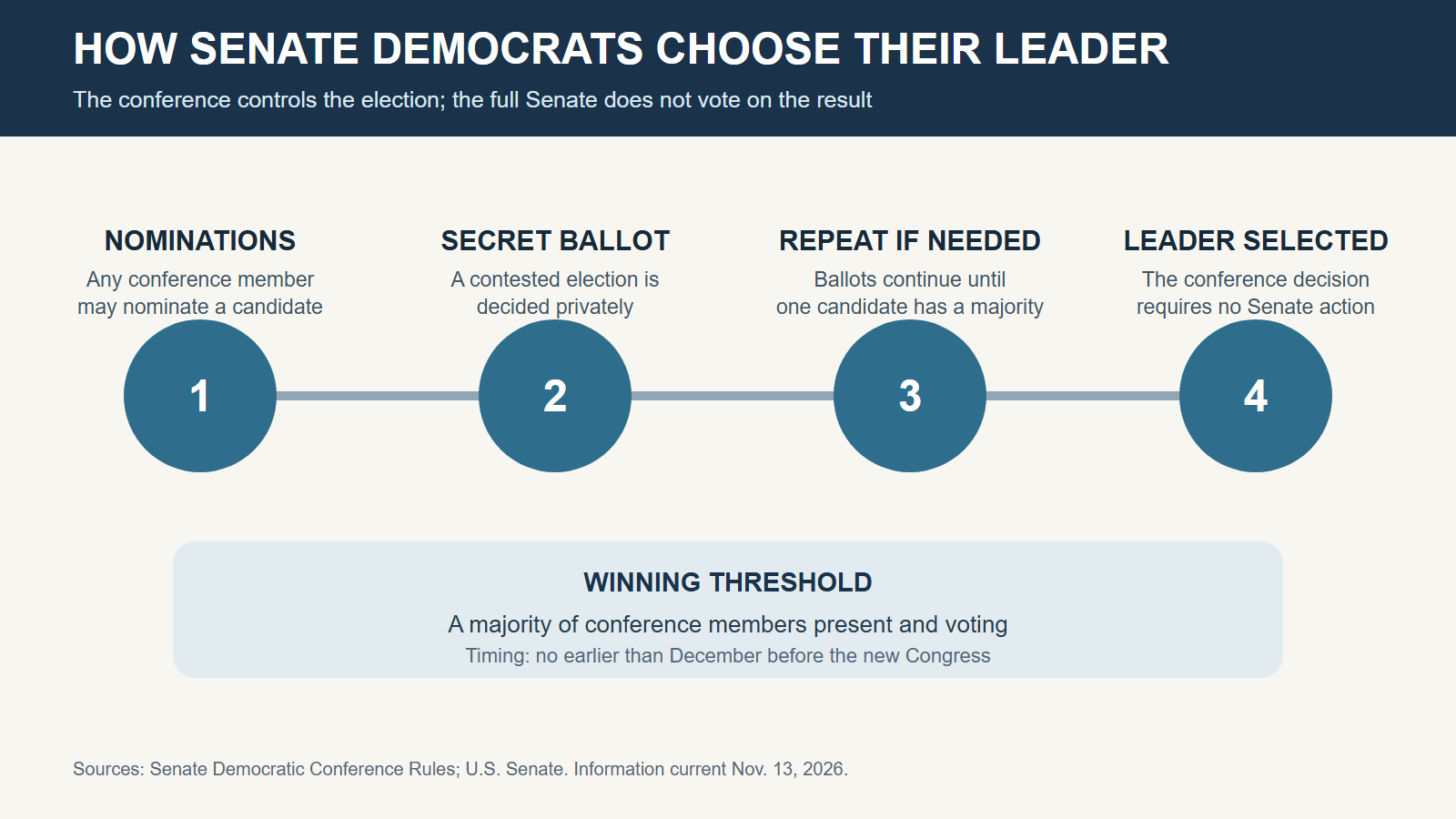
The Democratic Conference sets its own leadership rules. Any conference member may nominate a candidate. When more than one person is nominated, the election is conducted by secret ballot. Balloting continues until one candidate receives a majority of the members present and voting. If more than two candidates participate, the lowest vote-getter is removed after each ballot until a candidate reaches the threshold.
The conference rules state that leadership elections for the next Congress may not be held earlier than December. The winner is chosen solely by Democratic Conference members; the full Senate does not confirm the party leader. In the next Congress, the elected Democratic leader would be the majority leader if Democrats control the chamber or the minority leader if they do not.
What each candidate is arguing
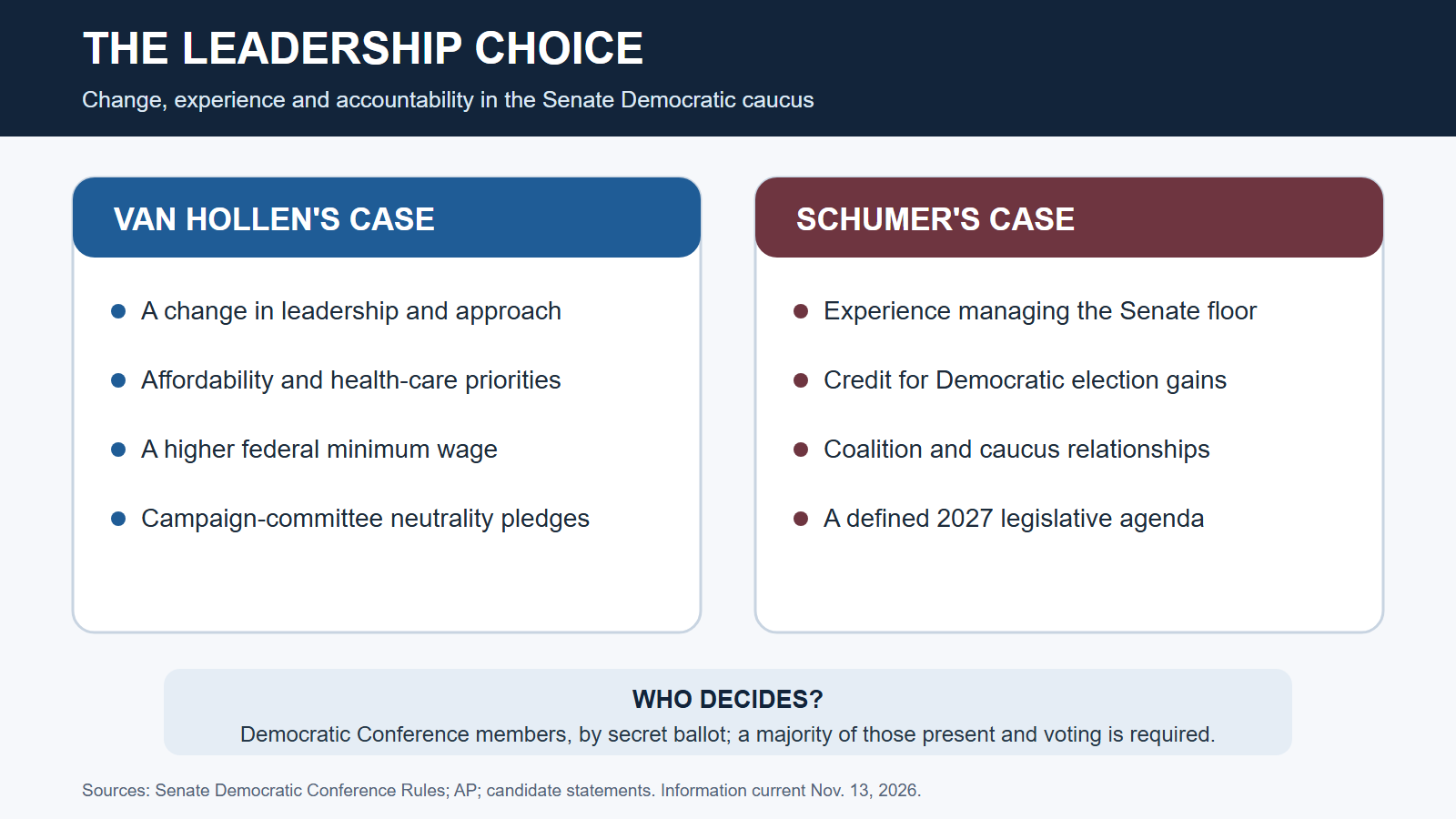
Van Hollen has framed his candidacy as a call for new leadership. In interviews, he has highlighted restoring Medicaid funding, extending Affordable Care Act subsidies, raising the federal minimum wage and limiting public subsidies for data centers. He has also proposed changes to how the party’s Senate campaign committee handles contested primaries and certain political contributions.
Those positions are campaign commitments by Van Hollen, not adopted rules of the caucus. Even if elected, he would need support from Democratic senators and, for legislation, enough votes on the Senate floor as well as agreement from the House and the president.
Schumer has emphasized the party’s 2026 election performance, saying Democrats hold 55 seats “and counting.” He has outlined an agenda focused on health-care costs, tariffs and ending the war with Iran. His supporters cite his experience managing Senate procedure, recruiting candidates and maintaining relationships across a caucus that includes progressives, moderates and independents who organize with Democrats.
Where support stands
Publicly identified supporters do not yet account for the entire conference. Sen.-elect Abdul El-Sayed and Sen. Bernie Sanders have supported Van Hollen. Schumer has received endorsements from senators including Sherrod Brown, Catherine Cortez Masto and Angus King. Other senators have not announced a preference or have said they are still considering the candidates.
Schumer remains the favorite because he is the incumbent, has long-standing relationships and says he has secured the necessary support. Van Hollen has acknowledged that he is the underdog. The secret ballot, however, means the final result cannot be verified in advance from public statements alone.
Why the job matters
The majority leader is central to Senate operations. The leader schedules floor business, calls up bills, coordinates party strategy and negotiates unanimous-consent agreements that determine how the chamber uses its time. By custom, the majority leader receives first recognition from the presiding officer, an advantage that helps shape the order of floor action.
The office also has limits. A leader cannot pass a bill without sufficient votes, cannot replace the work of committees and cannot by personal decision overcome every procedural hurdle. Legislation must also pass the House and be signed by the president, or receive enough votes to override a veto. Courts may review enacted laws.
What happens next
Both candidates will continue meeting privately with current and incoming senators before the December conference election. Members are likely to weigh the 2026 results, legislative priorities, committee assignments, campaign strategy and the candidates’ ability to manage a diverse majority.
The immediate question is who wins the secret ballot. The longer-term test will be whether the next leader can translate the party’s seat count into a durable agenda while managing conflict with the Trump administration and differences within the Democratic caucus. Until the votes are cast, claims about the final count remain unconfirmed.
Van Hollen’s Challenge Tests Whether Democrats Will Turn Midterm Momentum Into Change
Senate Democrats emerged from the 2026 elections claiming a stronger hand in Washington. Sen. Chris Van Hollen of Maryland argues that the party should pair that electoral momentum with a change at the top. His challenge to Sen. Chuck Schumer is therefore about more than two lawmakers competing for a title. It is a test of whether Democratic senators believe voters asked for a different governing style, a sharper economic message and greater accountability inside the caucus.
Van Hollen announced his bid on Nov. 12, saying the party needs new leadership to meet the political moment. He is an underdog against Schumer, who has led Senate Democrats since 2017 and says he has the votes to remain in charge. But the secret-ballot process gives members room to weigh loyalty, performance and future strategy without publicly disclosing their choice. That privacy could make the race less predictable than a public endorsement count suggests.
The case for a reset
Supporters of a leadership change can point to a familiar Democratic frustration: winning elections does not automatically settle questions about priorities, tactics or public trust. Van Hollen has emphasized affordability, health care and wages, issues that connect the leadership election to the daily pressures voters described throughout the campaign. He has also spoken about internal campaign practices, including neutrality in contested primaries and limits on certain donor relationships at the Democratic Senatorial Campaign Committee.
Those proposals would not bind every Democratic senator, and a majority leader cannot impose an entire program by personal decree. Still, leadership choices matter because the leader decides which fights receive floor time, how the caucus negotiates and what message it presents when legislation stalls. A change at the top can signal that the party intends to reassess not only its policy list but also the way it organizes power.
What change would mean
A Van Hollen victory would be read by many activists as a generational and strategic handoff. Van Hollen, 67, has experience in both chambers and previously led the Democratic Congressional Campaign Committee and the Democratic Senatorial Campaign Committee. That background gives him institutional credentials while allowing him to argue that the Senate needs a new public face.
The strongest progressive argument for Van Hollen is not that he would transform the Senate alone. It is that a leader more closely associated with economic populism, health-care expansion and skepticism toward concentrated campaign influence could make those themes more consistent across floor strategy, candidate recruitment and public communication. The challenge gives Democratic senators an opportunity to decide whether the election results call for continuity or a visible reset.
The counterargument for experience
Schumer’s defenders have a substantial answer. Democrats say they won 55 seats, and Schumer’s allies credit him with recruiting candidates, raising money and holding together a broad coalition. Sen. Angus King of Maine endorsed Schumer and argued that his understanding of the Senate and his strategic experience would be valuable in the next Congress. Other supporters have made a similar point: the party should not discard a leader after a successful election.
Experience is especially relevant in a chamber where procedure can determine whether a bill advances, an amendment receives a vote or a nomination is confirmed. Schumer has spent decades building relationships across the Senate and has navigated shutdown threats, budget negotiations and narrow margins. Replacing him could create a learning curve at the moment Democrats are preparing to manage a majority and confront a Republican White House.
A decision about accountability
The left’s best case for a contest is therefore not that Schumer has no achievements. It is that achievements should not eliminate internal accountability. A caucus that asks voters to evaluate Republican leaders can also examine its own leadership in a meaningful election. Competition can force both candidates to explain their agenda, management style and the role members will have in decisions.
There is also a democratic value in giving senators a real choice. The Democratic Conference rules allow any member to nominate a candidate and require a secret ballot in a contested race. If Van Hollen loses, the challenge may still affect Schumer’s priorities and the distribution of responsibilities inside the caucus. If Van Hollen wins, the outcome would show that private concerns about strategy were deeper than public endorsement lists revealed.
What to watch
The most important evidence will be concrete commitments rather than slogans. Senators can ask how each candidate would restore Medicaid funding, address expiring health-insurance assistance, raise wages, oversee the campaign committee and decide which bills receive scarce floor time. They can also ask how the leader would protect vulnerable members while allowing competitive primaries and ideological disagreement.
For voters on the left, the leadership election is an opportunity to connect election results with governing behavior. Van Hollen has opened the door to that debate. The caucus will decide whether to walk through it, and whether change in personnel is necessary to produce change in priorities.
Schumer Challenge Raises Questions About Senate Stability, Procedure and Power
Sen. Chris Van Hollen has the right under Democratic Conference rules to challenge Chuck Schumer, and a genuine contest can sharpen debate. But Senate Democrats should also consider the institutional cost of changing leaders just as they prepare to govern with a larger caucus. The Senate rewards procedural knowledge, relationships and patience. Those qualities are difficult to replace quickly and can matter more than the public visibility of the job suggests.
Schumer’s case begins with the 2026 election. Democrats say they secured 55 seats, and the incumbent leader argues that the result demonstrates confidence in the coalition and strategy he helped assemble. Senators who credit Schumer for candidate recruitment, fundraising and coordination may see little reason to start over before a new Congress begins.
The value of continuity
The Senate is not run like a campaign rally. Its work depends on unanimous-consent negotiations, committee schedules, amendment agreements and personal commitments that may take years to build. A leader who understands the preferences of every member can often identify the small compromise that keeps a bill alive. That institutional memory can be especially valuable when the House, the president and the courts impose separate checks on what a Senate majority can accomplish.
Schumer’s supporters can reasonably argue that replacing him would introduce uncertainty without guaranteeing different results. A new leader would face the same vote thresholds, the same independent-minded senators and the same constitutional structure. Frustration with the pace of legislation is not necessarily evidence that a different person could move the chamber faster.
Power with limits
The office is powerful because the majority leader decides what reaches the floor and in what sequence. The leader can call up bills, coordinate the caucus and negotiate the terms of debate. By custom, the leader also receives first recognition, which gives the office important control over floor procedure.
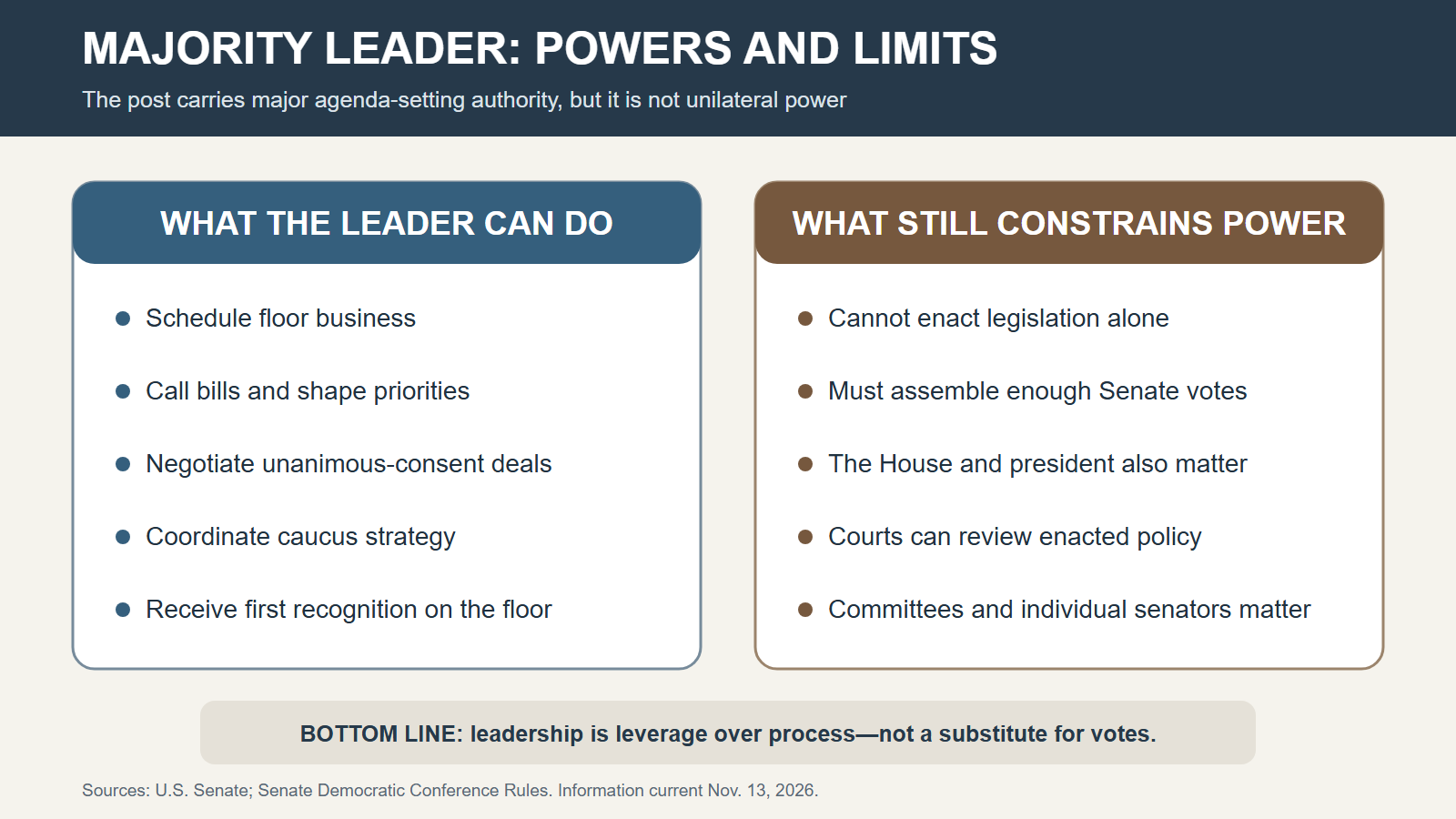
Yet the majority leader is not a prime minister. The position does not create votes that do not exist. Committee chairs control much of the legislative process, individual senators can use procedural tools to delay action and the minority retains leverage under many Senate rules. A bill that passes the Senate still requires House approval and presidential action. Changing leaders may alter strategy, but it cannot remove those constraints.
The risk of governing through internal conflict
A lengthy leadership fight could divide attention just when the caucus needs to organize committees and establish its legislative calendar. It could also encourage groups outside the Senate to treat every procedural disagreement as a loyalty test. That dynamic may make it harder for senators from politically different states to build the coalitions required for a durable majority.
Van Hollen’s proposals on campaign committees and donor relationships deserve debate, but they also raise questions about centralizing ideological rules inside leadership. Senators may disagree about when the party should remain neutral in primaries or which funding restrictions serve the broader coalition. A leader must manage those disagreements without turning the campaign arm into a vehicle for one faction.
The case for competition
There is a strong counterargument. A secret-ballot election is part of the caucus’s legitimate rules, and incumbency should not make leadership permanent. Van Hollen’s candidacy may reveal concerns that senators have been unwilling to express publicly. It may also require Schumer to explain his priorities and make specific commitments about how the majority will operate.
Competition can therefore strengthen continuity rather than merely threaten it. If Schumer wins after a real debate, he will have renewed authority and a clearer understanding of member concerns. If Van Hollen wins, the caucus will have chosen change through its established process. Either result is more defensible when members have compared the candidates directly.
Experience versus a mandate for change
The central question is whether election gains create a mandate to replace leadership or validate the existing leadership team. Van Hollen interprets the political moment as a demand for a new approach. Schumer interprets it as evidence that his strategy worked. Senators must decide which reading better reflects the voters who elected them and the realities of governing.
From an institutional perspective, the best choice is the candidate most capable of converting a majority into orderly, achievable action. That requires more than a policy wish list. It requires managing floor time, respecting committee work, protecting vulnerable members and recognizing when compromise preserves a larger goal.
What the caucus should demand
Before voting, Democratic senators should seek precise answers from both candidates. How would each leader set the floor calendar? Which health-care and cost-of-living measures would come first? How would the leader handle nominations, oversight and negotiations with the Trump administration? What role would moderates, progressives and newly elected senators have in strategy?
The challenge should not be reduced to age, personality or a simple contest between change and experience. It is a decision about stewardship of a Senate institution that operates through rules, trust and accumulated relationships. Van Hollen has created a legitimate test. Schumer’s response should be judged by whether he can demonstrate that continuity will produce disciplined governing, not merely preserve his position.

Explore Related Streets
Discover interconnected perspectives across the Knowledge Streets —each Street brings its own lens to the political landscape.

Politics Street
Politics Street covers campaigns, elections, legislation, and the shifting dynamics shaping power in America and beyond.

Government Streets
Policy, budgets, agencies, and oversight across federal, state, and local government—plain-English explainers and timely analysis.

Defense Street
Daily defense posture, procurement, readiness, strategy, and technology—curated updates for leaders and curious citizens.

Left Streets
Progressive politics, policy ideas, movement priorities, and media framing—news and analysis from the left lane.

Right Streets
Conservative politics, policy priorities, movement debates, and media framing—news and analysis from the right lane.

Citizen Streets
How government affects everyday life—services, rights, civic tools, and practical guides to participate with confidence.


Explore our other Politics related sites:
Politics Street
Government Streets
Constitution Street
Defense Street
Left Streets
Right Streets
Citizen Streets
News Street Network