

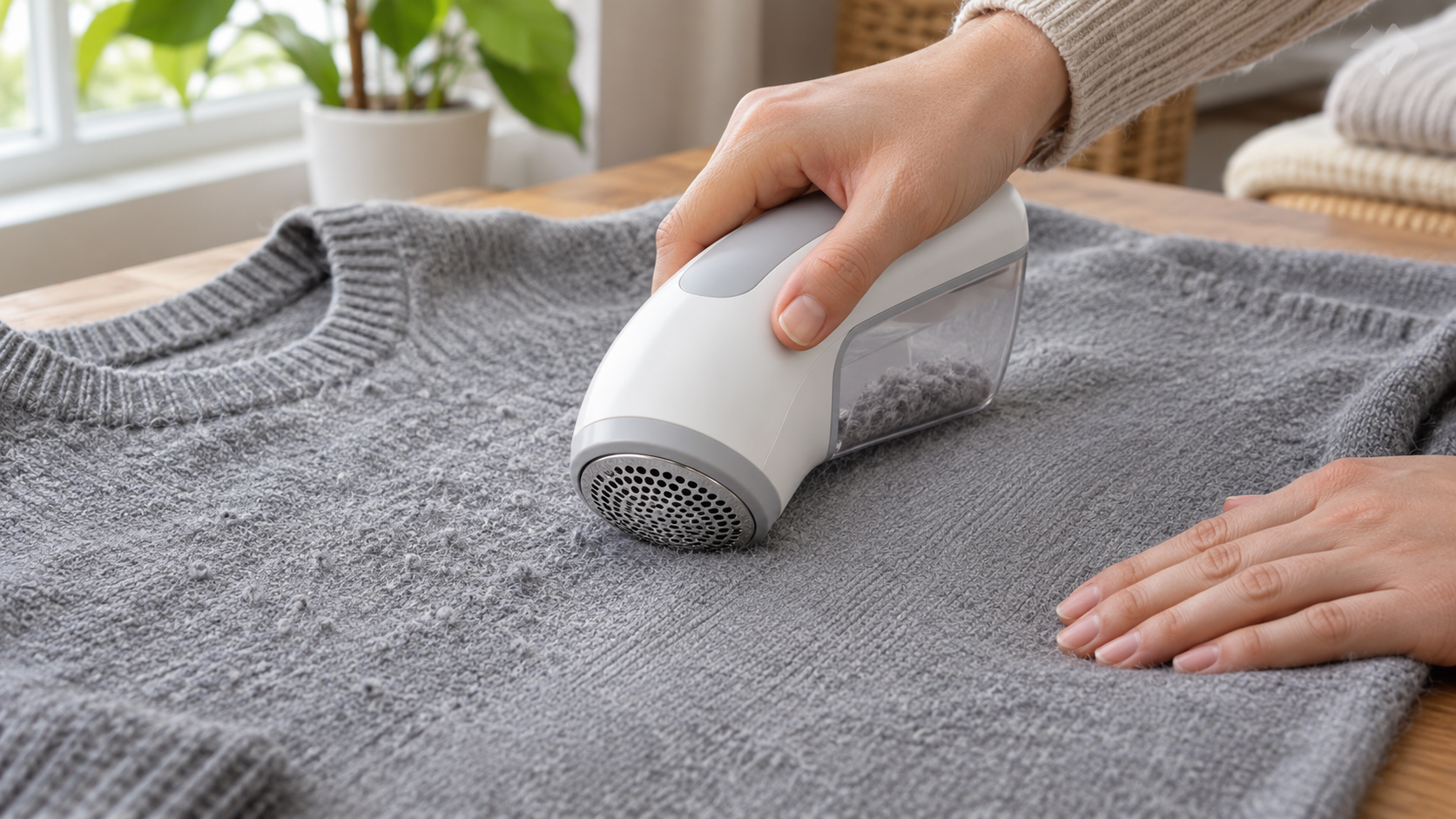
Perforated Foil, Rotating Blade, and Lint Chamber
A fabric shaver removes the small fuzzy balls that develop when loose surface fibers rub, tangle, and tighten into pills. The tool does not pull those knots from deep inside the cloth. Instead, it trims the raised portion close to the fabric surface. Its main parts are a thin perforated outer foil, a motor-driven rotary blade beneath that foil, an air path, and a chamber that collects the cut fibers.
The perforated foil is both an intake and a safety guard. As the shaver moves across a flat garment, pills and long fuzz project through its holes while the wider body of the fabric remains outside. Some foils use several hole sizes so small and large pills can enter. A spacer or adjustable guard may hold the cutting head farther from delicate or long-pile material, reducing how much fiber can reach the blade.
Inside the head, one or more cutting edges rotate very close to the back of the foil. When a pill enters a hole, the moving edge passes the fixed rim and shears the fibers between them. The action resembles a guarded rotary shear: the foil presents only protruding material to the blade, while the blade’s speed allows many small cuts during a gentle pass. Centrifugal motion and airflow then carry the clippings away from the cutting zone toward the lint chamber.
Performance depends on foil-hole size, blade sharpness, blade-to-foil clearance, motor speed, pressure, fabric tension, pill size, knit openness, and how quickly the tool moves. Pressing harder does not necessarily improve the cut. It can push soft cloth farther into the openings, increase drag, and make a snag more likely. A clean, flat foil and an evenly supported garment give the mechanism a more predictable surface to follow.
For safer use, the garment is laid flat on a firm surface, pockets are emptied, and wrinkles are smoothed before the shaver is switched on. Light overlapping passes are tested first in an inconspicuous area. Seams, buttons, zippers, embroidery, loose threads, open knits, and damaged spots require extra clearance or should be avoided because a projecting loop can enter the guard like a pill. The fabric and tool maker’s instructions should control whether a particular material is suitable.
When cutting slows, the cause may be a full chamber, clogged foil, wrapped fibers, a weak battery, or a dull blade rather than stubborn pilling. The tool should be powered off before the head is opened, and the foil, blade area, and chamber should be cleaned only as directed. In short, a fabric shaver works by separating raised fuzz from supported cloth, guiding that fuzz through a perforated guard, and shearing it with a protected rotating blade.
A fabric shaver guides raised pills through holes in a thin outer foil. A motor-driven blade rotates just behind that guard, shears the protruding fibers, and sends the clippings into a lint chamber.
Different openings admit a wider range of pill sizes while the foil continues to hold the main fabric surface away from the rotating cutter.
Yes. Thin cloth, loose loops, seams, embroidery, or fabric pushed hard into the foil can reach the blade. Flat support, light pressure, a test area, and the proper guard reduce—but do not eliminate—the risk.
Explore more "Explainers"
Discover additional explainers across politics, science, business, technology, and other fields. Each explainer breaks down a complex idea into clear, everyday language—helping you better understand how major concepts, systems, and debates shape the world around us.