

Garbage Disposal Grinding Explainer
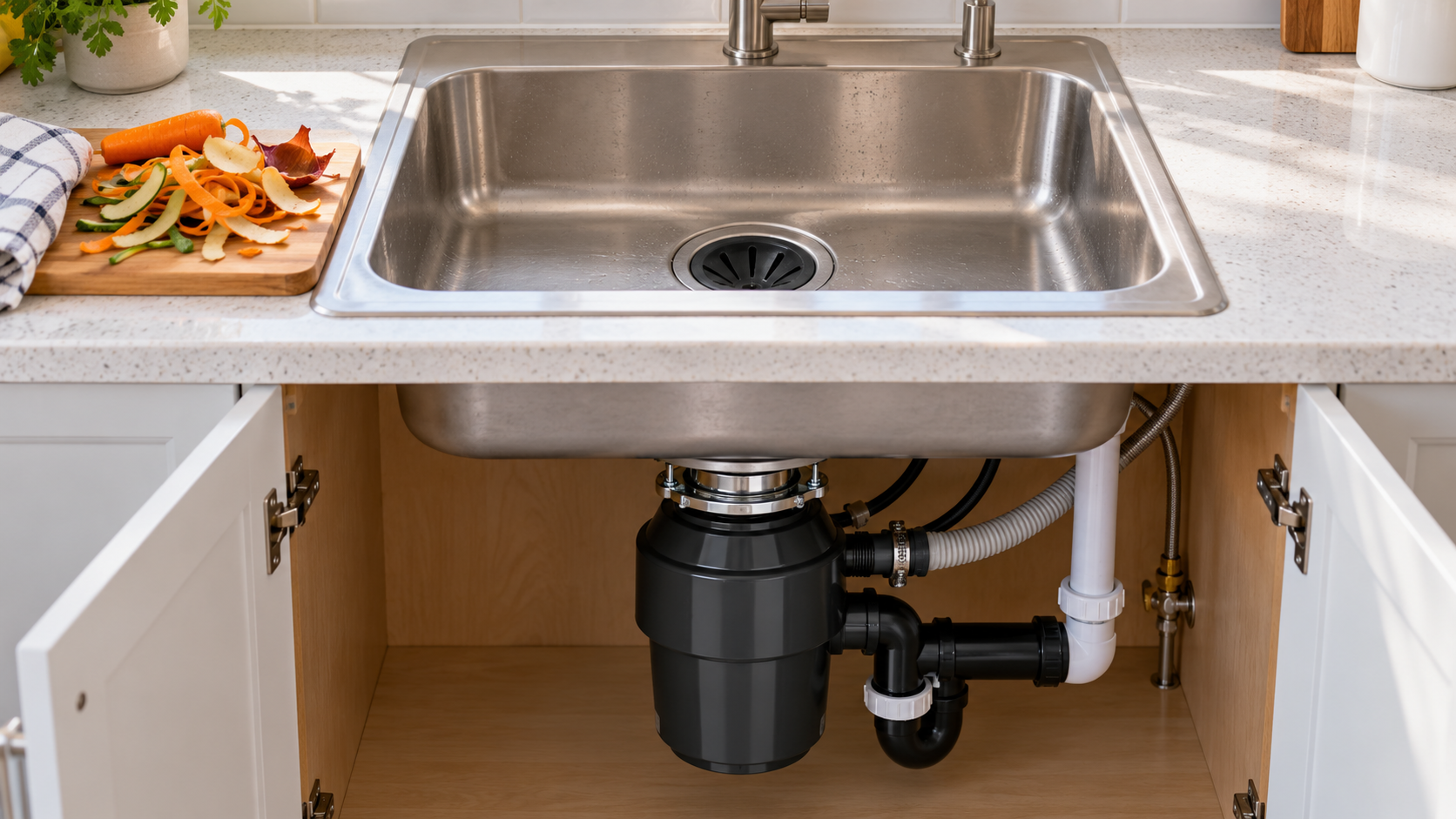
A household garbage disposal does not contain sharp rotating knives like a blender. Beneath the sink drain is a metal grinding chamber with a motor-driven plate at the bottom. Small swiveling impellers are mounted on that plate. When the motor turns, the impellers push food scraps outward against a stationary shredder ring around the chamber wall. The ring has raised cutting edges that break the scraps into much smaller particles. Running water suspends those particles and carries them through openings in the ring toward the drainpipe.
The motor spins the plate at high speed, while the impellers are free to pivot rather than staying rigid. That movement helps them strike or shove scraps without behaving like fixed blades. Centrifugal effects keep wet material moving toward the perimeter, where repeated contact with the shredder ring reduces its size. The chamber remains partly filled with water during normal use, so the flow cools the mechanism, moves particles, and helps prevent a thick paste from collecting in the outlet. The disposal is therefore a grinding-and-flushing system, not a storage container.
A rubber splash guard at the drain opening limits splashing and reduces the chance that small particles are thrown upward. Below it, a sealed bearing and motor shaft transmit rotation into the wet chamber while keeping water away from electrical components. Many units use an induction motor and include an overload protector that opens the circuit if the motor overheats or remains stalled. A small reset button may restore operation only after power is off, the obstruction is removed safely, and the unit has cooled according to its instructions.
Suitable material matters. Soft food remnants can usually be processed in small amounts, but fibrous stalks, large bones, grease, nonfood objects, and expandable starchy masses can jam the mechanism or obstruct plumbing. Cold running water is generally preferred because it keeps fats more solid until they move beyond the disposal, though fat and oil should not be poured into the drain at all. Food should be fed gradually with water already flowing, and the water should continue briefly after the grinding sound becomes smooth.
A hum without rotation often means the plate is jammed or the motor cannot start. Hands and utensils should never enter the chamber, even when the switch is off, because the mechanism may move unexpectedly or contain sharp stationary edges. The safe response is to disconnect power at the plug or breaker, follow the manufacturer’s clearing procedure, and use only the specified turning tool from below if the design provides one. Persistent leaks, repeated overload trips, or damaged wiring require qualified repair rather than repeated resetting.
The disposal’s usefulness depends as much on the plumbing as on the motor. Adequate water flow carries ground particles through the trap and branch drain; grinding alone cannot overcome a restricted pipe. Regular operation with cool water and ordinary dishwashing helps rinse the chamber, while corrosive drain cleaners can damage components and create hazards for anyone servicing the unit. The practical idea is simple: the machine reduces appropriate scraps to pumpable particles, but it cannot make every material disappear or replace careful waste handling.
A motor turns a plate with swiveling impellers that force scraps against a stationary shredder ring. Water carries the resulting particles into the drain. Key terms include grinding chamber, impeller, shredder ring, splash guard, overload protector, trap, and branch drain.
Usually no. Most household units use blunt swiveling impellers and a fixed toothed ring. The ring grinds material at the chamber wall rather than chopping it with blender-like knives.
Water cools the chamber, keeps particles suspended, and carries them through the ring and drainpipe. Grinding without enough flow can leave a dense mass that jams or clogs.
Explore more "Explainers"
Discover additional explainers across politics, science, business, technology, and other fields. Each explainer breaks down a complex idea into clear, everyday language—helping you better understand how major concepts, systems, and debates shape the world around us.