

Mechanical Pencil Lead-Advance Explainer
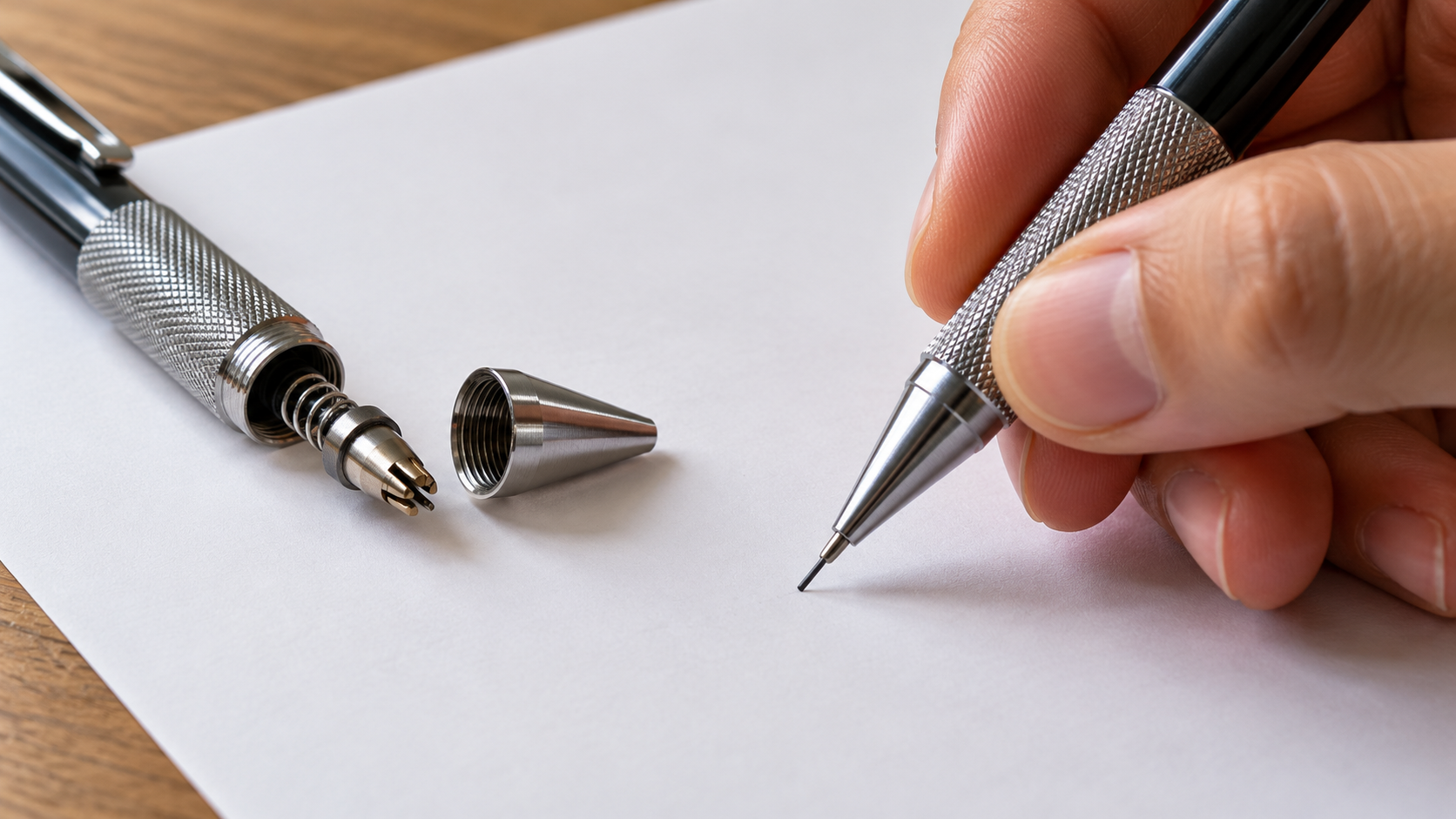
A mechanical pencil advances its writing core through a small spring-loaded clutch hidden inside the barrel. Pressing the top button moves a rod and the clutch assembly forward. At a specific point, a retaining ring or surrounding collar stops holding the clutch jaws closed, so they spread and release the core. A tiny length of core can then move toward the tip. Releasing the button lets the spring pull the mechanism back, the jaws close around the core, and the pencil holds it firmly for writing.
The three-jaw chuck found in many pencils grips the cylindrical core evenly around its circumference. The jaws are tapered, and a snug ring forces them inward when the mechanism is in its resting position. Their textured inner surfaces create friction without needing to crush the core. During a press, the chuck first carries the gripped core forward. When the chuck reaches its release position, the ring no longer clamps it and the jaws open. The distance traveled before release helps determine the amount advanced per click.
A small rubber or polymer lead retainer near the nose prevents the loose core from simply falling out while the clutch is open. It supplies enough drag to hold the newly advanced section as the chuck retracts. When the jaws close again, they grip at a new location farther back. The fixed metal sleeve around the exposed core supports it close to the paper and reduces bending. Drafting pencils often use a longer sleeve for ruler work, while pocket designs may retract the sleeve to prevent punctures and protect it from bending.
The refill magazine stores several cores in a tube behind the clutch. When one stick becomes too short to be gripped, a replacement can feed into the chuck, usually after repeated clicks with the pencil pointed downward. The label size—such as 0.5 or 0.7 millimeter—must match the chuck, sleeve, and retainer. A thinner core in an oversized mechanism slips; a thicker one jams or breaks. Hardness grades change darkness and wear rate but not the nominal diameter required by the pencil.
Breakage occurs when bending stress exceeds the brittle graphite-composite core’s strength. Extending too much creates a long lever arm outside the sleeve, making a small sideways writing force much more damaging. Heavy pressure, a bent tip, a dirty chuck, fragments in the sleeve, or low-quality irregular refill can also cause failure. To clear a jam, follow the manufacturer’s method, often removing the tip and using the supplied clean-out rod. A sewing needle may be too large or damage the precision sleeve.
Other pencils use twist, shaker, or automatic-feed mechanisms, but they still must alternate between releasing and gripping the core. Some “lead” is a graphite and clay or polymer mixture; modern writing cores do not normally contain metallic lead. The eraser cap may double as the push button and cover the refill opening, while a pin beneath it serves as a cleaner. The familiar click is therefore a compact sequence of motions: push the clutch, open the jaws, retain the core, return the clutch, close the jaws, and support the new writing length.
A mechanical pencil alternates a spring-loaded chuck between gripping and releasing the core while a tip retainer prevents it from falling out. Key terms include clutch, chuck, jaw, retaining ring, spring, push rod, lead retainer, sleeve, magazine, diameter, and clean-out rod.
The unsupported section acts like a longer lever. The same sideways writing force creates greater bending stress near the sleeve, so a short extension is stronger.
The clutch, retainer, and sleeve are sized for one diameter. A smaller core can slip, while a larger core can jam, fracture, or damage the mechanism.
Explore more "Explainers"
Discover additional explainers across politics, science, business, technology, and other fields. Each explainer breaks down a complex idea into clear, everyday language—helping you better understand how major concepts, systems, and debates shape the world around us.