

On This Day in Business: January 2, 1882
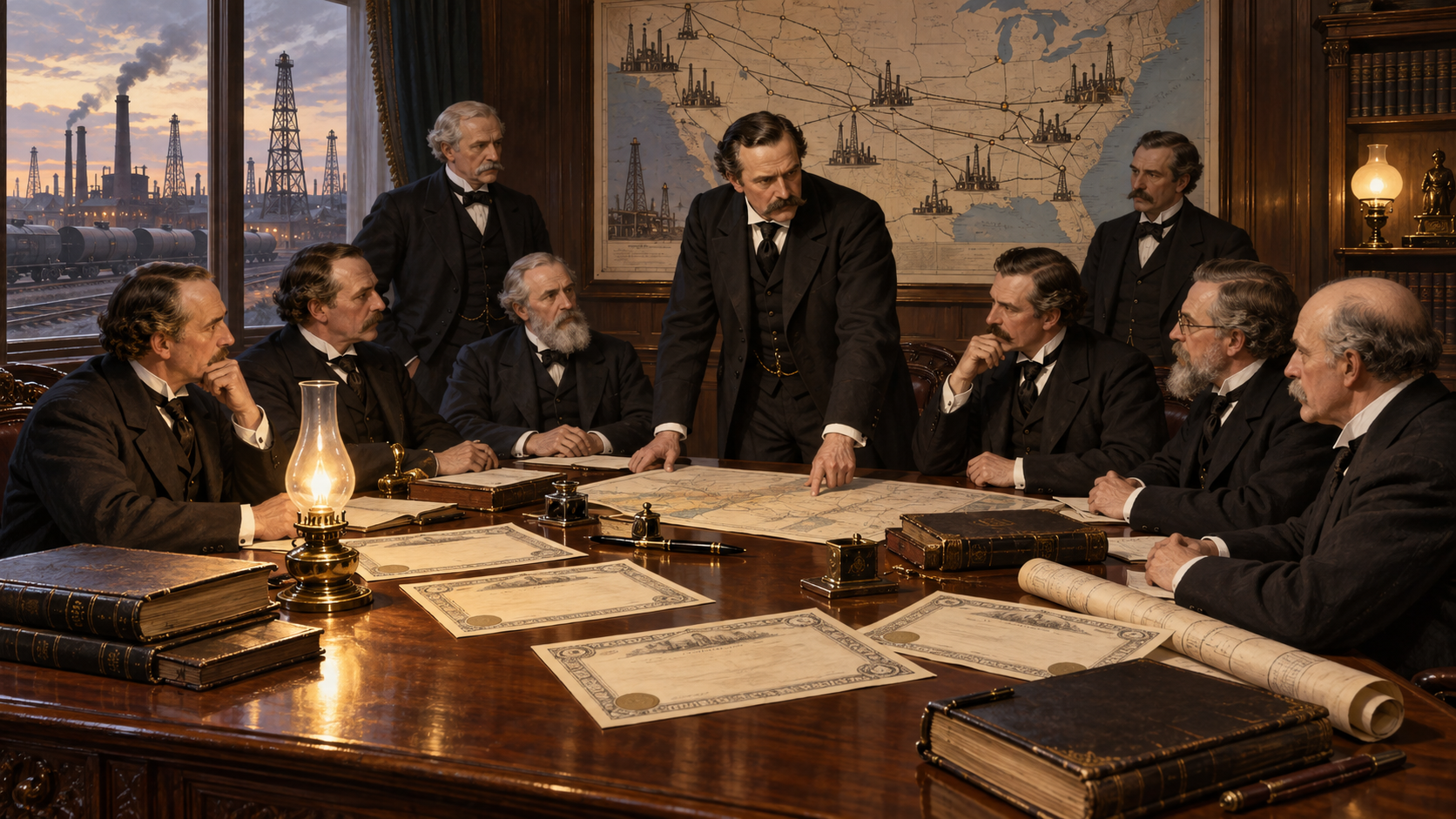
On January 2, 1882, Standard Oil’s owners entered an agreement that placed a sprawling group of petroleum businesses under centralized control. The Standard Oil Trust agreement brought shares in numerous corporations and limited partnerships into the hands of nine trustees, including John D. Rockefeller, William Rockefeller, Henry Flagler, John Archbold, and Charles Pratt. Investors who transferred their holdings received trust certificates representing their financial interest in the combined enterprise. The arrangement allowed one governing board to coordinate companies organized under the laws of several states while those companies continued to exist as separate legal entities.
Standard Oil had grown from an Ohio refining company founded in 1870 into a network with extensive interests in refining, pipelines, transportation, storage, and marketing. Kerosene was then a central lighting fuel, and controlling its movement from oil fields to refineries and urban customers offered enormous commercial leverage. Its leaders pursued lower costs and dependable distribution, but competitors and public critics also challenged the company’s railroad rebates, acquisitions, and ability to pressure independent refiners. Nineteenth-century state corporation laws made a single nationwide corporation difficult to construct. Attorney Samuel Dodd developed the trust structure as a way to bring the related companies under unified management without relying on one state charter to cover the entire operation.
The January agreement instructed participating owners to transfer stock or property to the trustees. In return, certificate holders shared in earnings distributed through the trust. The trustees could influence the boards and policies of the component companies, turning nominally separate businesses into a coordinated system. This was not a modern merger in which every company disappeared into one corporation, and the legal mechanics were complex. Local company names and charters could remain even as major investment and operating choices were aligned. Its business importance came from concentrating strategic decisions, capital, and profits in a small governing group while operating across many jurisdictions.
The word trust soon became shorthand for powerful industrial combinations, and Standard Oil became the leading symbol of the form. An Ohio court ordered the trust dissolved in 1892, although Standard’s interests remained closely coordinated and were later reorganized under a New Jersey holding company. Public concern about combinations had already helped produce the Sherman Antitrust Act of 1890. In 1911, the U.S. Supreme Court ruled that Standard Oil’s structure and practices violated federal antitrust law and ordered the group divided into separate companies. The 1882 agreement therefore influenced both corporate organization and the legal campaign to define the limits of private economic power.
Standard Oil expanded during an era when corporations were generally chartered by individual states. A nationwide petroleum system therefore involved many separate companies, partnerships, contracts, and ownership arrangements. Samuel Dodd, Standard Oil’s attorney, designed the trust mechanism to centralize control. Owners could exchange their company shares for certificates while trustees coordinated the businesses as a single economic network.
Nine trustees gained broad authority over the participating properties and the distribution of profits. Central control supported coordinated investment, refining, transportation, and marketing across state lines. The agreement did not erase every underlying corporation or eliminate legal challenges. Its effectiveness depended on transfers of shares, aligned directors, and cooperation among entities still governed by different state laws.
Other industrial combinations adopted similar structures, making trust a common public label for concentrated corporate power. Standard Oil became a central example in debates over competition, monopoly, and regulation. The trust was ordered dissolved in Ohio in 1892, and Standard later reorganized as a holding company. Federal antitrust litigation ultimately led the Supreme Court to require the group’s breakup in 1911.
Explore more of "On This Day ..."
Discover more events from the same date across news, politics, technology, sports, and other fields. Each link highlights significant moments that shaped history on different fronts.