

On This Day in Life: January 2, 1974
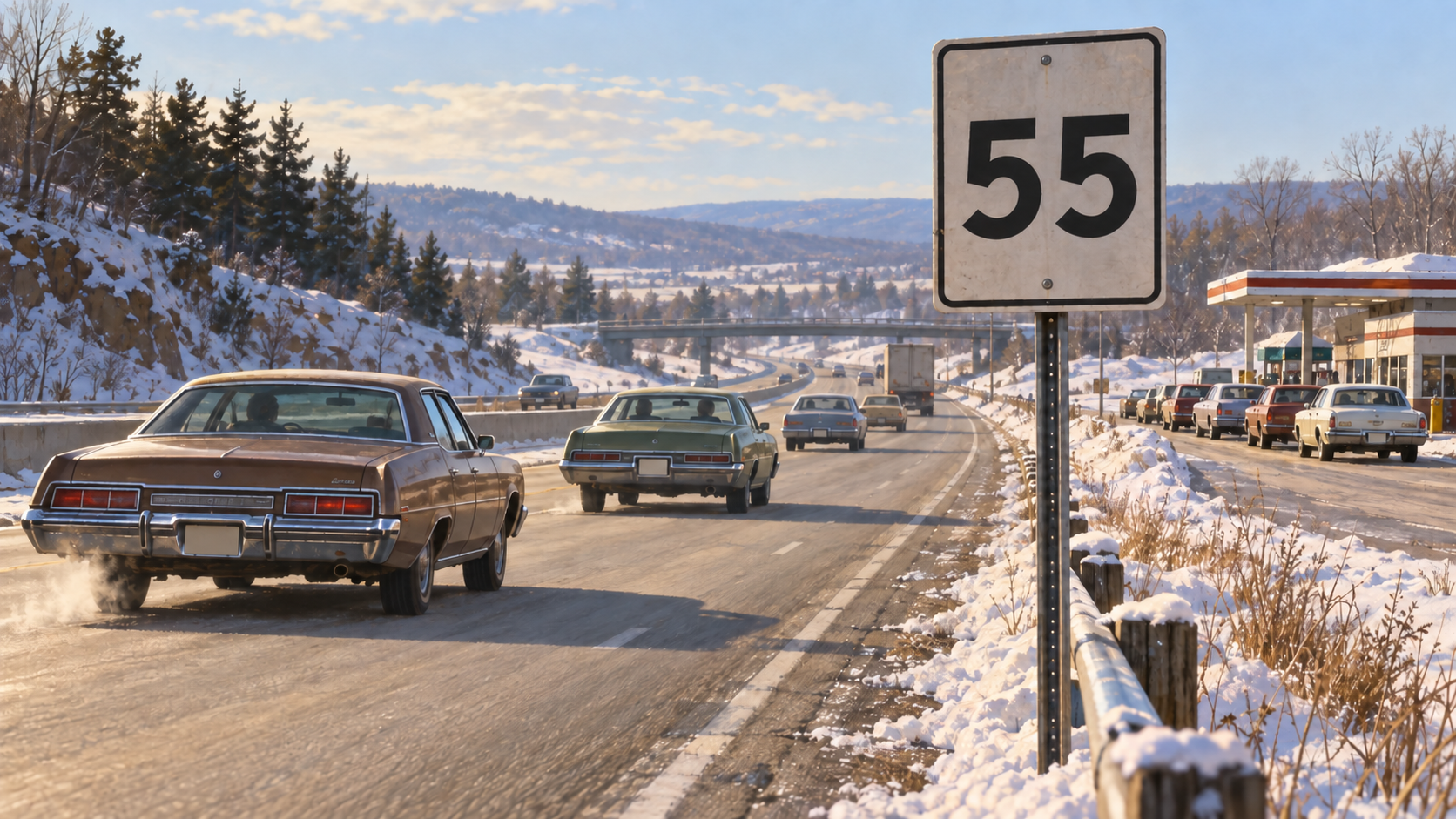
On January 2, 1974, President Richard Nixon signed the Emergency Highway Energy Conservation Act in Washington, changing how Americans drove during the national energy crisis. The law encouraged every state to set a maximum highway speed of 55 miles per hour. Because states, not the federal government, normally establish speed limits, Congress used federal highway authority as leverage: the Federal Highway Administration could not approve projects in a state whose maximum limit remained above 55. States could legally refuse, but doing so would put federal highway support at risk, and all ultimately complied.
The measure followed the 1973 Arab oil embargo and the sharp disruption of petroleum supplies that accompanied it. Motorists faced long gasoline lines, reduced station hours, higher prices, and uncertainty about whether fuel would be available. The Nixon administration promoted conservation steps that also included lower thermostats and reduced energy use by government facilities. Highway speeds became an especially visible target because vehicles generally consumed more fuel at higher speeds, and a uniform limit could be introduced more quickly than major changes to cars, public transit, or land use. New roadside signs made the conservation campaign visible on nearly every long-distance trip.
In his signing statement, Nixon presented the act as an emergency response intended to reduce gasoline and diesel consumption. The administration estimated that nationwide compliance could save nearly 200,000 barrels of fuel each day, though actual savings depended on enforcement, traffic conditions, vehicle efficiency, and driver behavior. The law did not place federal officers on ordinary roads or make every violation a federal offense. State and local governments still posted limits, issued citations, and decided how aggressively to enforce the rule. That distinction explains why the familiar national limit was functionally uniform without being a single federal traffic code.
The 55 mph rule outlasted the immediate embargo and became part of everyday American travel for more than two decades. Supporters pointed to fuel conservation and reductions in high-speed crashes, while critics objected to slower trips, uneven enforcement, and a standard that seemed poorly suited to lightly traveled rural highways. Congress allowed 65 mph on some rural interstates in 1987 and repealed the federal requirement in 1995, returning full authority to the states. The January 2 law nevertheless left a durable cultural mark, from dashboard habits to highway design debates, and demonstrated how a national emergency could reshape an ordinary activity through the conditions attached to federal funding.
The 1973 oil embargo exposed how heavily American transportation depended on imported petroleum. Gasoline shortages and price increases made fuel conservation an immediate household and government concern.
States traditionally controlled speed limits, so Congress linked the 55 mph ceiling to federal highway approvals and funding rather than creating an ordinary nationwide traffic offense enforced by federal police.
All states adopted compliant limits, making 55 mph the visible national standard. Signs changed quickly, but enforcement intensity and driver compliance varied widely across jurisdictions and road types.
Fuel savings were influenced by vehicle design, congestion, trip length, and actual speed. The policy could reduce consumption, but it could not by itself resolve the broader supply, pricing, and infrastructure problems behind the energy crisis.
The limit remained after the embargo, partly because advocates connected lower speeds with fewer severe crashes. It became one of the most recognizable federal responses to the energy shocks of the 1970s.
Congress permitted higher limits on selected rural interstates in 1987 and repealed the federal requirement in 1995. States again set their own maximums, producing the varied speed-limit map familiar today.
Explore more of "On This Day ..."
Discover more events from the same date across news, politics, technology, sports, and other fields. Each link highlights significant moments that shaped history on different fronts.