

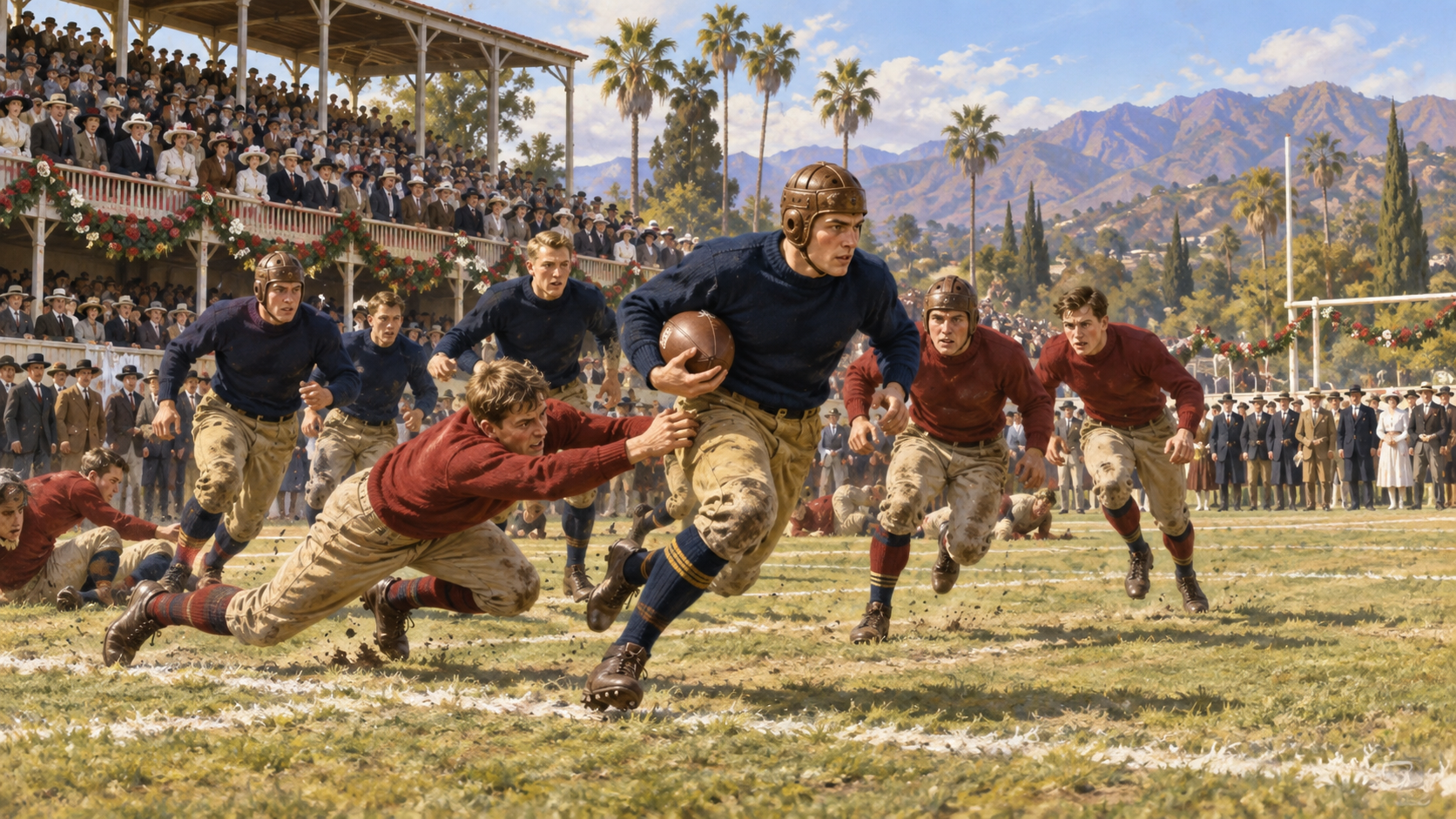
On This Day in Sports: January 2, 1922
On January 2, 1922, Washington & Jefferson College met the University of California at Tournament Park in Pasadena in a Rose Bowl game remembered for both a scoreless finish and a barrier-breaking quarterback. Charles Fremont West started for Washington & Jefferson, becoming the first Black quarterback to play in the Rose Bowl. The Presidents arrived as undefeated eastern underdogs against California’s powerful Golden Bears, who were also unbeaten. In rainy conditions, the smaller school resisted a team widely expected to win and completed a 0–0 tie, the only scoreless result in Rose Bowl history.
Washington & Jefferson enrolled only about 450 students and brought a traveling squad of seventeen players to California. Head coach Greasy Neale, who also played professional baseball, relied heavily on the same eleven players for the full game because substitution rules and roster depth offered little flexibility. California entered with a celebrated offense and the prestige of consecutive dominant seasons. West, a quarterback in the single-wing system, directed an attack that moved the ball more effectively than many observers expected while also contributing to a defense that prevented California from completing a pass.
The game turned on defense, field position, and a disputed scoring opportunity. Washington & Jefferson later recorded 114 rushing yards to California’s 49 and held the Golden Bears to two first downs. A long touchdown run by W&J halfback Wayne Brenkert was erased by an offside penalty, leaving neither team with points. The Presidents’ Russ Stein was recognized as the game’s outstanding player. Freshman Herb Kopf also made history as the first freshman to appear in the Rose Bowl. The result preserved undefeated seasons for both teams and concluded the event’s years at Tournament Park before it moved into the newly built Rose Bowl stadium.
West’s appearance carried significance beyond the final score. Black athletes faced exclusion and discrimination throughout American college sports, and opportunities at quarterback—the position most associated with directing a team—were especially restricted. West also excelled in track, became a national collegiate pentathlon champion, and was an alternate for the 1924 U.S. Olympic team. He later graduated from Howard University Medical School and practiced medicine for decades in Alexandria, Virginia. His 2017 induction into the Rose Bowl Hall of Fame gave wider recognition to a milestone that had long received less attention than the game’s unusual tie. The 1922 contest endures as a story of competitive balance, limited rosters, and a player who expanded the visible possibilities of his sport.
California was an established western power, while Washington & Jefferson was a small Pennsylvania college with an undefeated team and limited roster. The matchup was widely viewed as a test of whether the eastern underdog belonged.
The game was played at Tournament Park because the stadium now known as the Rose Bowl was not yet ready. January 1 fell on a Sunday in 1922, moving the contest to Monday, January 2.
Washington & Jefferson held California scoreless and produced more rushing yardage, but an offside call erased its best scoring play. The 0–0 finish remains the only scoreless tie in Rose Bowl history.
West’s milestone did not eliminate racial exclusion in college football. Black athletes still faced discriminatory travel, accommodation, recruiting, and positional barriers that limited opportunities long after this game.
Charles West became the first Black quarterback in the Rose Bowl and later built distinguished careers in track and medicine. The Rose Bowl inducted him into its Hall of Fame in 2017.
The game also marked the end of the event’s Tournament Park era. The next contest moved to the new Rose Bowl stadium, helping transform the postseason game into a lasting national institution.
Explore more of "On This Day ..."
Discover more events from the same date across news, politics, technology, sports, and other fields. Each link highlights significant moments that shaped history on different fronts.