

On This Day in Tech: September 7, 1927
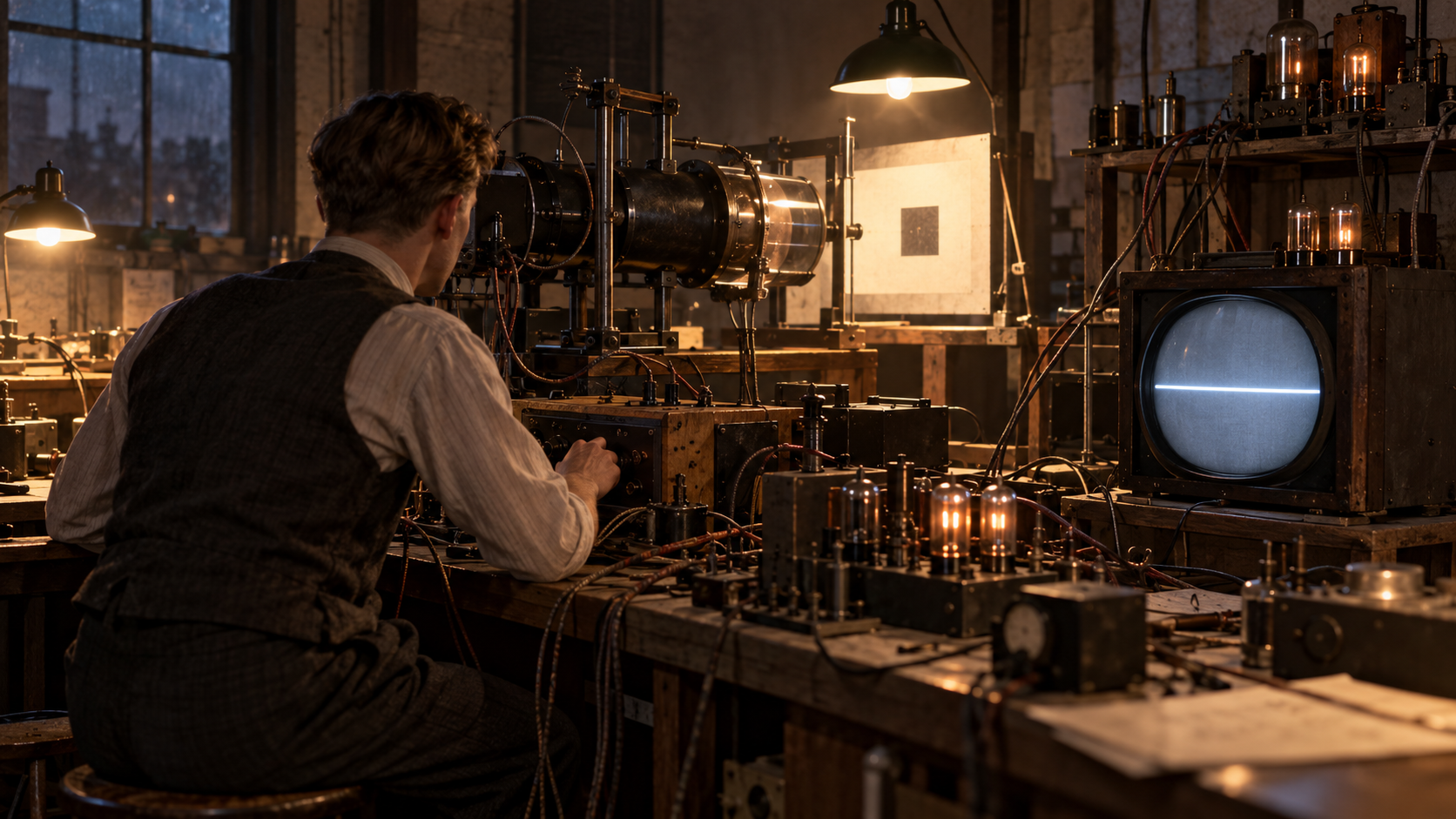
On September 7, 1927, Philo Farnsworth and his small team transmitted an image using an entirely electronic television system in a laboratory at 202 Green Street in San Francisco. The image was simple—a bright line rather than a recognizable face—but the method was revolutionary. Earlier television experiments often depended on spinning mechanical disks to scan scenes. Farnsworth’s apparatus used electronic scanning at both ends: an image-dissector camera tube converted light into an electrical signal, and a cathode-ray receiver reconstructed that signal as a visible pattern. The successful test showed that television could escape the speed and resolution limits of mechanical machinery.
Farnsworth had imagined the central idea years earlier while growing up on a farm in Idaho. Looking across straight, parallel rows in a field, he reasoned that an image might be divided into lines and sent one line at a time. As a teenager he sketched the concept for a teacher, then spent years finding financial support and turning the insight into working vacuum-tube hardware. In San Francisco, glass tubes, high-voltage supplies, amplifiers, coils, and hand-built circuits crowded the benches. The September demonstration was therefore not a flash of inspiration by itself; it was the moment a long chain of design, fabrication, and troubleshooting produced an observable result.
The experiment worked by focusing an optical image onto a photosensitive surface inside the image dissector. Electron emissions representing different parts of the scene were scanned into a changing electrical signal. That signal traveled through the laboratory’s circuits to the receiver, where an electron beam swept across a fluorescent screen in corresponding lines. Synchronization was crucial. If the scanning at the camera and display drifted apart, the image broke down. The clean line seen that day proved the chain could preserve geometry from one end to the other, establishing a foundation for more detailed moving pictures.
Farnsworth was not the only inventor pursuing electronic television, and the technology’s commercial future would be shaped by patents, corporate laboratories, manufacturing, and standards battles. Yet the Green Street test remains a defining engineering milestone because it demonstrated a complete electronic path from camera to display. Modern screens no longer use Farnsworth’s exact tubes, but they still turn images into ordered signals and reconstruct them as controlled fields of light. On September 7, a modest laboratory image made that architecture real. It transformed television from a collection of partial inventions into a functioning electronic system.
The first successful laboratory image was a simple bright line. The goal was not entertainment-quality detail but proof that the system could preserve and reproduce a controlled visual pattern electronically.
Farnsworth’s team soon moved to more complex shapes and motion. Each improvement tested whether the camera tube, amplifiers, synchronization, and receiver could work together reliably.
The image dissector was Farnsworth’s electronic camera tube. It translated light from different parts of an optical image into a time-varying electrical signal that could be amplified and transmitted.
Its importance was the absence of a rotating scanning disk. Electronic scanning promised faster operation, finer pictures, and a more practical route to future broadcasting.
No single person created every part of television. Researchers in several countries developed scanning methods, camera tubes, receivers, amplifiers, and broadcasting systems over decades.
Farnsworth’s distinctive achievement was demonstrating a complete all-electronic camera-to-display system in 1927. His work became central to both television engineering and later patent disputes.
Explore more of "On This Day ..."
Discover more events from the same date across news, politics, technology, sports, and other fields. Each link highlights significant moments that shaped history on different fronts.