

On This Day in Tech: October 2, 1955
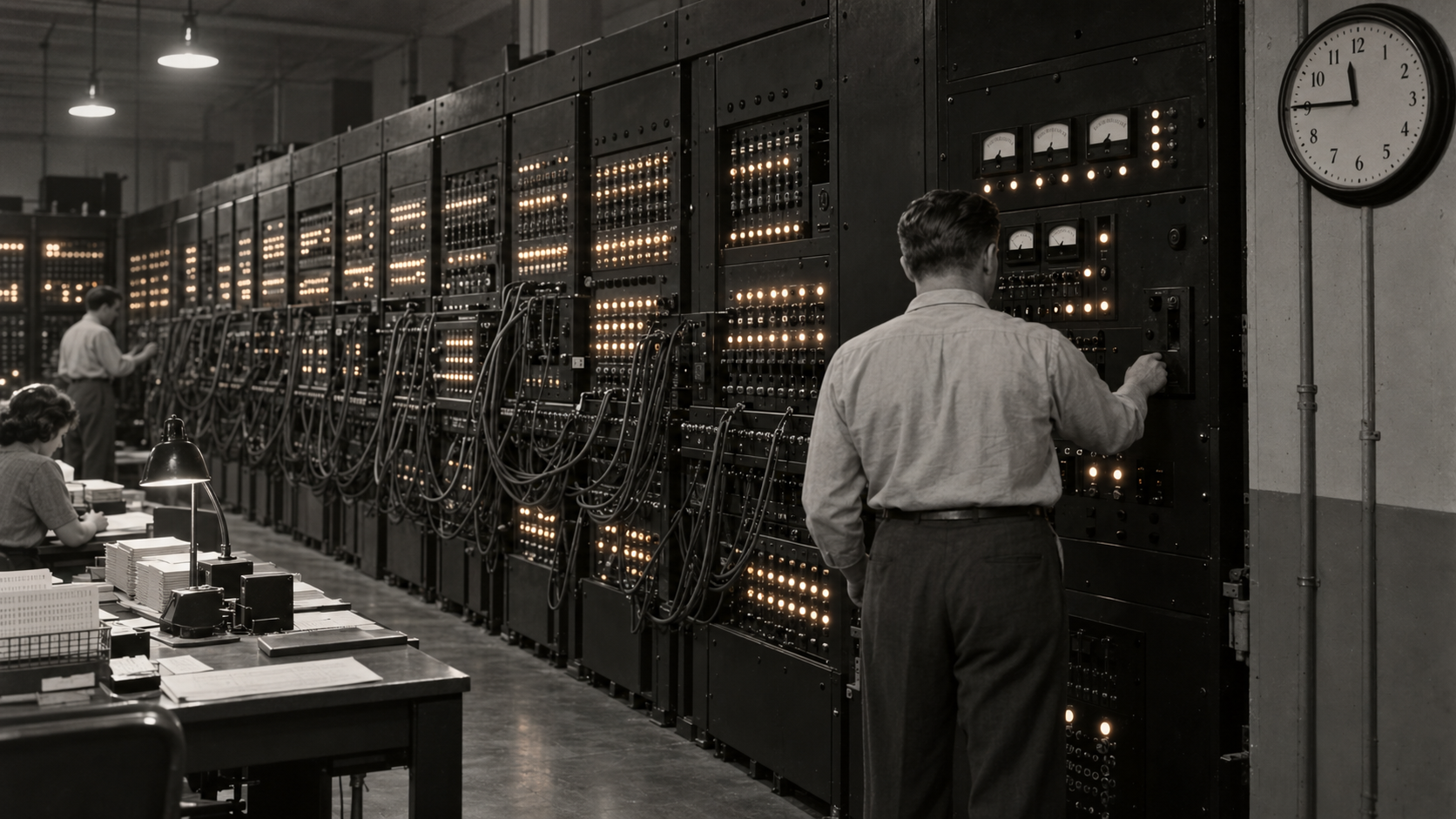
At 11:45 p.m. on October 2, 1955, electrical power was removed from ENIAC for the final time at the U.S. Army’s Ballistic Research Laboratory at Aberdeen Proving Ground, Maryland. The shutdown ended the working life of a machine that had helped establish electronic digital computing as a practical tool. Designed by J. Presper Eckert and John Mauchly at the University of Pennsylvania’s Moore School, ENIAC had been unveiled publicly in February 1946. It was moved to Aberdeen in 1947, where Army teams used it for ballistics, weapons research, weather-related calculations, and other demanding numerical problems.
ENIAC was enormous by later standards. Its cabinets occupied a large room, drew substantial electrical power, and contained roughly eighteen thousand vacuum tubes along with switches, relays, counters, and miles of wiring. The machine represented decimal numbers rather than using the binary arithmetic common in later computers, and its electronic circuits could perform thousands of additions each second. Early programs were configured with switches and patch cables, a process that could take days. A later conversion allowed instructions to be read from function tables, making the computer easier to reprogram and bringing it closer to a stored-program style of operation.
The computer did not remain frozen in its original design. Engineers installed an electronic shifter in 1952 and added a one-hundred-word magnetic-core memory in 1953, extending its usefulness. Even with those improvements, newer machines such as EDVAC and ORDVAC offered more efficient operation. ENIAC remained capable and reportedly achieved about one hundred hours of trouble-free service per week during its final years, but its operating costs were high. The laboratory gradually transferred its workload to newer systems until the veteran machine was no longer economically competitive. Its final shutdown was therefore a planned retirement, not a sudden failure.
Parts of ENIAC were preserved rather than allowing the entire system to disappear. Sections entered collections at the Smithsonian, the U.S. Military Academy, the University of Pennsylvania, and other institutions, where their dense panels and patch cords continue to show the physical scale of early electronic computation. The machine’s legacy extends beyond its hardware. The programmers and operators who translated mathematical problems into working configurations developed methods that helped define the emerging profession of programming. When ENIAC went dark on October 2, it closed one chapter of computing history while demonstrating how rapidly the field it helped create had already advanced. Its long service life also validated electronic computing under sustained operational demands.
ENIAC was designed at the University of Pennsylvania for U.S. Army ballistics work. After its 1946 public unveiling, it moved to Aberdeen Proving Ground and entered regular service in 1947.
At 11:45 p.m. on October 2, 1955, staff removed power from ENIAC for the final time after its workload had shifted to newer computers.
Thousands of vacuum tubes and a room-sized network of panels enabled electronic calculations far faster than earlier methods, but demanded great amounts of power, maintenance, and space.
Upgrades included an electronic shifter and magnetic-core memory. Even so, EDVAC and ORDVAC eventually handled Army work more efficiently and made ENIAC too costly to operate.
ENIAC proved that large electronic digital machines could solve practical scientific and military problems. Its programmers also pioneered techniques for turning mathematical procedures into machine operations.
Preserved sections at museums and universities make the machine's scale tangible today. Its retirement showed how quickly computer architecture was advancing only a decade after its debut.
Explore more of "On This Day ..."
Discover more events from the same date across news, politics, technology, sports, and other fields. Each link highlights significant moments that shaped history on different fronts.