

On This Day in Tech: October 28, 1971
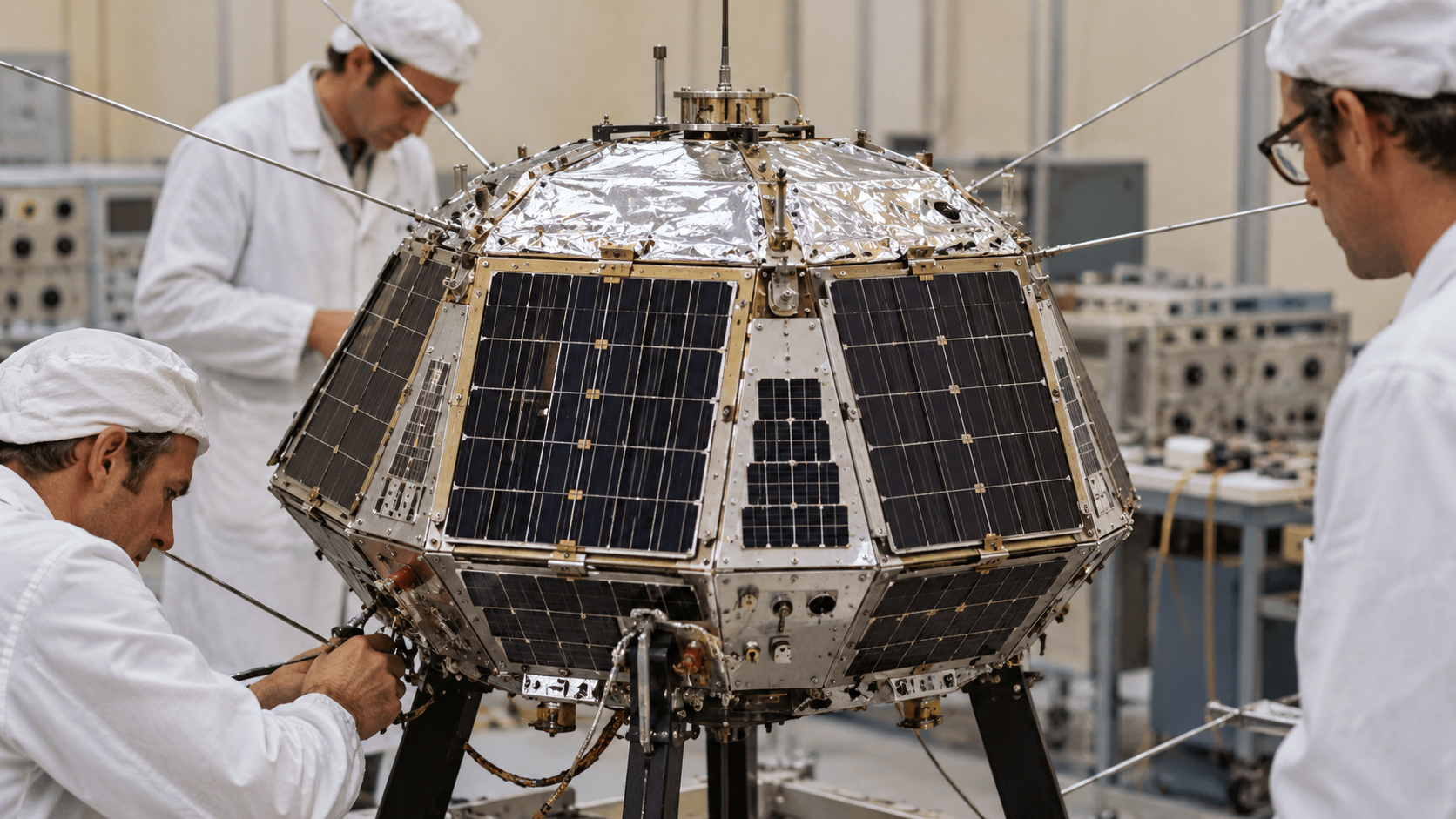
On October 28, 1971, the British satellite Prospero reached Earth orbit after launching from Woomera in South Australia aboard a Black Arrow rocket. It was the first successful orbital launch of a British satellite by a British-built launch vehicle. Britain had already participated in satellite missions using other countries’ rockets, so the distinction concerns the launcher as well as the spacecraft. The flight joined the work of government research establishments and industrial teams in a complete orbital mission. Its success demonstrated a domestic launch capability, but it did not begin a continuing series of Black Arrow satellite launches: the program had already been cancelled.
Prospero was a compact technology-development satellite rather than a communications platform carrying television broadcasts or telephone traffic. Its experiments examined equipment and materials intended for spacecraft, including solar cells, surface finishes, and electronics. Operating such hardware in orbit supplied evidence that ground tests could not reproduce completely. Sunlight, temperature changes, radiation, vacuum, and small-particle impacts created a demanding environment. The spacecraft needed to obtain electrical power, keep equipment within workable conditions, and return useful information by radio. These apparently supporting functions were central to the mission because an experiment could produce value only if the surrounding spacecraft continued to operate well enough to report its results.
The Black Arrow launch required several stages to work in sequence, with guidance, propulsion, separation, and final acceleration placing the payload on an orbital trajectory. Earlier test flights had produced a mixed record, making the successful Prospero mission a significant engineering result. The launch took place at an Australian range rather than from British territory, another distinction sometimes lost in shortened accounts. Ground tracking and communications were part of the wider mission infrastructure. Reaching orbit was not just a matter of climbing high above the atmosphere; the rocket had to give the satellite sufficient sideways speed to continue falling around Earth rather than promptly returning to the surface.
Preserved Black Arrow hardware and a Prospero flight spare now help museums explain the program’s design and historical context. A flight spare is a related engineering artifact, not the spacecraft that remained in orbit, and museum displays should be identified accordingly. The October success stands at an unusual intersection of technical achievement and policy: a vehicle demonstrated orbital capability after the decision to end its development. October 28 therefore records both a distinctive British space milestone and a reminder that successful engineering does not by itself guarantee a continuing program. Funding, institutional priorities, launch demand, and international alternatives help determine which demonstrated technologies become sustained services and which survive mainly through their hardware, records, and influence.
Prospero reached orbit on October 28, 1971, from Woomera in Australia. A British-built Black Arrow launched the British satellite.
Earlier British satellites had flown on other launchers. The milestone concerns this particular combination of spacecraft and national launch-vehicle capability.
The satellite tested space technology and materials. Power, thermal behavior, electronics, and radio operations supported those experiments.
Orbital flight required staged propulsion and sufficient sideways velocity. Simply reaching a high altitude would not have accomplished the mission.
The program had already been cancelled before the successful flight. The achievement did not lead to a continuing Black Arrow orbital service.
Museum hardware and a flight spare preserve the engineering story. Technical success and the policy decision to sustain a program are separate matters.
Explore more of "On This Day ..."
Discover more events from the same date across news, politics, technology, sports, and other fields. Each link highlights significant moments that shaped history on different fronts.