

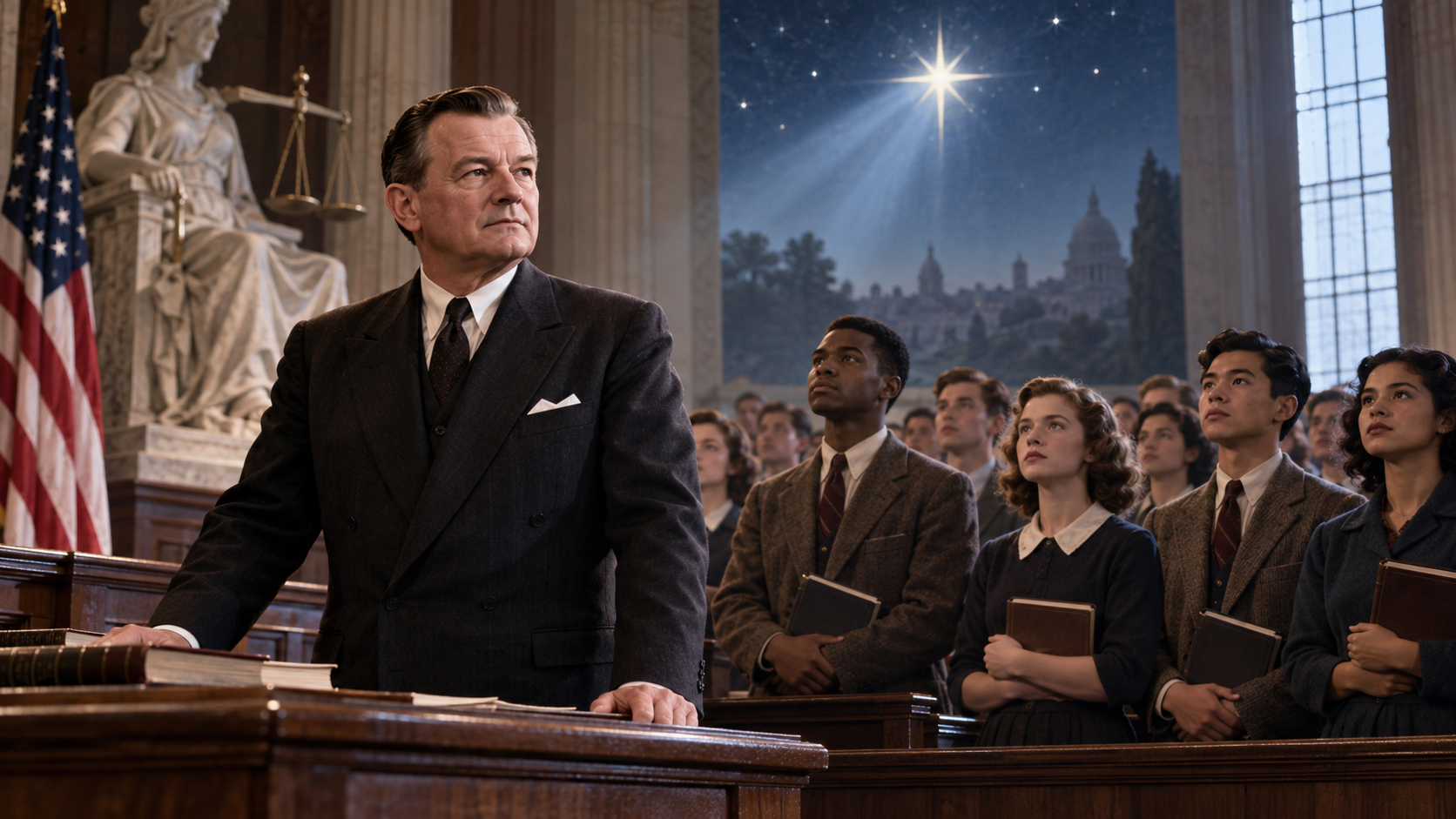
“If there is any fixed star in our constitutional constellation, it is that no official, high or petty, can prescribe what shall be orthodox.”
Justice Robert H. Jackson wrote these words for the Supreme Court in West Virginia State Board of Education v. Barnette in 1943. The case involved Jehovah’s Witness schoolchildren whose religious convictions prevented them from saluting the American flag. West Virginia required the salute and treated refusal as insubordination. The Court reversed a decision it had made only three years earlier and held that government could not force students to declare a belief. Jackson’s “fixed star” passage continued beyond the familiar excerpt, listing politics, nationalism, religion, and other matters of opinion as fields where officials cannot compel citizens to confess an approved faith.
The opinion concerns compelled expression, not a general rule that every institution must distribute every message. Schools, employers, and newsrooms make legitimate decisions about conduct and content. The constitutional issue was the state using legal authority to prescribe belief and punish refusal. For journalism, that distinction is essential when reporting disputes over patriotism, protest, education, and public employment. A story should identify whether a policy regulates action, requires an affirmation, or suppresses a viewpoint. Treating those categories as interchangeable can obscure the actual legal and civic stakes.
The quotation remains powerful because official narratives often arrive wrapped in symbols that make disagreement look like disloyalty. Reporters serve the public by examining the law, hearing from people subject to it, and refusing to equate criticism with rejection of the community itself. The decision also demonstrates that institutions can correct serious error; the Court openly displaced its recent precedent. That history encourages journalism to record changes in reasoning, not just outcomes. Freedom of conscience is most visible when the protected view is unpopular. Jackson’s fixed star is a reminder that democratic unity cannot safely be manufactured by forcing everyone to speak as though they agree.
Jackson’s prohibition on official orthodoxy provides a precise lens for stories about compelled speech, loyalty requirements, education policy, and symbolic protest. The central reporting question is not whether a belief is admirable, but whether government is using its authority to force affirmation or punish dissent. Coverage should identify the exact rule, the sanction attached to it, the people subject to it, and the constitutional arguments on each side. It should also distinguish state compulsion from criticism by private citizens, because disagreement and legal coercion are not interchangeable. Jackson’s language does not remove institutions’ ability to set conduct standards, nor does it make every claimed belief immune from neutral laws. Its relevance lies in demanding careful boundaries. Journalism can clarify those boundaries by quoting the operative policy, tracing how it is enforced, and resisting vague culture-war labels. That gives readers a factual basis for judging when public authority has moved from governing conduct to prescribing belief.
The Barnette family and other Jehovah’s Witnesses challenged a mandatory school flag salute. The Court ruled during World War II, when public pressure for national conformity was exceptionally strong.
Jackson did not say that rules or shared civic institutions are illegitimate. The boundary was compelled affirmation: government may not force citizens to profess an approved opinion as the price of ordinary participation.
The case guides reporting on loyalty tests, protest, classroom speech, and official messaging. Precise coverage separates compelled belief from ordinary disagreement and shows who has the power to impose consequences.
Explore more "Quotes of The Day"
Discover more notable quotes from influential voices across politics, science, business, technology, sports, and culture. Each quote offers insight into how ideas, beliefs, and decisions shape the world around us.