

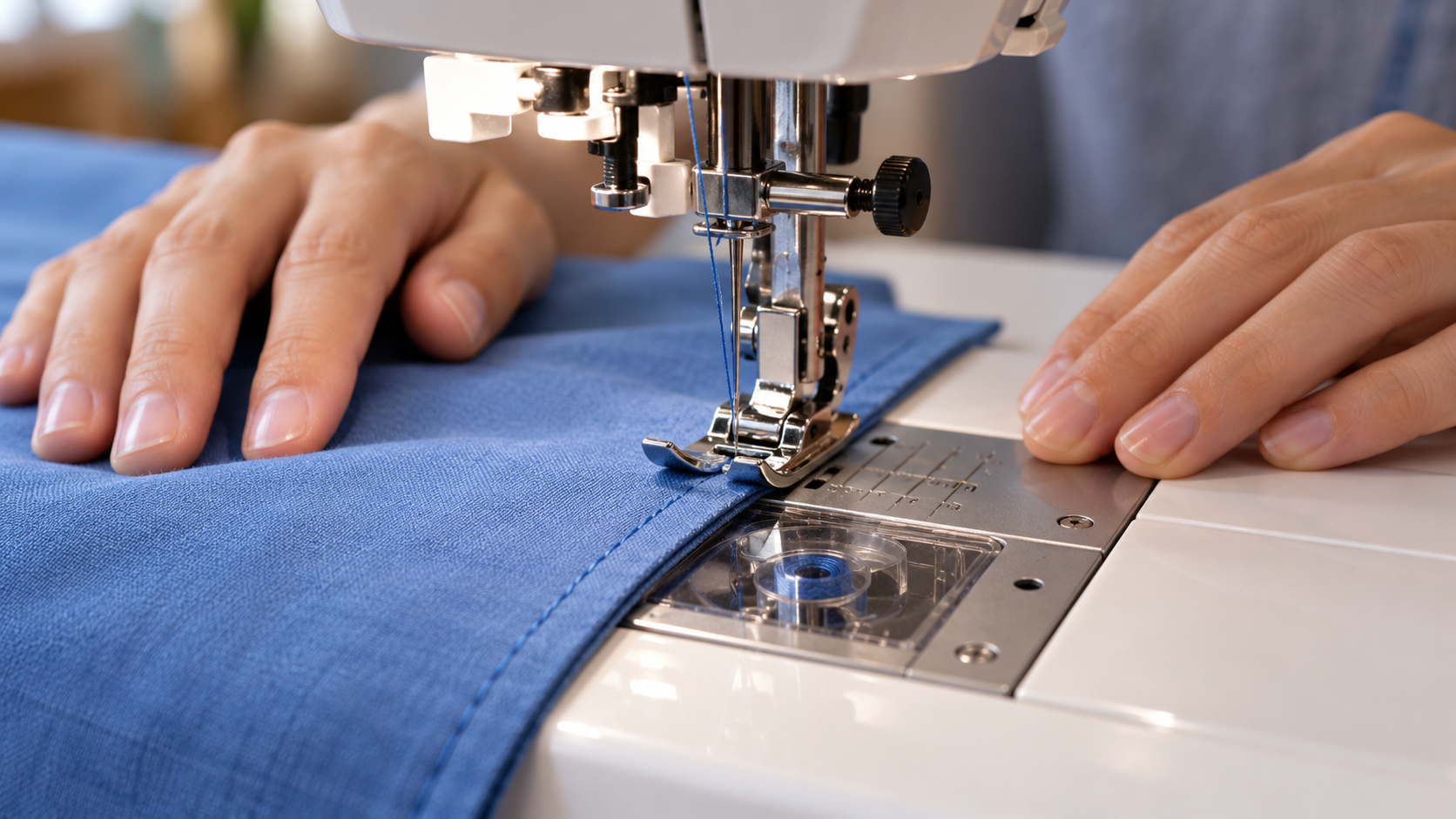
Sewing Machine Lockstitch Explainer
A lockstitch sewing machine joins fabric with two threads. The needle carries the upper thread down through the material. As the needle begins to rise, friction with the fabric helps a small loop form behind it. A rotating or oscillating hook catches that loop and carries it around the bobbin case, enclosing the lower thread. The take-up lever then pulls excess upper thread back, tightening the interlock so it settles between the fabric layers. Repeating the timed motion creates the familiar straight stitch with one thread visible mainly on each side.
Several parts must arrive at precise positions. The needle bar moves vertically while the hook passes close to the needle just after its lowest point. If the hook arrives too early, too late, or too far away, it misses the loop and produces skipped stitches. The needle has a specific orientation and scarf that provide clearance for the hook. A bent, dull, incorrectly inserted, or unsuitable needle can disturb the loop even when the machine timing is correct. Needle size and point style should match the fabric and thread rather than being selected only by habit.
Thread tension determines where the interlock sits. The upper thread passes between tension discs and through guides and the take-up lever. The bobbin thread leaves its case under a smaller spring tension. Balanced tension pulls the knot into the middle of the material. Loops on the underside often indicate incorrect upper threading rather than a defective bobbin, while bobbin thread appearing strongly on top can reflect excessive upper tension or weak lower control. Threading should be redone with the presser foot raised so the upper thread can enter the opened tension discs.
The presser foot holds fabric against the feed dogs, toothed bars that rise through the needle plate, move the material one stitch length, drop, and return. The feed dogs advance after the needle leaves the fabric, preventing the needle from bending as cloth moves. A stitch-length control changes that travel. Pulling fabric from behind can defeat the synchronized feed and damage the needle; guiding with light hands lets the machine move the layers. Specialized feet and differential-feed systems solve other tasks, but the basic lockstitch still depends on controlled pressure and timing.
A machine that nests thread, breaks it, or skips should be stopped before force makes the problem worse. Reinsert or replace the needle, rethread both paths using the manual, confirm the bobbin direction, remove lint, and test on a scrap of the same layered fabric. Wrong thread size, damaged spool edges, burrs, dense seams, and inadequate presser-foot pressure can all matter. Internal timing, electrical work, and persistent mechanical resistance require qualified service. Oil should be applied only where the model instructions specify because many modern machines have sealed bearings.
The lockstitch is strong and tidy because neither thread has to pass completely through the workpiece. The upper loop temporarily expands around the bobbin assembly and then contracts, placing the crossing inside the seam. This also explains why the machine needs two correctly threaded supplies and why one loose path produces trouble on the opposite side. What appears to be a single needle punching a line is actually a coordinated cycle of loop formation, hook capture, bobbin enclosure, take-up, fabric feeding, and tension balancing repeated many times each second.
A lockstitch forms when the needle’s upper-thread loop passes around the bobbin thread and tightens between fabric layers. Key terms include needle, hook, bobbin, bobbin case, take-up lever, tension discs, presser foot, feed dogs, and timing.
Large underside loops often mean the upper thread missed a guide or the tension discs. Rethread with the presser foot raised, check the needle, and test before adjusting internal timing.
No. Feed dogs move the fabric in time with the needle. Pulling can bend the needle, distort stitch length, and strain the mechanism; guide lightly while the machine feeds.
Explore more "Explainers"
Discover additional explainers across politics, science, business, technology, and other fields. Each explainer breaks down a complex idea into clear, everyday language—helping you better understand how major concepts, systems, and debates shape the world around us.