

Electronic Paper Explainer
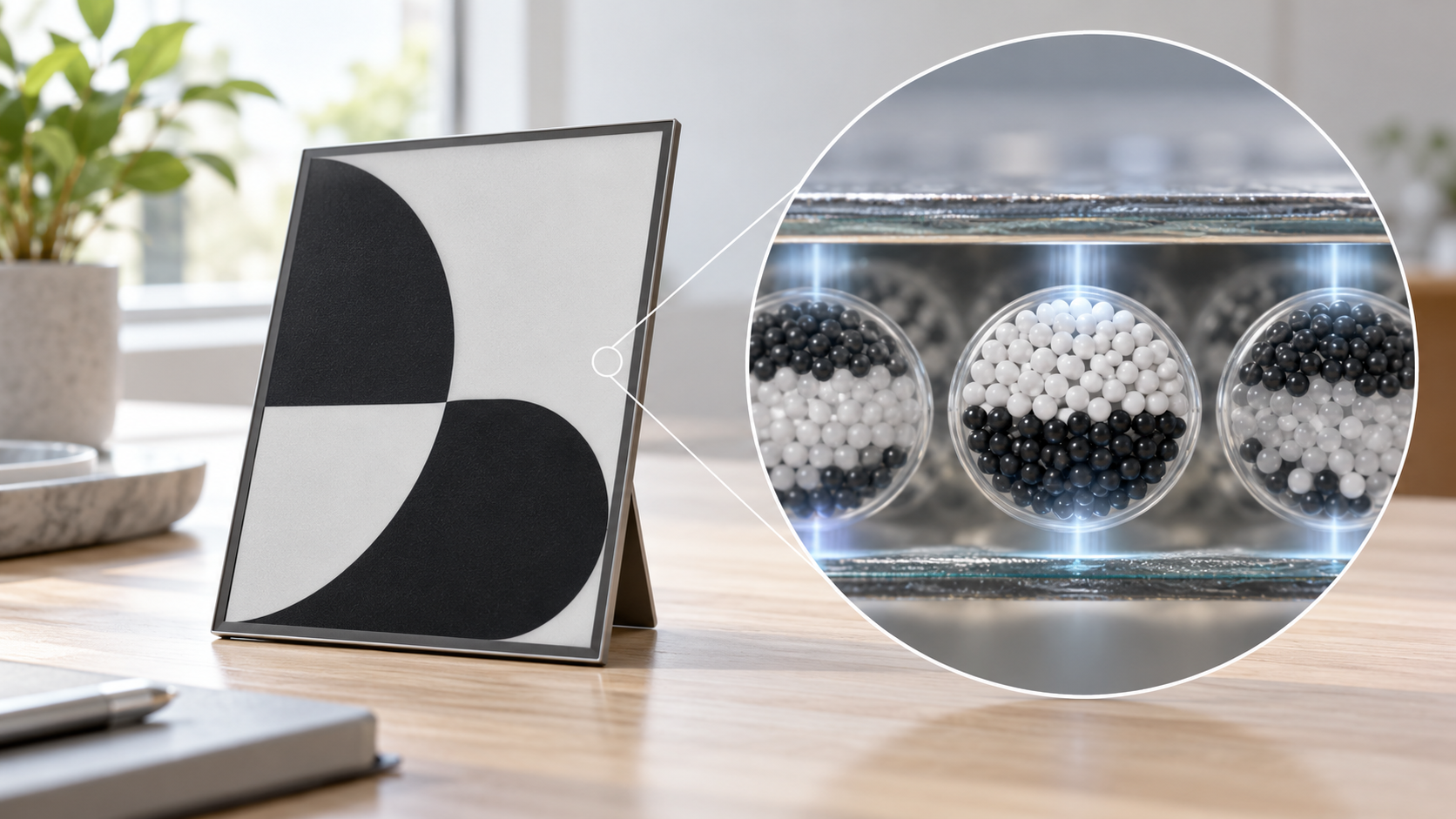
Electronic paper is a reflective display technology designed to resemble ink on a physical surface and retain an image with very little continuing power. In a common electrophoretic design, each pixel area contains microscopic capsules or cells filled with fluid and differently charged pigment particles. Applying an electric field moves selected particles toward the viewing surface and others away from it. The particles near the top determine whether that region appears light, dark, or—in color systems—one of several available tones.
The display stack includes a backplane of thin-film transistors that addresses the pixel electrodes. A controller sends waveforms with carefully timed voltage sequences rather than a single simple pulse. The sequence moves pigments while compensating for their previous state, temperature, and desired new shade. A front electrode and optical layers complete the field path, while the viewer sees ambient light reflected by the pigments. Unlike an LCD, ordinary electronic paper does not need a continuously illuminated backlight to keep the image visible.
Its low static power comes from bistability. After the particles reach a stable arrangement, they remain there when the field is removed, so the page can hold text or a graphic without refreshing every frame. Energy is mainly used when content changes, along with the device’s processor, wireless connection, lighting, and touch system. This makes electronic paper effective for e-readers, shelf labels, signs, and dashboards that change occasionally and must remain readable for long periods.
Changing an image is slower and more complex than driving a conventional display. Pigment particles move physically through fluid, and their response varies with temperature and recent history. A full refresh can use a sequence that clears residual charge and reduces ghosting, sometimes producing visible flashes. Partial refreshes update faster and with less disturbance but may leave faint remnants after repeated use. Controllers balance speed, contrast, gray levels, and accumulated artifacts through waveform design.
Color electronic paper can add colored pigments, layered filters, or other optical arrangements. More particle states and filtering increase control complexity and may reduce brightness, saturation, or refresh speed compared with emissive screens. Front lights can illuminate the reflective surface in darkness, but they are separate from the image-retention mechanism. Direct sunlight often improves perceived readability because the display uses reflected rather than competing emitted light, while rapidly animated video remains a poor fit for many electrophoretic panels.
Electronic paper is not completely powerless and does not preserve an image forever under every condition. Leakage, temperature extremes, material behavior, and controller policy may eventually require maintenance updates. The surrounding electronics can consume more energy than the panel during networking or computation, and physical impact can damage a thin display. Designers choose it when readability and static efficiency matter more than high frame rate or vivid luminous color. The essential mechanism is persistent particle placement: electric fields arrange charged pigments to form a page, and the material’s stable states keep that page visible after the driving voltage stops.
Temperature sensing helps the controller choose a waveform because cold fluid slows particle motion and heat changes response. A sequence tuned for room temperature may leave poor contrast or more ghosting outdoors. Panel makers characterize combinations of pigments, electrodes, timing, and temperature, then provide waveform tables for supported update modes. Product designers must match the controller and panel generation rather than assume any voltage pattern will work. This calibrated drive system explains how a seemingly simple black-and-white page can produce repeatable gray levels while preserving the bistable behavior that makes electronic paper efficient.
Long-lived signs also schedule occasional full refreshes so contrast remains consistent as weather and displayed content change over time.
Electronic paper moves charged pigment particles within microscopic capsules or cells, then relies on stable particle positions to hold the image. Key terms include electrophoresis, pigment, charge, capsule, electrode, backplane, waveform, reflective display, bistability, ghosting, partial refresh, and front light.
The pigment particles settle into stable positions that do not require a continuous electric field. Power is used mainly to rearrange them during an update, although the device’s other electronics may still consume energy.
A full refresh can drive pixels through clearing and balancing states to reduce retained charge and ghost images. Faster partial updates use shorter waveforms but may accumulate visible remnants over time.
Explore more "Explainers"
Discover additional explainers across politics, science, business, technology, and other fields. Each explainer breaks down a complex idea into clear, everyday language—helping you better understand how major concepts, systems, and debates shape the world around us.