

On This Day in Lifestyles: January 25, 1915
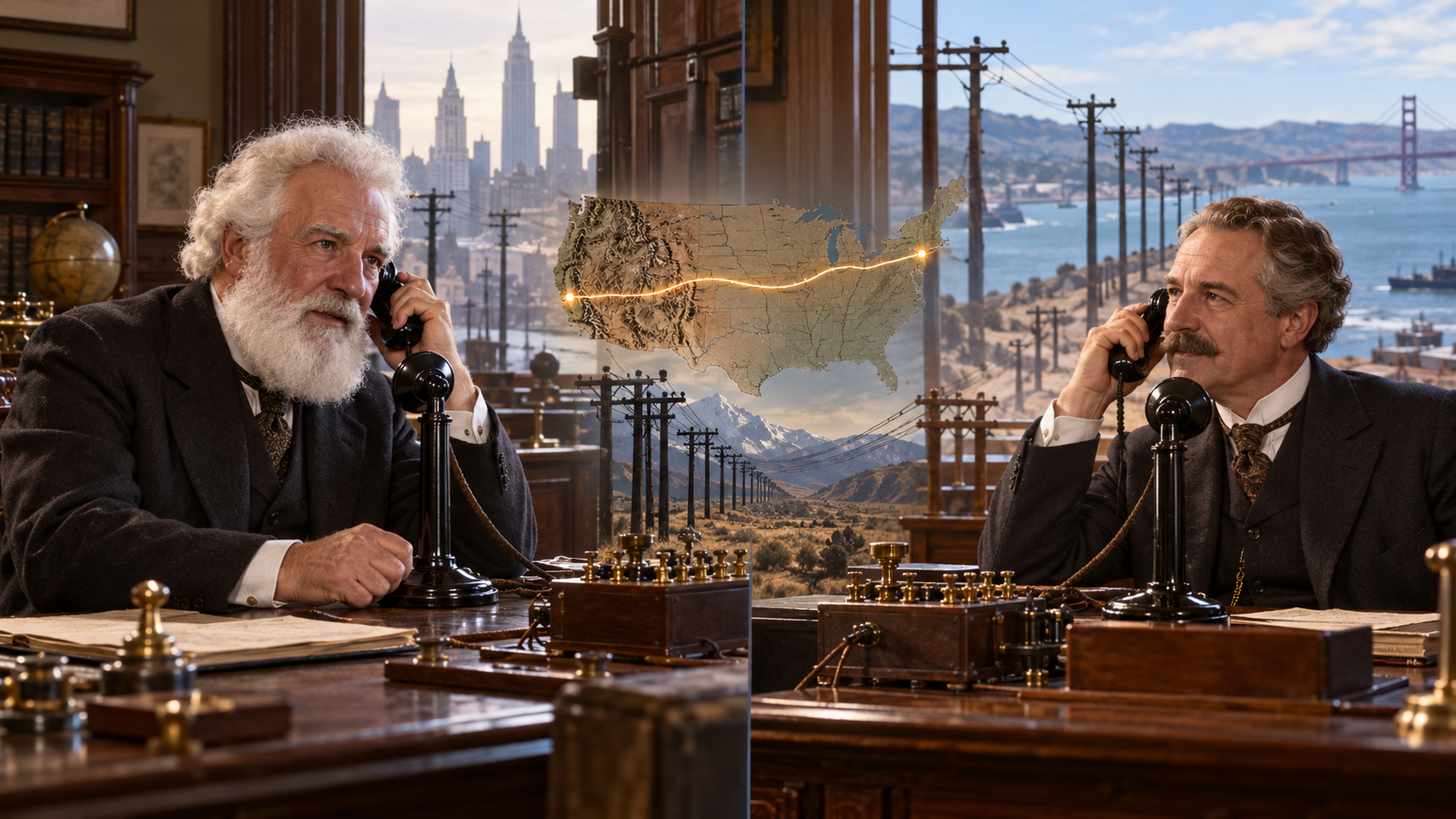
On January 25, 1915, Alexander Graham Bell in New York spoke with his former assistant Thomas Watson in San Francisco during the first ceremonial transcontinental telephone call. Bell repeated the famous words from their 1876 experiment, asking Watson to come to him. Watson answered that it would now take about a week. The playful exchange marked an enormous technical leap: a voice could travel roughly 3,400 miles through a connected network of wires, amplifiers, switchboards, and human operators.
The call celebrated a line completed after years of engineering work by the Bell System. Long-distance signals weakened as they traveled, so practical coast-to-coast service depended on loading coils, improved cables, and vacuum-tube repeaters that amplified speech. The event linked several locations. President Woodrow Wilson spoke from Washington, D.C., and Theodore Vail, the president of American Telephone and Telegraph, joined from Georgia. Operators coordinated the connections, reminding listeners that early telephone service was a carefully managed human system as well as a technological achievement.
At first, transcontinental calling was not an everyday convenience. A three-minute conversation cost far more than most workers earned in a day, and users had to arrange calls through operators. Yet the demonstration changed expectations. Families, businesses, newspapers, and government offices could imagine conversations crossing a continent faster than a train or letter. As networks expanded and prices gradually fell, the telephone became a fixture of domestic life. Its ring could carry family news, medical help, travel plans, business decisions, and emergency messages directly into the home.
The habits created by long-distance telephony still shape life in an age of mobile phones and video calls. People expect distant voices to arrive instantly and treat geography as less of a barrier to relationships and work. The infrastructure has changed from copper wire and manual switchboards to fiber optics, satellites, and wireless networks, but the social promise remains familiar: connection across distance. On this day, a carefully staged conversation between two old colleagues made a vast country feel smaller and offered a preview of the connected life that followed. The achievement depended on thousands of workers who installed lines, operated switchboards, maintained equipment, and guided each connection. Their often-invisible labor turned invention into dependable service. As the network grew, etiquette grew with it: people learned how to answer, identify themselves, keep conversations brief, and share a household telephone with others. These conventions helped turn a remarkable connection into a predictable part of social life.
Alexander Graham Bell spoke from New York with Thomas Watson in San Francisco, recreating words from their earliest telephone experiment.
President Woodrow Wilson and AT&T president Theodore Vail also participated from other locations.
Long-distance speech weakened over wire, requiring improved circuits and repeaters to carry a usable signal across the continent.
Operators and switching centers coordinated the route, making the network both a technical and human system.
Early transcontinental calls were expensive and had to be arranged, placing them beyond ordinary routine for most households.
Falling costs and expanding networks eventually made long-distance conversation central to family, business, and emergency communication.
Explore more of “This Day in Lifestyles”
Discover more moments in everyday life, design, education, travel, food, fashion, and culture. Each story connects a calendar date with an event that changed how people lived.