

Spatial Audio Direction Explainer
Spatial audio creates the impression that sound comes from particular directions, distances, or heights rather than from a flat left-right line. The system works by recreating cues that human hearing already interprets. A sound arriving from the right reaches the right ear slightly earlier and often louder than the left. The head and outer ears also filter frequencies according to angle. Reflections provide information about room size and distance. Loudspeakers or headphones reproduce carefully controlled versions of these differences so the brain assigns each sound an apparent location.
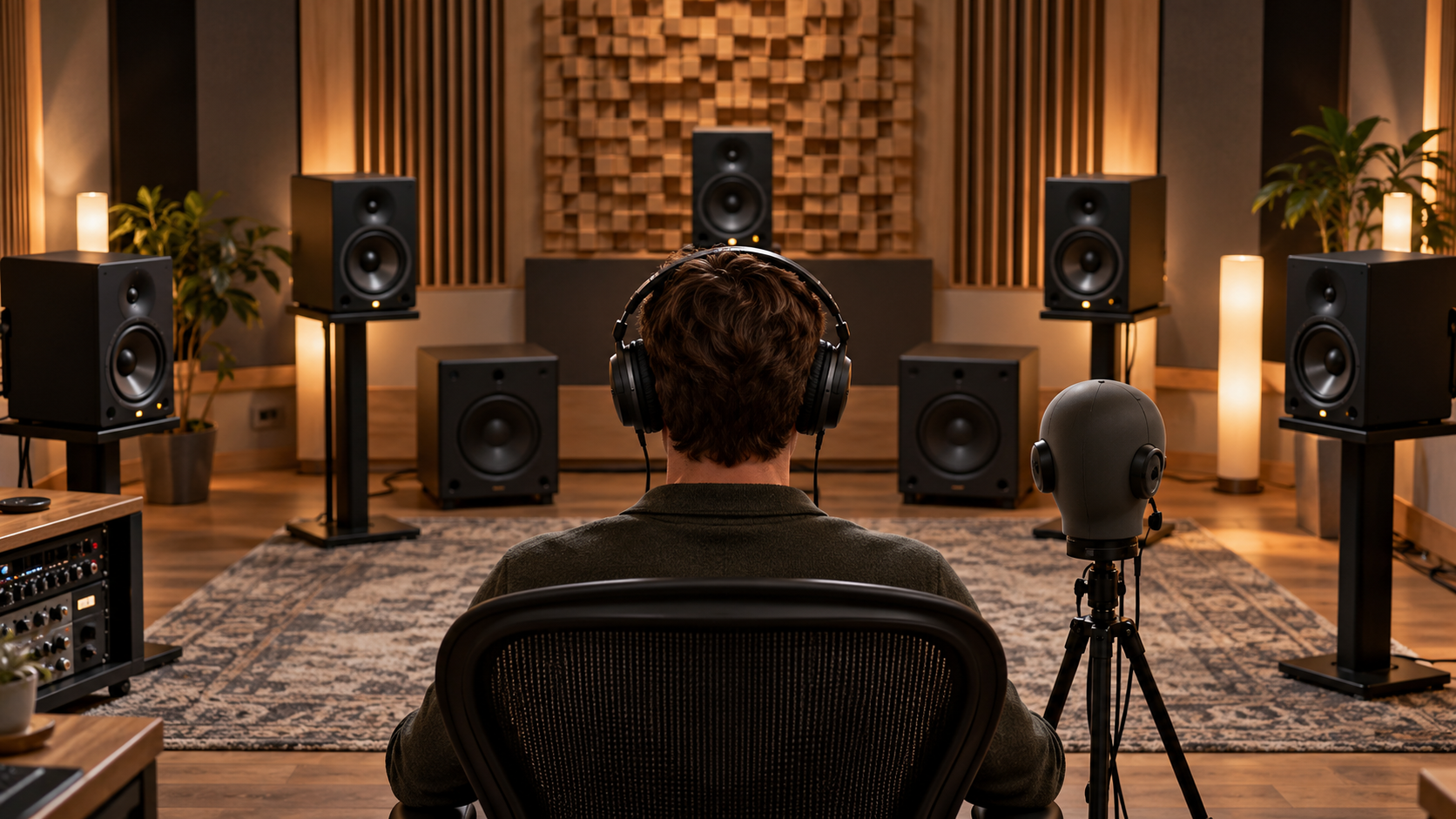
With multiple speakers, a renderer sends different amounts of a sound to physical positions around the listener. Two neighboring speakers can form a phantom source between them when their timing and level are balanced. Surround and height speakers extend the available directions. Object-based formats store a sound and its intended position separately from a fixed channel mix. During playback, the renderer maps each object to the actual speaker layout, allowing one production to adapt to a theater, soundbar, or home system.
Headphones require another method because each ear normally hears only the nearby driver. Binaural rendering filters a sound with a head-related transfer function, or HRTF. That filter models the delays and frequency changes caused by the listener’s head, torso, and outer ears for a particular direction. Crossfeed, reflections, and distance cues help place the apparent source outside the head. Generic HRTFs work better for some listeners than others because ear shape and head size vary. Personalized measurements or ear scans can improve localization.
Elevation is especially dependent on spectral cues from the folds of the outer ear. A filter creates direction-specific peaks and notches that the auditory system has learned to associate with above, below, front, or rear. Front-back confusion can occur when a generic filter produces similar cues for two directions. Small head movements normally resolve that ambiguity in real life. Systems with head tracking update the rendering as the listener turns, keeping a virtual source fixed in the room instead of rotating with the headphones.
Distance is not a single volume control. A nearby source may have a high ratio of direct sound to reflections and different high-frequency content, while a distant source includes more room reverberation and less precise direction. Renderers combine level, delay, early reflections, reverberation, and sometimes air-absorption models. Soundbars use several drivers, wall reflections, and digital beamforming to create virtual positions from the front of a room. Their effectiveness depends strongly on seating and room geometry.
Spatial audio does not guarantee an accurate image in every environment. Speaker placement, phase, room reflections, listener position, hearing differences, and headphone fit all influence the result. Downmixing may preserve some cues while losing others. Excessive processing can make timbre unnatural or smear transients. Production engineers monitor on several systems and use metadata to define how objects should behave when the playback layout is smaller than the original mix.
The illusion succeeds because the renderer controls evidence rather than drawing an audible coordinate grid. It calculates what each ear would receive from a source at the requested position, then delivers those waveforms through speakers or headphones. Timing and level dominate horizontal location; outer-ear filtering supports elevation and front-back judgment; reflections and direct-to-reverberant balance suggest space. Head tracking makes the scene stable during movement. The brain combines those cues and supplies the experience of a sound existing beyond the hardware that produced it.
Spatial audio uses timing, level, and filtering cues to make sound seem to come from positions around a listener. It can be used with headphones, speakers, games, and immersive video.
Processing changes what each ear or speaker receives so the brain recognizes familiar differences between sounds arriving from different directions. Head tracking can update those cues as a listener turns.
Headphones, room acoustics, source mixing, and individual ear shape all influence how convincing spatial audio feels. The effect can be subtle when the original recording has little positional information.
Explore more "Explainers"
Discover additional explainers across politics, science, business, technology, and other fields. Each explainer breaks down a complex idea into clear, everyday language—helping you better understand how major concepts, systems, and debates shape the world around us.