

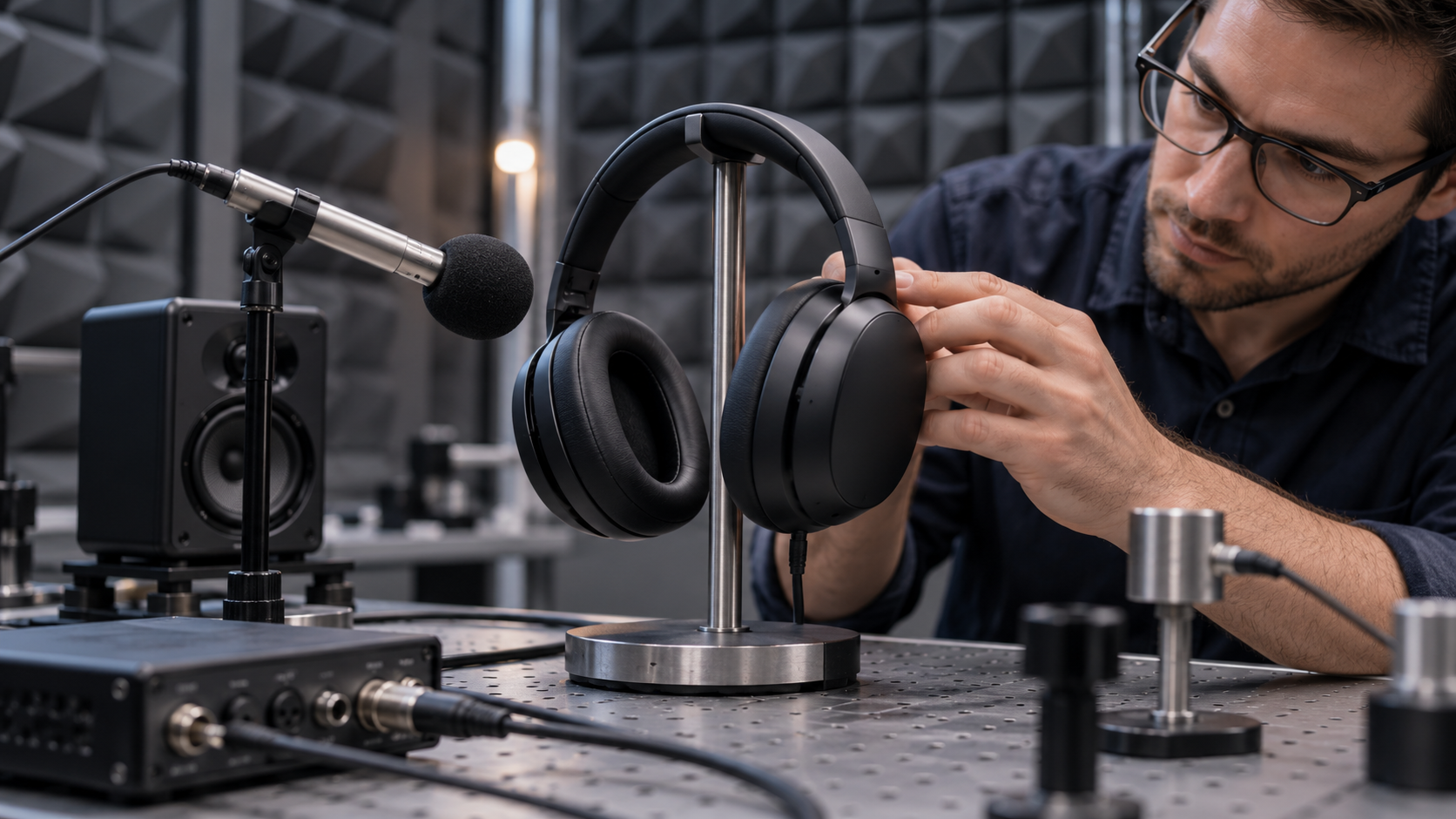
Active Noise Cancellation Explainer
Active noise cancellation reduces unwanted sound by adding another sound that produces lower pressure at the listener’s ear. Microphones measure noise around or inside a headphone cup, and a digital controller estimates what that noise will become at the eardrum. The headphone driver then plays a counter-signal with the needed amplitude and phase. When the unwanted and controlled waves combine, their pressure variations partly cancel. The system does not erase sound in the room; it creates a quieter result at a small target region near the ear.
A feedforward design places a microphone on the outside of the ear cup. It hears incoming noise before that sound passes through the cushion and enclosure, giving the processor time to act. A feedback design places a microphone inside the cup and measures the result near the ear, including effects from driver response and seal. Hybrid headphones use both. Each arrangement has tradeoffs: an outside microphone can be disturbed by wind, while an inside loop must remain stable despite variations in fit, ear shape, and acoustic leakage.
The controller applies adaptive filters that model the path from microphone to ear and from speaker to ear. Delay is critical. A counter-wave that arrives too late may reinforce rather than reduce part of the noise. Low frequencies change relatively slowly, so engines, fans, and cabin rumble are favorable targets. High-frequency sounds have shorter wavelengths and rapid changes, making exact prediction difficult. Passive insulation from ear cups and tips usually handles much of the high-frequency reduction, while active processing contributes most strongly in the bass and lower midrange.
Real environments are not perfectly repetitive. The processor continuously adjusts filter coefficients as noise and headphone position change. It must avoid reacting badly to speech, bumps, feedback, or a sudden broken seal. Microphone self-noise, converter quality, driver limits, and computational precision set a floor on performance. Algorithms may also preserve awareness by mixing external sound intentionally. Transparency mode uses the same microphones but aims to reproduce the outside environment naturally rather than cancel it.
The acoustic seal is part of the system. Glasses, hair, jaw movement, or an incorrect ear tip changes leakage and the transfer path. Feedback sensing can correct some variation, but a large leak reduces passive isolation and forces the driver to work harder. Very strong cancellation at one point can create less reduction elsewhere because pressure varies across the small cavity. Manufacturers therefore tune for a range of ears and positions rather than one laboratory fixture.
Active cancellation cannot protect against every hazardous sound. A headphone may reduce steady low-frequency noise while leaving speech, alarms, sharp impacts, or very loud peaks comparatively audible. The electronics and driver have finite output, and clipping a counter-signal creates distortion. Safety ratings for industrial hearing protection require specific testing and should not be inferred from consumer cancellation claims. Users also differ in their sensitivity to the low-frequency pressure sensation or processing artifacts.
The essential loop is measure, predict, generate, and correct. Microphones observe the disturbance, digital filters estimate its arrival at the ear, the speaker produces an opposing waveform, and feedback updates the model. The most convincing results come from combining that loop with physical isolation, accurate drivers, low-latency electronics, and a consistent fit. Active noise cancellation is therefore controlled interference at a listening point, not a silent field around the person wearing the headphones.
A MEMS microphone is a tiny microphone made with microelectromechanical systems techniques. It turns changes in air pressure into an electrical signal that phones, computers, and sensors can process.
Sound pressure moves a thin diaphragm relative to a fixed plate, changing an electrical property such as capacitance. Electronics convert that small change into an analog or digital audio signal.
Noise, sensitivity, directionality, packaging, and the surrounding device all shape the recorded result. Wind, vibration, and openings that become blocked can make a small microphone sound less clear.
Explore more "Explainers"
Discover additional explainers across politics, science, business, technology, and other fields. Each explainer breaks down a complex idea into clear, everyday language—helping you better understand how major concepts, systems, and debates shape the world around us.