

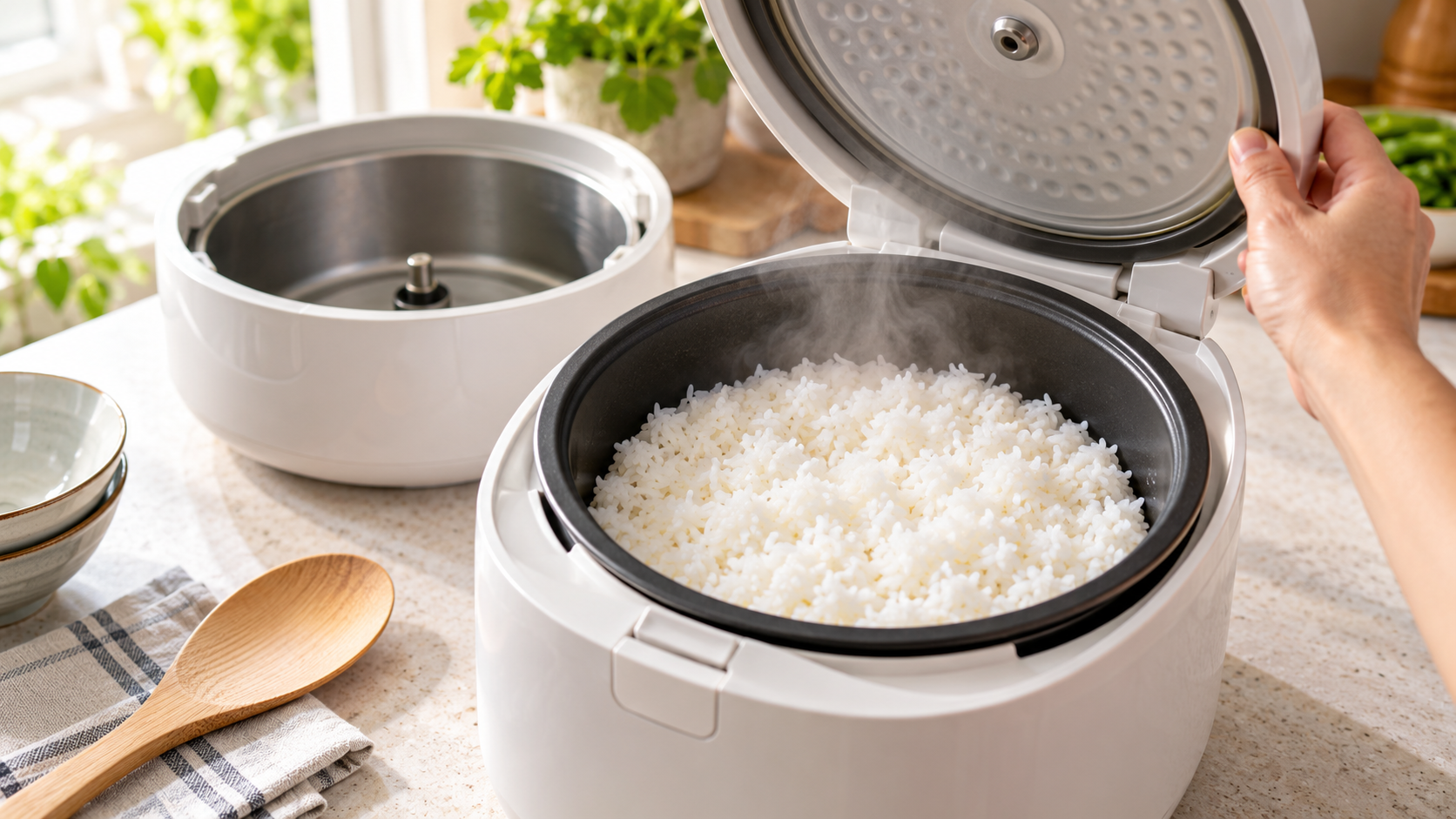
Rice Cooker Temperature-Switch Explainer
A basic rice cooker knows when to stop full-power cooking by sensing a temperature change that occurs after free water is no longer controlling the pot. While water remains in contact with the heated inner pot, much of the supplied energy goes into boiling and evaporation. At ordinary pressure, the pot bottom stays near the local boiling temperature of water rather than rising without limit. When the rice has absorbed most accessible water and the remaining free water boils away, the pot temperature begins to climb. A thermostat detects that rise and switches the appliance from cook to warm.
The sensing assembly commonly sits in a spring-loaded button at the center of the heater so it presses against the removable pot. Good contact matters because the sensor is measuring the pot, not tasting the rice. Traditional designs use a temperature-responsive magnet and lever. Below its characteristic transition temperature, the magnet helps hold the cook switch engaged. When the sensor becomes hotter, magnetic force weakens enough for the spring mechanism to release, opening the high-power circuit and selecting a lower-power warming path. Other models use bimetal thermostats or electronic sensors and controllers.
The water-to-rice ratio sets up the timing indirectly. Rice starch absorbs water as granules heat and swell, while some water escapes as steam. If the measured amount matches the rice variety and desired texture, the disappearance of free water occurs after the grains have had enough hot, moist time to cook. The cooker does not count individual grains or directly measure softness. Too little water can make the temperature rise before the center is tender; too much can prolong boiling and produce a soft or overflowing result.
After the switch, stored heat and steam continue redistributing moisture. Instructions often call for a covered resting period so wetter and drier areas equalize and the grain structure settles. Keep-warm mode supplies intermittent or reduced heat to hold the contents above a target temperature without continuing vigorous boiling. It is not a substitute for safe storage indefinitely: rice can support bacterial growth if held in an unsafe temperature range, and dried edges or quality loss can develop during long holding. The manufacturer’s time and food-safety guidance should be followed.
Foam, residue, a warped pot, or a grain under the sensor can interfere with heat transfer and switching. The outer surface of the inner pot and heater plate should be clean and dry before use. Lifting the pot, opening the lid repeatedly, using the wrong pot, or placing ingredients that block normal boiling can also change results. Altitude lowers the boiling temperature, so cooking may take longer even though the switch still responds to a temperature rise above the water-controlled plateau. Multigrain and porridge modes may need different programmed heating patterns.
Modern fuzzy-logic and pressure rice cookers add thermistors, microcontrollers, pressure sensors, timers, and staged power control. They can infer soaking, heating rate, boil behavior, and resting conditions, then adjust the profile. Even so, the central physical clue remains useful: liquid water absorbs large amounts of energy during vaporization and holds the pot near a predictable range. When that thermal buffer disappears, temperature rises. The humble automatic cooker turns this phase-change signal into a mechanical or electronic decision, providing a repeatable endpoint without seeing the rice.
A rice cooker watches the pot temperature: boiling water creates a plateau, and the temperature rises when free water is depleted. Key terms include boiling point, latent heat, thermostat, spring sensor, Curie temperature, magnetic switch, thermistor, cook mode, keep-warm, and resting.
Usually not. Basic models infer an endpoint from pot temperature after free water disappears. Correct water ratio and resting time help that thermal event coincide with the desired texture.
The heater and center sensor need reliable contact with the removable pot. Residue, moisture, dents, or trapped grains can distort heat transfer and switching behavior.
Explore more "Explainers"
Discover additional explainers across politics, science, business, technology, and other fields. Each explainer breaks down a complex idea into clear, everyday language—helping you better understand how major concepts, systems, and debates shape the world around us.