

Dog Scent-Trail Tracking Explainer
A dog follows a scent trail by collecting a changing mixture of odor molecules and repeatedly deciding where that mixture becomes stronger, fresher, or more consistent. A person or animal leaves skin cells, sweat residues, disturbed vegetation, crushed soil organisms, and other compounds along a route. Wind also carries a separate plume away from the source. The dog does not perceive a glowing line on the ground. It samples overlapping airborne and surface odors, compares locations, and moves through a chemical landscape whose shape changes with time and weather.
Air enters a dog’s nose in rapid sniffs rather than one continuous breath. Internal structures direct part of that air across a large olfactory region lined with receptor cells. Different receptors respond to different molecular features, and the brain interprets the combined activity as an odor pattern. The moist nasal surface helps capture soluble molecules. Slits at the sides of the nostrils release exhaled air in a way that can draw fresh odor toward the front, allowing repeated sampling without completely blowing the target scent away.
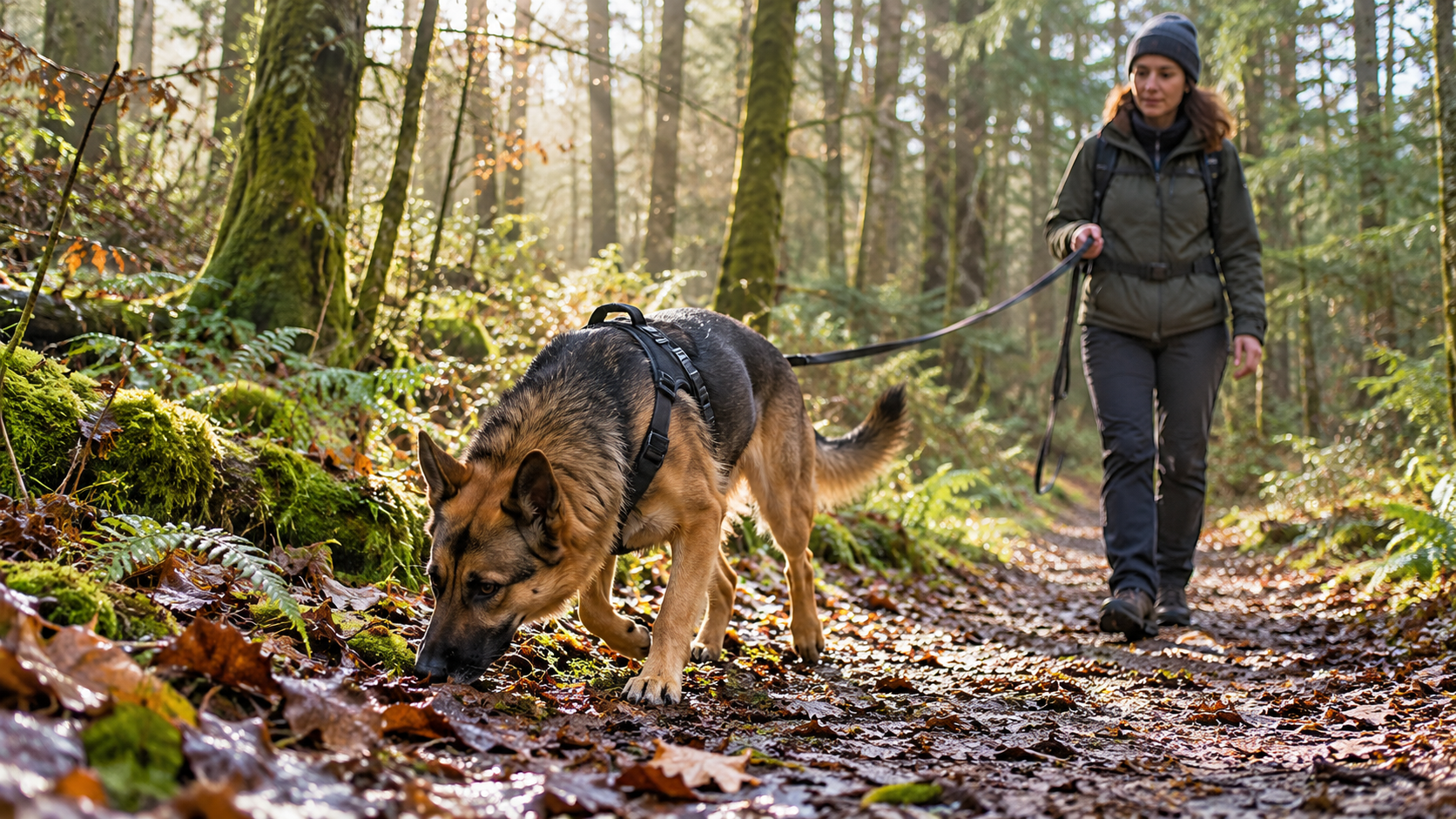
Paired nostrils provide spatial clues. If odor reaches one side slightly earlier or at greater concentration, the dog can orient its head and body. During close ground tracking, the nose sweeps from side to side and samples footprints, vegetation, and soil. During air scenting, the head may rise as the dog crosses a wind-borne plume. Moving across the trail and then turning back is not necessarily an error; casting lets the animal find the plume edges and establish the direction of increasing odor.
A trail changes after it is laid. Heat increases evaporation but can also create turbulent rising air. Moisture often helps hold and release odor, while heavy rain can redistribute it. Sun, shade, surface material, wind, traffic, other people, and time all reshape the mixture. Individual odor also interacts with background scents and with disturbance odors made by every footstep. Dogs can discriminate extremely complex mixtures, but capability is not unlimited, and there is no universal maximum trail age or distance that applies to every dog and condition.
Learning gives the sensory information a task. The dog associates a target odor or start cue with a reward and practices following it while ignoring distractions. Memory helps maintain the relevant pattern even as intensity varies. A tracking line and harness can give the dog freedom to choose direction, while the handler watches changes in pace, head position, tension, and search pattern. Pulling the dog toward an expected route or unintentionally cueing a choice can bias the result, which is why controlled training and blinded testing matter.
Scent work can locate missing people, wildlife, contraband, disease-related samples, or a hidden toy, but each application requires distinct training and validation. An alert is behavior, not an infallible chemical measurement. Fatigue, heat stress, nasal illness, motivation, contamination, handler cues, and an unfamiliar environment can reduce reliability. Operational teams use records, proficiency testing, appropriate rest, and corroborating evidence. The dog’s achievement comes from sensitive airflow sampling, a large receptor system, rapid spatial comparisons, learned odor recognition, and active search behavior working together.
Dogs track by repeatedly sampling complex ground and airborne odor mixtures, comparing space, and matching the pattern to a learned target. Key terms include odor molecule, olfactory receptor, sniff, nasal airflow, paired nostrils, plume, ground scent, casting, discrimination, contamination, and handler cue.
Side-to-side casting helps the dog locate the edges of an odor plume, recover a weak trail, and determine which direction leads toward a stronger or fresher pattern.
No. Trail persistence varies with wind, rain, heat, sunlight, surface, traffic, contamination, the individual dog, and training. There is no single age or distance guaranteed in every setting.
Explore more "Explainers"
Discover additional explainers across politics, science, business, technology, and other fields. Each explainer breaks down a complex idea into clear, everyday language—helping you better understand how major concepts, systems, and debates shape the world around us.