

On This Day in Business: January 28, 1958
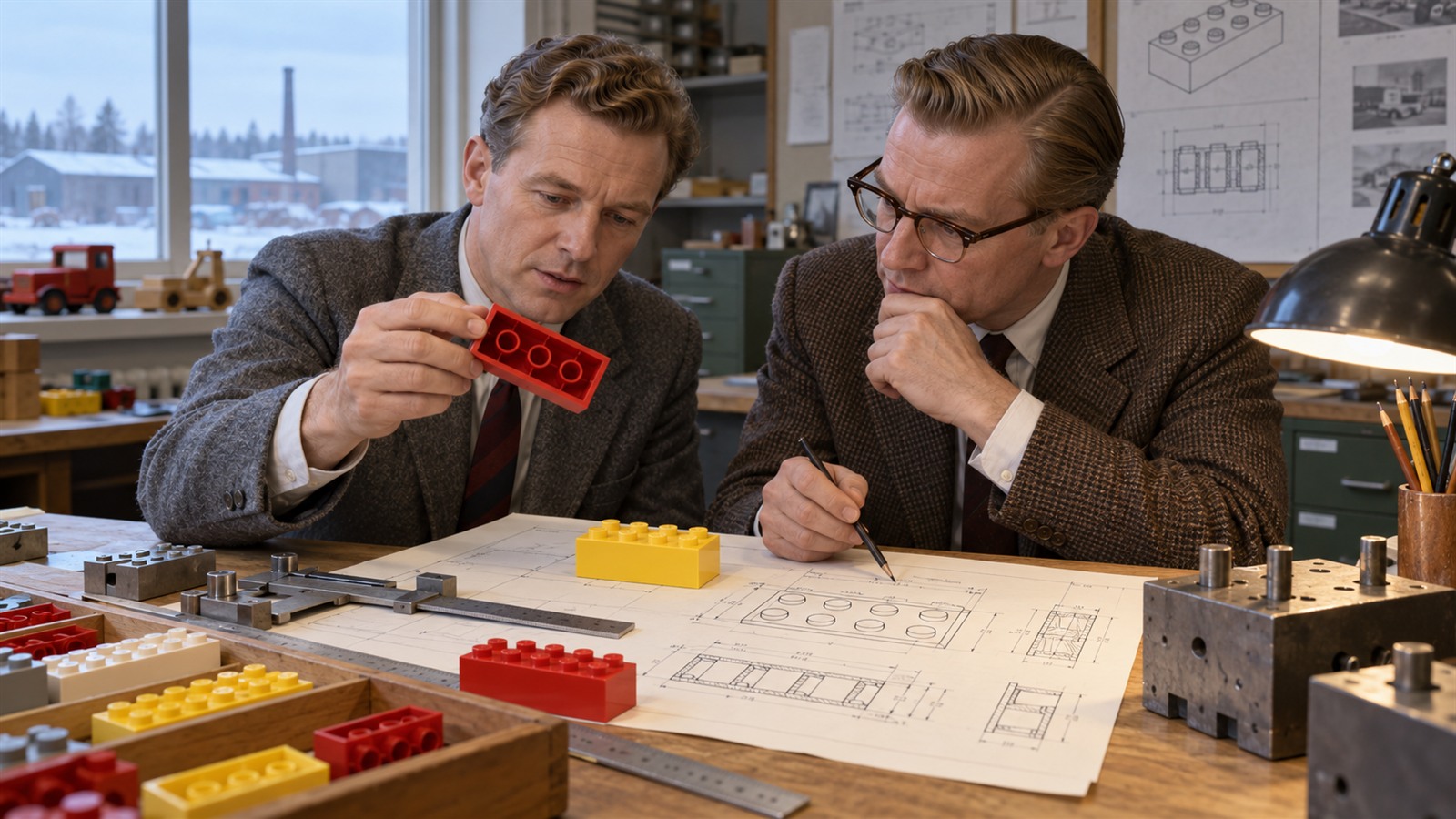
On January 28, 1958, the LEGO company submitted a Danish patent application for the stud-and-tube coupling system that defined its modern plastic building brick. The filing was made at 1:58 in the afternoon after company leader Godtfred Kirk Christiansen and designer Axel Thomsen worked through several possible internal structures. LEGO had sold Automatic Binding Bricks since 1949, with studs on top and a hollow underside, but constructions lacked the dependable grip needed for ambitious play. Adding tubes beneath the brick created multiple contact points with the studs below, producing what the company called clutch power while still allowing a child to separate and reuse the pieces.
The improvement turned individual toys into a system. In 1955 LEGO had introduced its 'System in Play' idea: every element should fit with others, encourage creativity and remain useful as a collection grew. The 1958 geometry gave that promise technical durability. A brick made decades later could connect with one from the early system because dimensions and tolerances were carefully controlled. For families, compatibility preserved the value of previous purchases. For retailers, new sets could stimulate demand for old pieces rather than render them obsolete. For LEGO, each additional shape or theme expanded a platform whose installed base already existed in children's rooms.
Patents protected the coupling principle during a crucial period of expansion. LEGO sought protection in Denmark and numerous foreign markets, ultimately filing in 33 countries. The rights did not eliminate competition, but they gave the company time to invest in precision molding, manufacturing scale and international distribution around a recognizable standard. Quality was essential because tiny dimensional errors changed the strength of the connection. The design therefore linked intellectual property to process capability: a drawing described the idea, while tools, resin control and inspection made millions of pieces behave consistently. That repeatability helped transform a Danish woodworking business into a global plastics manufacturer.
The basic patent eventually expired, yet the brick system remained commercially powerful through brand, design, community and continuous product development. Sets changed, licensed themes arrived and digital experiences expanded, but the physical connection stayed familiar. January 28 matters because the patent captured an architectural decision with consequences far beyond one object. LEGO did not simply create a better brick; it established a compatibility rule that rewarded customers for returning and made the catalog more valuable as it grew. The lesson resembles modern platform strategy: stable interfaces encourage participation, protect accumulated investment and let a company innovate at the edges without breaking the foundation that users already trust.
LEGO's early plastic Automatic Binding Bricks had top studs but a hollow underside, so larger models could separate too easily during play.
The 1955 System in Play strategy called for compatible elements that would remain useful and gain value as families added more pieces.
On January 28, 1958, LEGO filed a Danish patent describing tubes beneath the brick that pressed against studs and improved clutch power.
Precise dimensions let pieces connect firmly yet separate by hand, making construction stable, repeatable and suitable for continual rebuilding.
International patent filings supported expansion while precision molding and quality control turned the geometry into a reliable manufacturing standard.
Even after patent expiration, backward compatibility, brand and a growing catalog preserved a platform whose value increases with every interoperable element.
Explore more of "On This Day ..."
Discover more events from the same date across news, politics, technology, sports, and other fields. Each link highlights significant moments that shaped history on different fronts.