

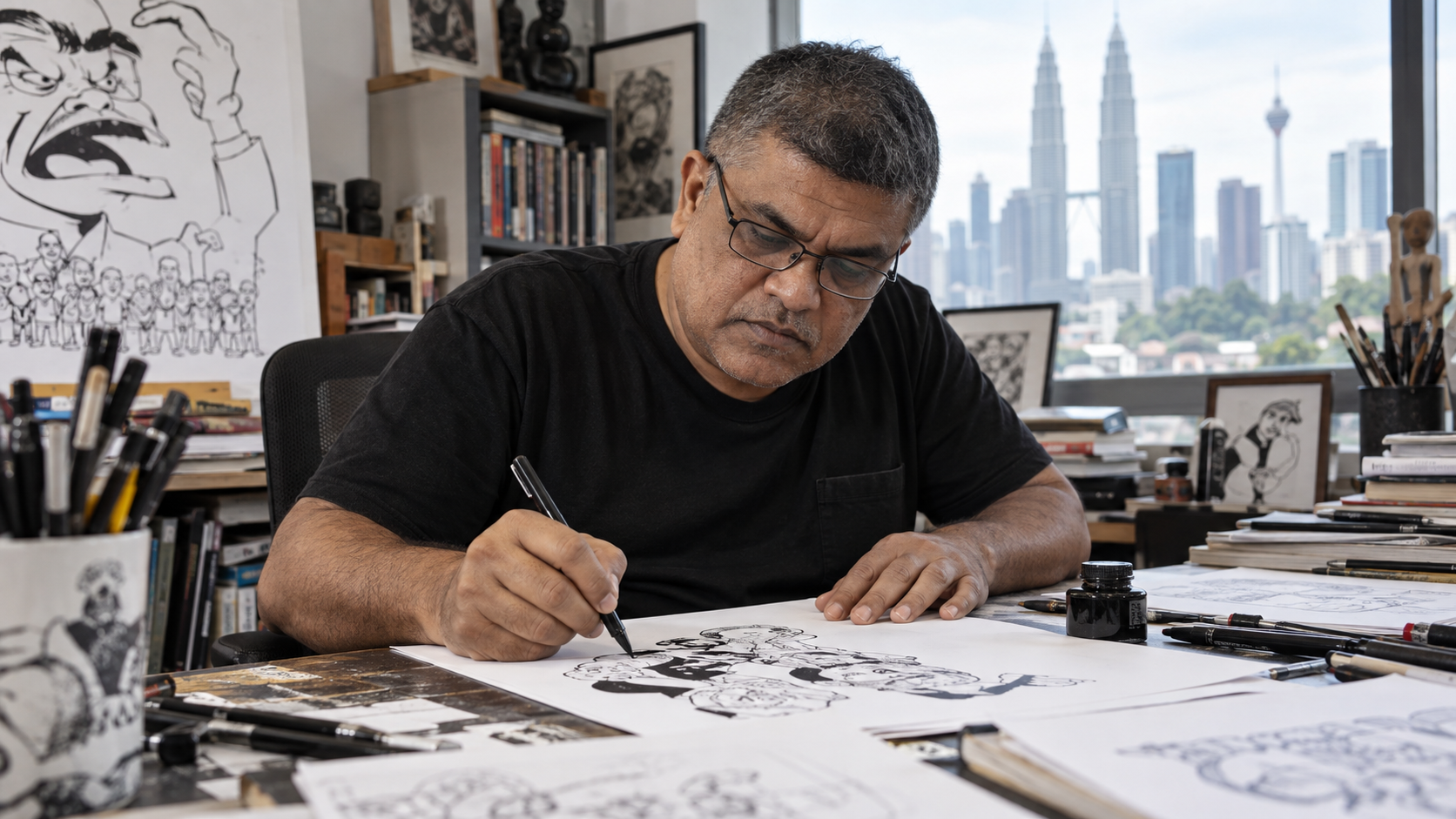
“They can ban my cartoons, they can ban my books, but they cannot ban my mind.”
Malaysian political cartoonist Zulkiflee Anwar Ulhaque, known as Zunar, used these words while accepting a 2015 International Press Freedom Award. His drawings criticized high-level corruption and abuses of government power. Police detained him, raided his office and printers, and authorities banned or confiscated several collections of his work. At the time of his speech, he faced multiple sedition counts connected to critical posts. The quote distinguishes control over distribution from control over thought: officials may seize paper or block a website, yet the underlying judgment can survive and find another form.
Political cartoons compress reporting, interpretation, and exaggeration into a single frame. Their clarity gives them power, but it also demands careful construction. A cartoonist should understand the verified event, policy, court decision, or financial record being criticized and make the target recognizable without inventing conduct. Editors can check names, dates, symbols, and factual premises while preserving the artist’s opinion. Corrections may be necessary when the underlying information changes, even though caricature itself is not a literal portrait of reality.
Satire also tests whether rules are applied consistently. Governments may describe ridicule as disorder, sedition, or disloyalty while tolerating favorable propaganda. Newsrooms should document the precise law, charge, seized work, hearing schedule, and penalty rather than treating censorship as an abstract controversy. Legal analysis can show whether a restriction is narrowly tied to a specific harm or broadly punishes criticism. Publishing the disputed work with context, when safe and lawful, lets audiences evaluate what authorities claimed was dangerous.
Zunar described laughter as a form of protest and drawing as his mission. Humor can lower barriers to complex subjects, expose contradiction, and help people recognize that official prestige is not the same as public legitimacy. It can also reinforce stereotypes or simplify victims’ experiences, so ethical satire aims upward at power and remains attentive to foreseeable harm. Distributed archives, international exhibitions, secure backups, and multiple publishers make creative work harder to erase. The quote endures because censorship often fails at the level that matters most: ideas migrate. A banned image can be remembered, redrawn, described, or carried across borders. That resilience does not remove the costs imposed on artists, printers, and families. It makes practical solidarity essential—legal defense, safe publication channels, and sustained attention that protects the space where independent imagination becomes public argument. Transparent records of seizures and hearings also prevent the censor’s version from becoming the only surviving account.
Zunar delivered the line in his 2015 CPJ speech after detention, office raids, book bans, confiscations, and sedition charges tied to political cartoons and posts.
Ethical editorial cartoons rest on verified facts, identifiable targets, proportionate symbolism, factual review, and corrections when the underlying record changes.
Legal documentation, contextual republication, secure archives, multiple distributors, exhibitions, and defense funds help creative dissent survive attempts at removal.
Explore more "Quotes of The Day"
Discover more notable quotes from influential voices across politics, science, business, technology, sports, and culture. Each quote offers insight into how ideas, beliefs, and decisions shape the world around us.