

On This Day in Health: August 11, 1858
Christiaan Eijkman was born in Nijkerk, the Netherlands, on August 11, 1858. He trained as a military physician at the University of Amsterdam and later worked in the Dutch East Indies, where beriberi was a major cause of paralysis, heart failure, and death. In the 1880s, many investigators expected an infectious microbe to explain the disease. Eijkman joined a laboratory in Batavia, now Jakarta, established partly to investigate that possibility. He brought bacteriological training shaped by Robert Koch’s methods, but the evidence he encountered would force a different explanation of how food could determine health.
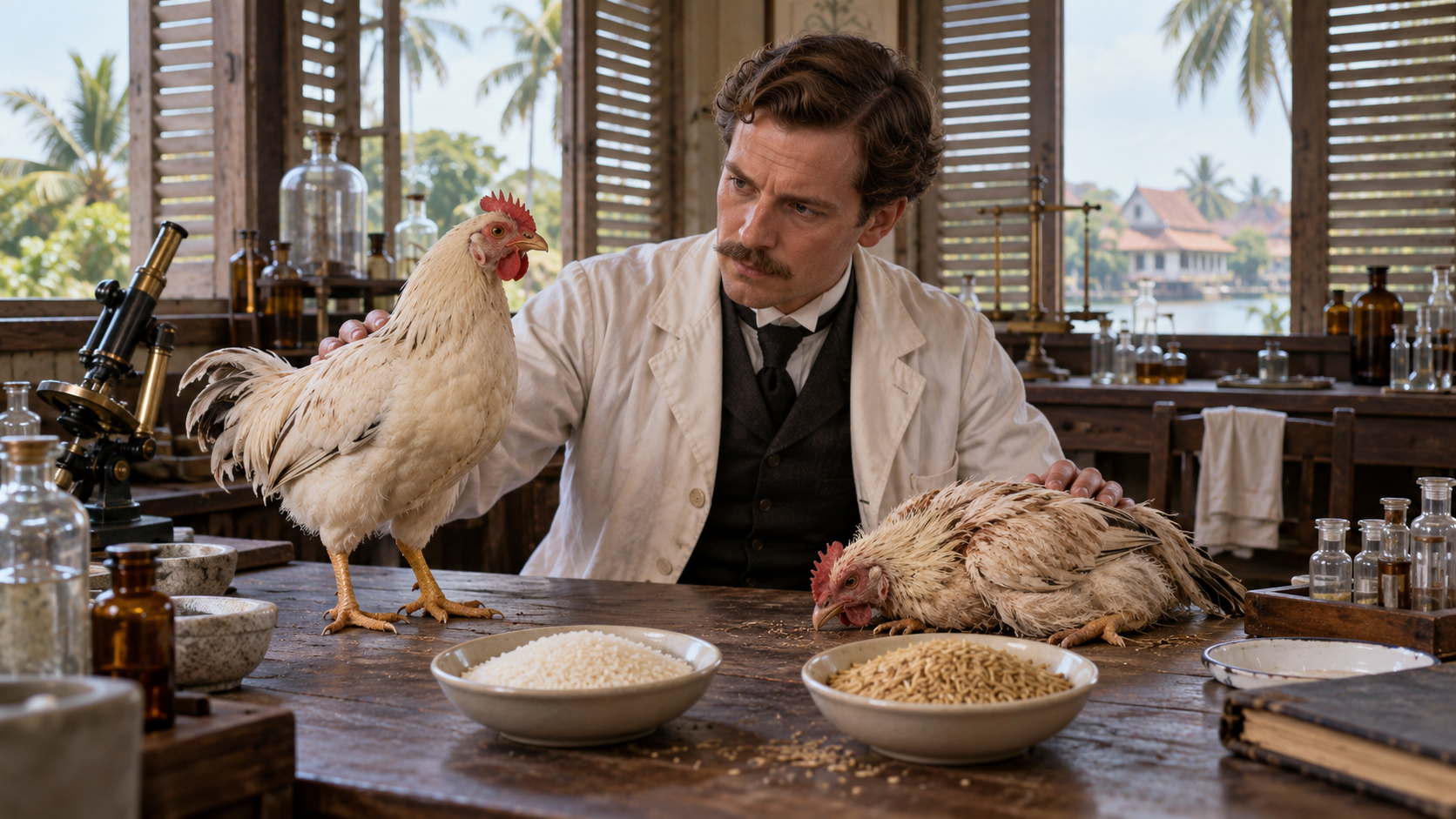
At the Batavia laboratory, chickens unexpectedly developed a disorder resembling human beriberi. Eijkman traced the problem to a change in their feed: birds given polished white rice became ill, while those eating unpolished rice recovered. He first interpreted the outer rice layer as containing an antidote to a toxin in the grain. That explanation was incomplete, and the bird disease was not identical to human beriberi, but the controlled dietary contrast was decisive. It shifted attention from a hypothetical pathogen toward something removed during milling and supplied by the rice bran.
Gerrit Grijns, Eijkman’s successor in the investigation, developed the nutritional interpretation further. He proposed that natural foods contained protective substances needed for metabolism and that their absence could cause disease. Casimir Funk later popularized the term vitamin, and researchers identified thiamine, or vitamin B1, as the factor whose deficiency produces beriberi. In 1929, Eijkman shared the Nobel Prize in Physiology or Medicine with Frederick Gowland Hopkins for work that helped establish the importance of dietary accessory factors. The recognition reflected a chain of observations and corrections rather than a single finished discovery.
Eijkman’s birthday marks a turning point in the understanding of deficiency disease. His work helped medicine see that a food could provide enough calories yet still fail to protect health if processing removed an essential micronutrient. That insight influenced nutrition research, food fortification, and public-health programs far beyond beriberi. It also carries a useful caution: Eijkman’s original mechanism was wrong, and later scientists refined the interpretation. Progress came from reproducible evidence, willingness to revise a theory, and attention to everyday systems such as milling and diet. Vitamin B1 is now understood as essential to energy metabolism and nerve function, and deficiency remains preventable with adequate nutrition and timely treatment. The discovery also changed how governments approached staple foods. Where populations relied heavily on polished rice, education, dietary diversity, enrichment, and access to less-refined grain could prevent illness more effectively than searching for a contagious source. Thiamine deficiency can still occur with severe malnutrition, malabsorption, or alcohol-use disorder, making the historical lesson clinically relevant.
Eijkman was born in the Netherlands on August 11, 1858, trained as a military physician, and later joined a beriberi investigation in colonial Batavia.
Beriberi was often treated as an infectious problem, so Eijkman initially approached it with the bacteriological methods then reshaping medicine.
Chickens fed polished rice developed neurological illness, while birds given unpolished rice recovered, directing attention to something removed with the bran.
Eijkman first proposed an antitoxin effect; Gerrit Grijns and later researchers established the stronger idea that a missing nutrient caused the disease.
Identification of thiamine connected beriberi to vitamin B1 deficiency and helped create the modern concept of essential micronutrients.
Nutrition programs and food fortification still reflect the lesson that processing can remove biologically necessary substances even when calories remain plentiful.
Explore more of "On This Day ..."
Discover more events from the same date across news, politics, technology, sports, and other fields. Each link highlights significant moments that shaped history on different fronts.