

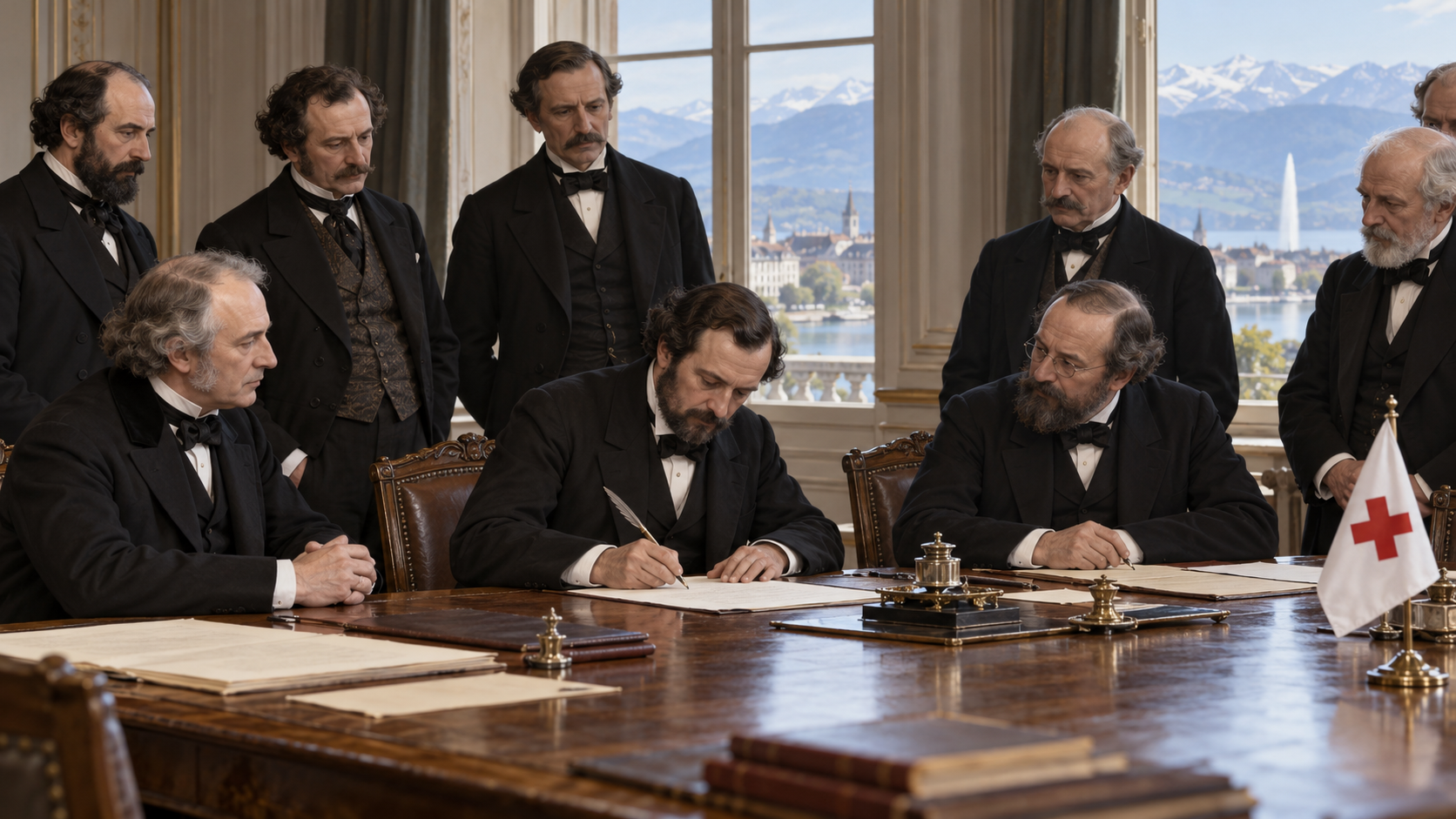
On This Day in Health: August 22, 1864
On August 22, 1864, delegates in Geneva adopted the Convention for the Amelioration of the Condition of the Wounded in Armies in the Field. Representatives of sixteen states had met at the invitation of the Swiss government after organizing by the Geneva Committee, the body that became the International Committee of the Red Cross. The treaty responded to the suffering of wounded soldiers described by Henry Dunant after the Battle of Solferino. It created a legal framework for care during war at a time when medical units and volunteers could be attacked, obstructed, or treated as combatants.
The ten-article convention required wounded and sick soldiers to be collected and cared for without distinction of nationality. It recognized neutrality for ambulances, military hospitals, and medical and transport personnel while they performed their duties. It also adopted a red cross on a white ground as a distinctive protective emblem. Twelve states signed the original instrument. These commitments were limited compared with modern humanitarian law, and enforcement depended heavily on governments and commanders, but the treaty made medical protection an explicit international obligation rather than a matter of goodwill alone.
Later conflicts exposed gaps. Revised Geneva Conventions in 1906 and 1929 expanded protections, and the four conventions of 1949 covered wounded and sick forces on land and sea, prisoners of war, and civilians. Additional protocols developed rules further. The red-cross emblem, joined in treaty law by other protected emblems, identifies authorized medical and humanitarian services; misuse can endanger the people it is meant to protect. Despite near-universal acceptance of the modern conventions, health workers and facilities continue to face violence, interference, and shortages in armed conflicts.
The August 22 anniversary belongs in health history because medicine cannot function in war without protected space, staff, transport, supplies, and access to patients. Clinical skill alone is insufficient when ambulances cannot move or hospitals become targets. The first convention linked humanitarian concern to practical rules and an identifiable emblem, laying foundations for international humanitarian law. It did not end battlefield suffering, and legal status does not guarantee compliance. Its lasting value is the principle that wounded people deserve care because they are wounded, and that those providing care must be respected so they can treat patients impartially. The convention also shaped the idea of organized voluntary aid before national medical services reached their modern form. Relief societies trained volunteers, stocked material, and coordinated with armed forces while claiming a protected humanitarian role. That model continues to influence disaster and conflict medicine, although neutrality must be demonstrated through consistent conduct and care based on need.
Dunant’s account of wounded soldiers after Solferino inspired organizing for volunteer relief societies and international rules protecting battlefield care.
Sixteen states attended the Geneva conference, and twelve signed the convention adopted on August 22, 1864.
The treaty protected wounded soldiers without distinction of nationality and recognized neutrality for medical personnel, ambulances, and military hospitals.
A red cross on white became the distinctive emblem, intended to identify protected medical services rather than to serve as a general medical logo.
Later conventions expanded protections to more people and settings, while armed conflicts continue to test whether states and fighters comply.
Health care in war depends on law, access, logistics, professional impartiality, and practical respect for the people and places that treat the wounded.
Explore more of "On This Day ..."
Discover more events from the same date across news, politics, technology, sports, and other fields. Each link highlights significant moments that shaped history on different fronts.