

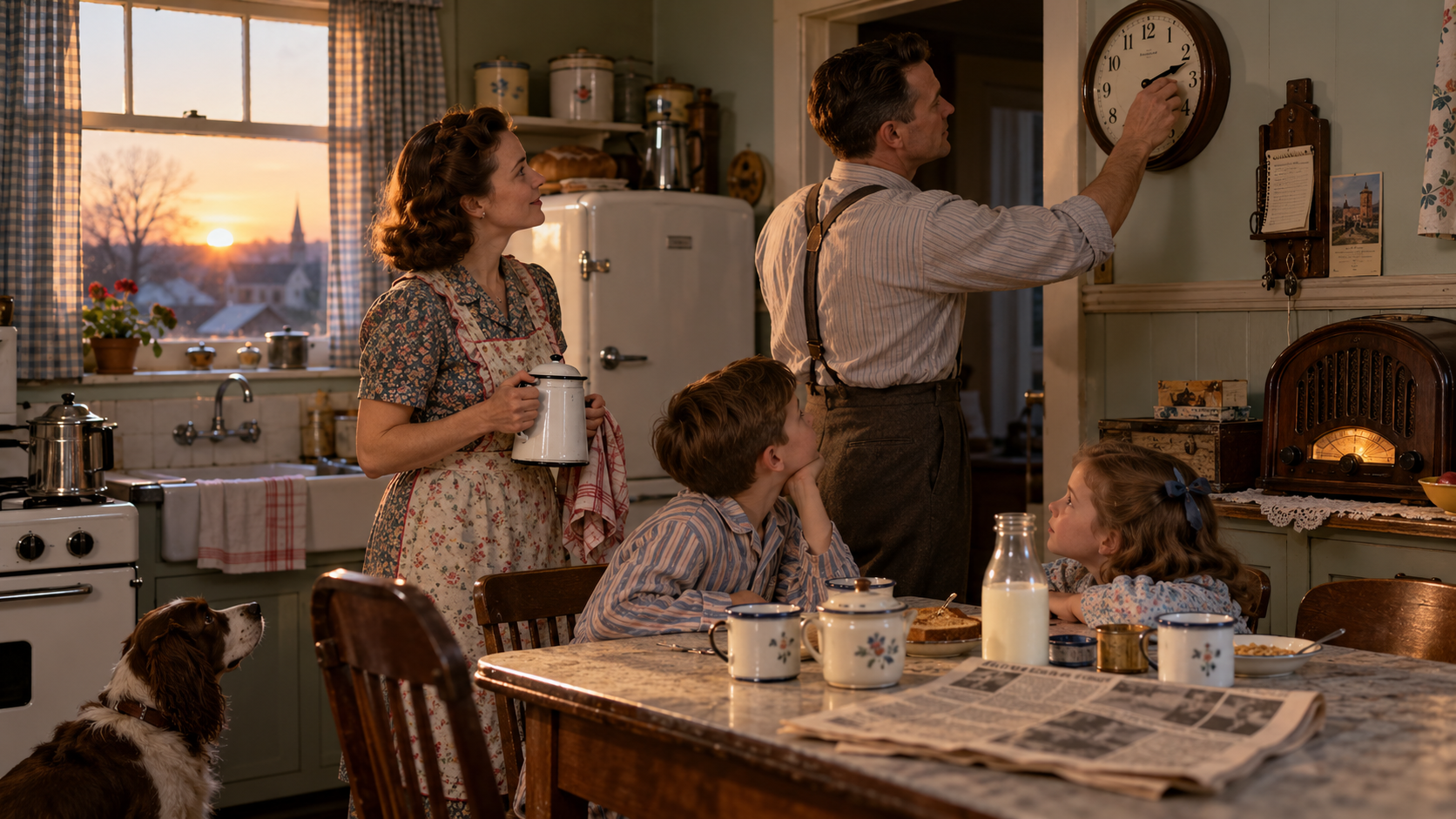
On This Day in Lifestyles: February 9, 1942
On February 9, 1942, most Americans moved into year-round daylight saving under federal wartime policy. Clocks shifted forward and the nation adopted what was commonly called War Time. The change reached into every household and workplace: train schedules, factory shifts, radio programs, school mornings, meals, and bedtime all had to be understood through a newly ordered hour. The occasion became memorable because a large historical shift took a form people could see and feel. It joined public significance with an ordinary action, turning an abstract change into a shared experience that could be described at dinner tables and remembered later.
Daylight saving had been used during the First World War and remained a recurring, controversial idea. After the United States entered the Second World War, Congress authorized the national shift as part of a broader effort to coordinate production and conserve resources. The measure did not literally create more daylight, but it moved an hour of usable light from morning toward late afternoon and evening. Seen against its background, the moment was the product of sustained work rather than sudden inspiration. Earlier advocates, craftspeople, researchers, performers, organizers, or users supplied the knowledge and pressure that allowed the event to happen when it did.
The adjustment was simple on a clock face and complicated in lived experience. Early risers met darker winter mornings, while after-work errands and chores gained more daylight. Railroads, broadcasters, offices, and factories had to synchronize records and timetables. Because federal time policy touched everyone at once, it made national mobilization visible in an intimate place—the kitchen or bedside clock. Its first effects unfolded through details: schedules, rooms, tools, printed pages, broadcasts, conversation, and the movement of bodies through new routines. Those details show how history enters life—not as a slogan, but as hundreds of small adjustments made by real people.
Year-round War Time ended after the conflict, and the United States returned to a patchwork before later federal rules brought more uniformity. Arguments over energy, safety, sleep, commerce, and convenience continue whenever clocks change. The 1942 shift shows why timekeeping is not merely technical. Public authorities organize the clock, but families and bodies absorb the consequences through routines repeated every day. Later generations inherited both the achievement and its unresolved tensions. The event helped establish a durable practice or institution, yet its meaning continues to evolve as society asks harder questions about inclusion, power, environmental cost, memory, and cultural ownership. The anniversary also reminds us that everyday life is where large historical forces become personal, repeated, debated, and ultimately durable.
Federal wartime policy moved clocks forward and kept much of the nation on year-round daylight saving time.
This detail helps place the anniversary in its original setting.
Officials linked the policy to wartime coordination and conservation by shifting usable daylight toward the evening.
The wider context explains why the moment drew public attention.
Work, school, travel, broadcasts, meals, sleep, and household chores all had to follow the new clock.
Its legacy remains visible in contemporary culture and everyday life.
Explore more of “This Day in Lifestyles”
Discover more moments in everyday life, design, education, travel, food, fashion, and culture. Each story connects a calendar date with an event that changed how people lived.