

On This Day in Politics: February 25, 1986
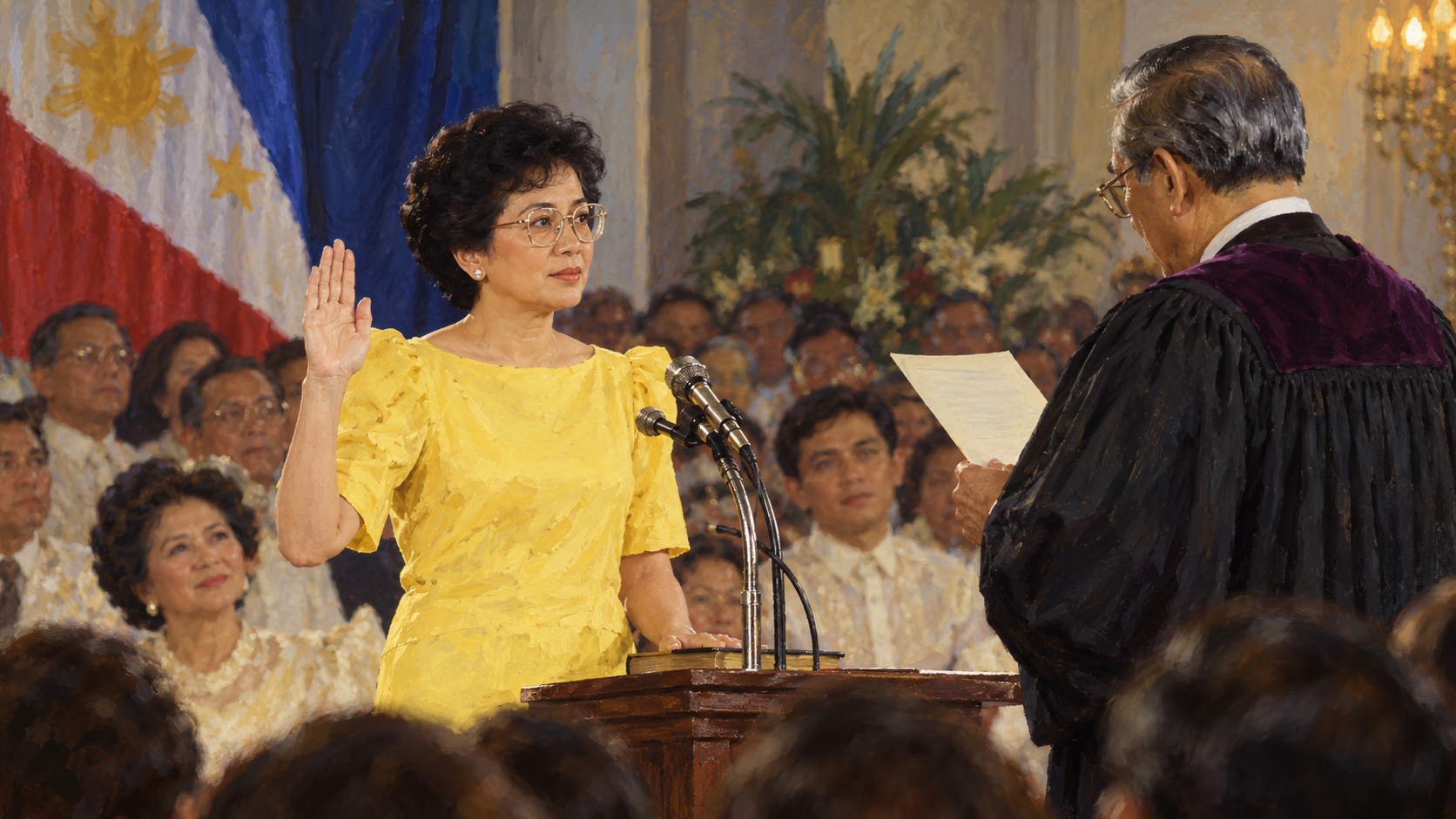
On February 25, 1986, Corazon Aquino took her oath as president of the Philippines at Club Filipino in San Juan. Justice Claudio Teehankee Sr. administered the oath during a day that marked the decisive transition away from Ferdinand Marcos’s rule. Aquino’s inauguration followed the mass mobilization remembered as the People Power Revolution. It was more than the installation of a new individual in office: it represented a claim that political authority should answer to the public after an intensely contested struggle over the country’s leadership. The ceremony gave institutional form to a movement whose strength had been demonstrated in the streets.
The days of February 22–25 brought citizens together in a confrontation over the future of government. Aquino became the central civilian figure around whom opposition to Marcos gathered, but the change depended on a much wider participation. Public demonstrations, political organizing, and decisions within state institutions all contributed to the outcome. Remembering only the oath would miss that collective dimension. At the same time, a movement capable of challenging a ruler still faced the separate task of establishing a government. The inauguration was a bridge between those two phases: resistance to an existing authority and the assumption of responsibility for the country’s administration.
International recognition followed the transfer. On February 25, the United States announced its recognition of the government headed by Aquino. The statement also acknowledged Marcos’s departure from office and emphasized the peaceful character of the transition. Such recognition did not create the popular movement or determine its legitimacy by itself, but it mattered to the new administration’s external relationships. A government emerging from a political crisis had to secure practical cooperation while confronting domestic expectations. Economic development, national security, and the rebuilding of public confidence were immediate responsibilities, even as the ceremonies expressed relief and hope after the confrontation.
The significance of February 25 lies in the opportunity opened by that change of power, rather than in any claim that an inauguration could instantly solve the country’s problems. Aquino’s government inherited the demanding work of translating a democratic mandate into institutions, rules, and public accountability. The anniversary is therefore both a commemoration of nonviolent civic action and a reminder of the work that begins after a political breakthrough. A leader can take an oath in a few moments, but restoring confidence in government requires sustained choices. The day remains a landmark because ordinary citizens helped make a different political future possible and because the transfer placed the responsibility for pursuing that future in new hands.
The People Power mobilization is commemorated across February 22–25. Aquino’s oath on the final day marked a concrete transfer of executive leadership.
The movement’s force came from broad participation. Its history includes citizens and institutions as well as the leaders most visible at the ceremony.
Aquino took the oath at Club Filipino in San Juan before Justice Claudio Teehankee Sr.
The United States recognized the Aquino government on February 25, an important step in the new administration’s international position.
The transition created an opening for democratic government, but administration and institutional rebuilding remained difficult tasks.
The anniversary connects civic courage with political responsibility: successfully challenging a ruler is followed by the work of governing accountably.
Explore more of "On This Day ..."
Discover more events from the same date across news, politics, technology, sports, and other fields. Each link highlights significant moments that shaped history on different fronts.