

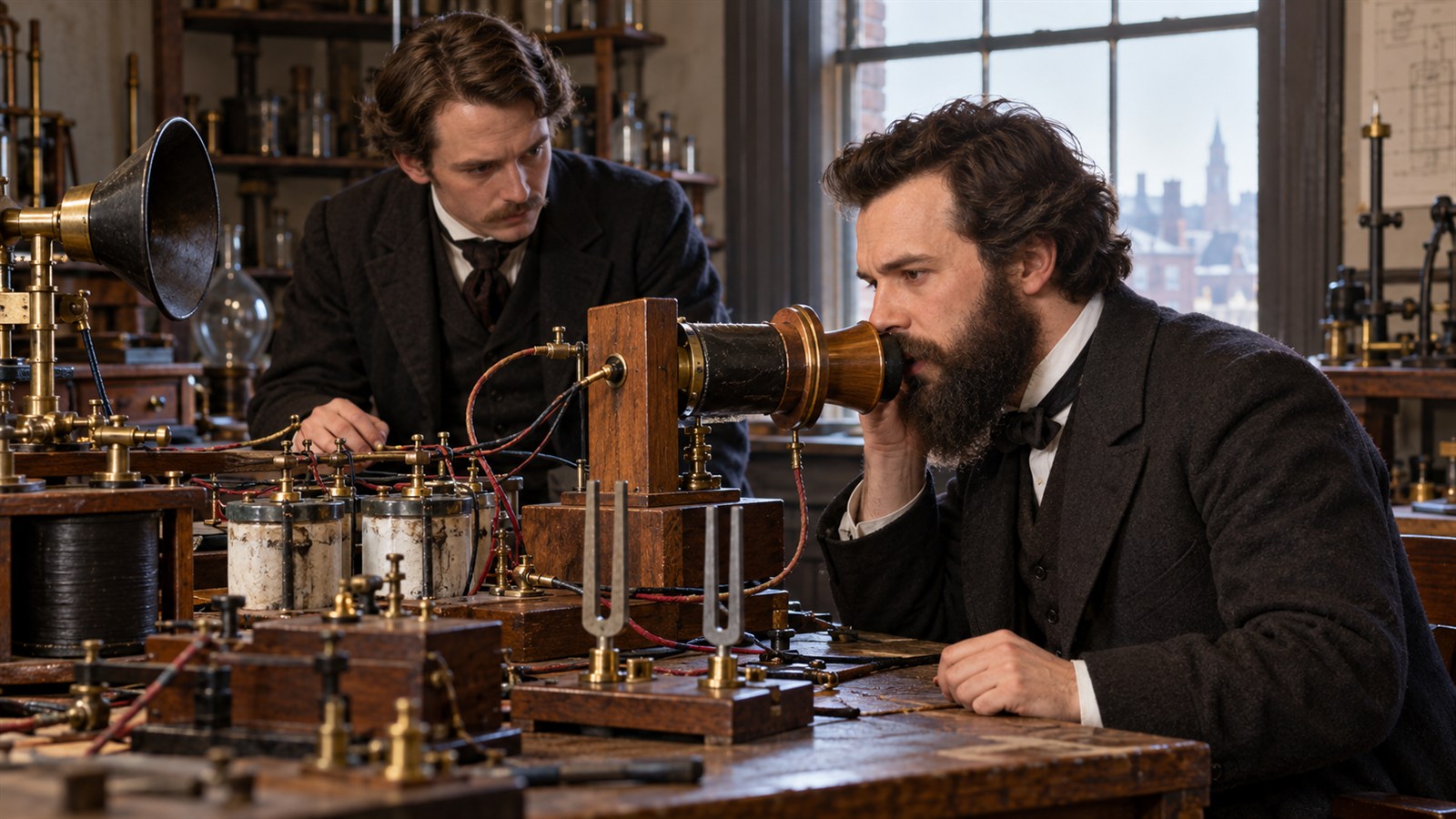
On This Day in Business: March 7, 1876
On March 7, 1876, the United States Patent Office granted Alexander Graham Bell Patent No. 174,465 for improvements in telegraphy. The document described a method of transmitting vocal or other sounds by electrical undulations resembling the vibrations of air. Three days later, Bell's famous laboratory experiment produced intelligible speech over a wire. The patent did not arrive in an empty field; inventors were racing to improve telegraph systems and transmit multiple signals. Its broad claims, however, became a central legal foundation for Bell's effort to commercialize the telephone.
Turning the invention into a business required an organization, capital, equipment, and a network. Bell and his backers first demonstrated the device, licensed rights, and formed companies that could install instruments and lines. Unlike a product that delivers full value to one buyer, a telephone becomes more useful as more people can be reached. That network effect encouraged local exchanges, switchboard operators, directories, standardized equipment, and recurring service charges. The emerging model moved communication from ownership of a machine toward paid access to a connected system.
Patent disputes followed quickly. Competitors challenged Bell's priority and the scope of his claims, while courts examined overlapping experiments by several inventors. Litigation was not a side issue; it influenced who could raise capital, build exchanges, and control technical standards during the industry's formative years. Bell interests defended the patents while expanding service, eventually creating the corporate lineage associated with American Telephone and Telegraph. The resulting system connected businesses to customers and suppliers with a speed that letters and messengers could not match.
The March patent marks a change in the economics of distance. Real-time voice communication shortened decision cycles, supported centralized management, and created new occupations from operator to equipment maker. It also reveals the strategic importance of intellectual property in network industries. A patent can protect an inventive principle, but commercial success still depends on deployment, interoperability, reliability, and adoption. Bell's advantage came from combining a defensible claim with a growing operating network. That combination helped transform an experimental sound transmitter into infrastructure that businesses and households increasingly treated as essential. Telephone economics also encouraged consolidation. Connecting separate local systems increased usefulness, but incompatible equipment or refusal to interconnect could protect regional power. Companies had incentives both to expand the network and to control access to it. That tension eventually drew regulators into questions of rates, universal service, competition, and common carriage. The original patent thus helped open not only a product market but a continuing policy debate over who should govern essential communications infrastructure.
Inventors were searching for ways to send more information over telegraph wires, and several approached the problem of transmitting sound.
Bell's application described electrical waves that corresponded to sound vibrations, creating a broad foundation for voice transmission claims.
Patent No. 174,465 was granted on March 7, 1876, shortly before Bell demonstrated intelligible speech over a wire.
Commercial use required instruments, exchanges, operators, local wiring, maintenance, capital, and enough subscribers to make connections valuable.
Bell-affiliated companies defended the patent in court while expanding a network that became increasingly important to business and everyday life.
The episode established a recurring technology pattern: intellectual property matters, but networks, standards, service, and scale determine lasting value.
Explore more of "On This Day ..."
Discover more events from the same date across news, politics, technology, sports, and other fields. Each link highlights significant moments that shaped history on different fronts.