

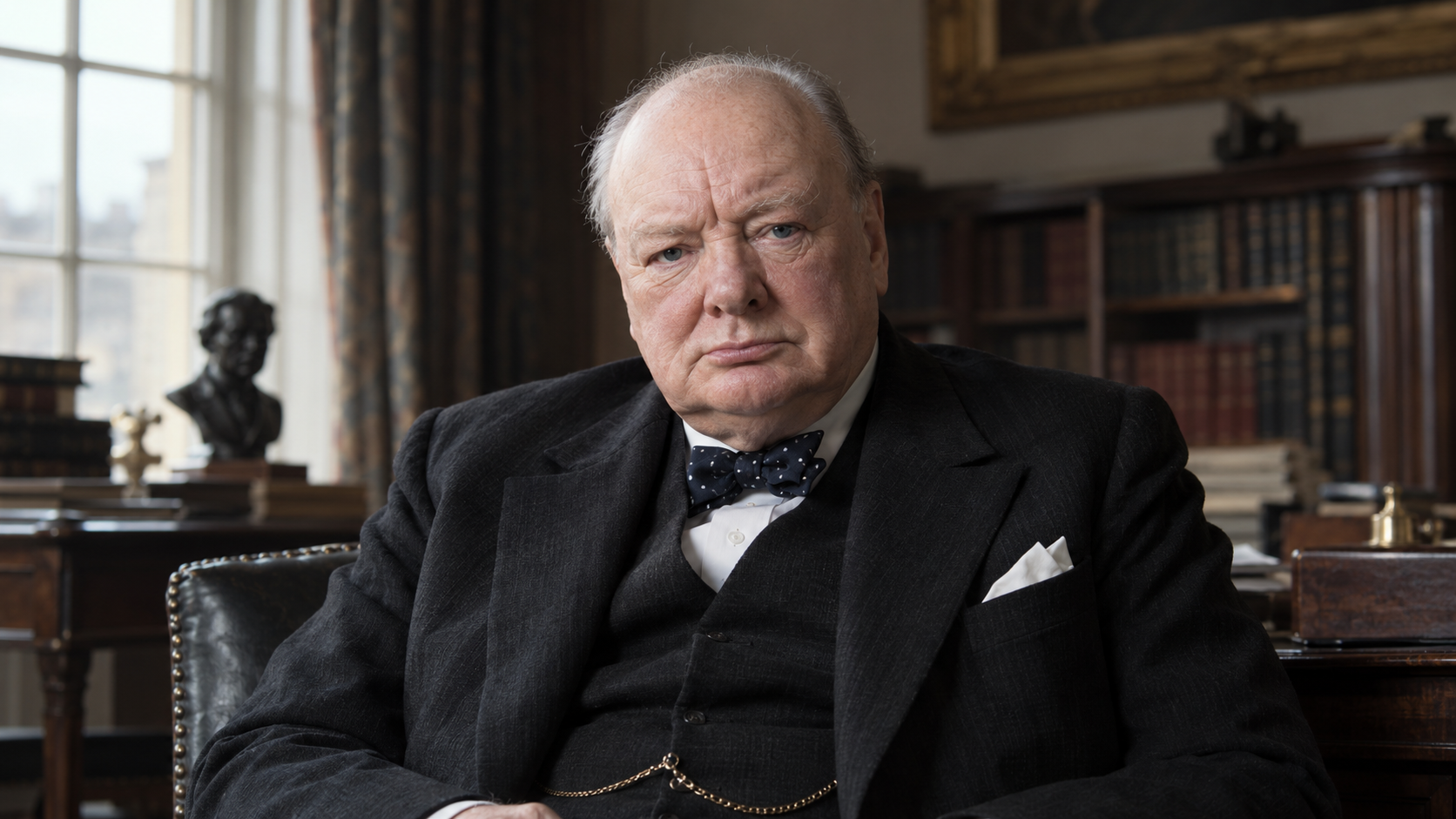
“No one pretends that democracy is perfect or all-wise.”
Winston Churchill made this observation in the House of Commons on November 11, 1947, during debate on the Parliament Bill. The official parliamentary record places it within an argument about constitutional safeguards and the relationship between the elected government and the public. Churchill was speaking as leader of the opposition, rather than as a prime minister making a general address about the virtues of his administration. The distinction gives the sentence a more specific political setting. He was challenging a government’s proposals while defending the principle that ministers remain accountable to the people. His acknowledgment of democratic imperfection was therefore part of an argument about how public power should be checked. It was not a detached verdict that elections or representative institutions had no value.
The surrounding passage helps explain the balance he intended. Churchill argued that public opinion, expressed through constitutional means, should influence and control ministers. His point allowed democracy to be fallible while insisting that those who govern must answer to those they serve. The next sentence contains the much more famous comparison between democracy and other forms of government. Importantly, he introduced that comparison as something that had been said, rather than claiming to have invented its wording. The short sentence selected here is directly recorded in his speech and does not require assigning him authorship of that older comparison. It identifies a realistic starting point: democratic decisions can be mistaken. Acknowledging that possibility can support scrutiny and correction, rather than become an excuse to remove the public from political decisions altogether.
This distinction is useful when evaluating frustration with representative government. A bad decision may demonstrate a need for better evidence, a clearer debate, or a functioning avenue of challenge. It does not by itself establish that unaccountable rule would produce better decisions. Conversely, invoking democracy cannot settle every dispute about the design of a second chamber or the pace of legislative change. Churchill’s own argument was made in a contested parliamentary debate, with opponents who understood the proposed reforms differently. Readers should separate the principle of public accountability from automatic endorsement of his position on that particular bill. The quotation offers no assurance that democratic safeguards work without effort. Its value lies in leaving room for political error while preserving the possibility of political correction. Citizens can ask whether a government explains its decisions, responds to criticism, and remains subject to constitutional limits. Perfection is an impossible test, but accountability is a practical one whose presence or absence can be examined. February 4 assigns this entry its place in the quotation collection; the Commons speech occurred in November 1947.
Hansard records the sentence during the resumed debate on the Parliament Bill on November 11, 1947. Churchill addressed the Commons as the opposition leader.
The debate concerned changes to constitutional arrangements involving the House of Lords. The quotation arose from a disagreement about safeguards and legislative power.
The sentence allows democratic institutions to make mistakes. The surrounding argument retains the people's authority to shape and check governmental action.
It should not be read as praise of every decision made by an elected government. Nor does it settle the merits of the particular bill under discussion.
The International Churchill Society reproduces this passage from the 1947 speech. The neighboring “worst form” comparison is introduced by Churchill as a saying already in circulation.
The continuing question is how a political system permits correction. Public criticism, constitutional procedures, and accountability matter precisely because no form of decision-making is infallible.
Explore more "Quotes of The Day"
Discover more notable quotes from influential voices across politics, science, business, technology, sports, and culture. Each quote offers insight into how ideas, beliefs, and decisions shape the world around us.