

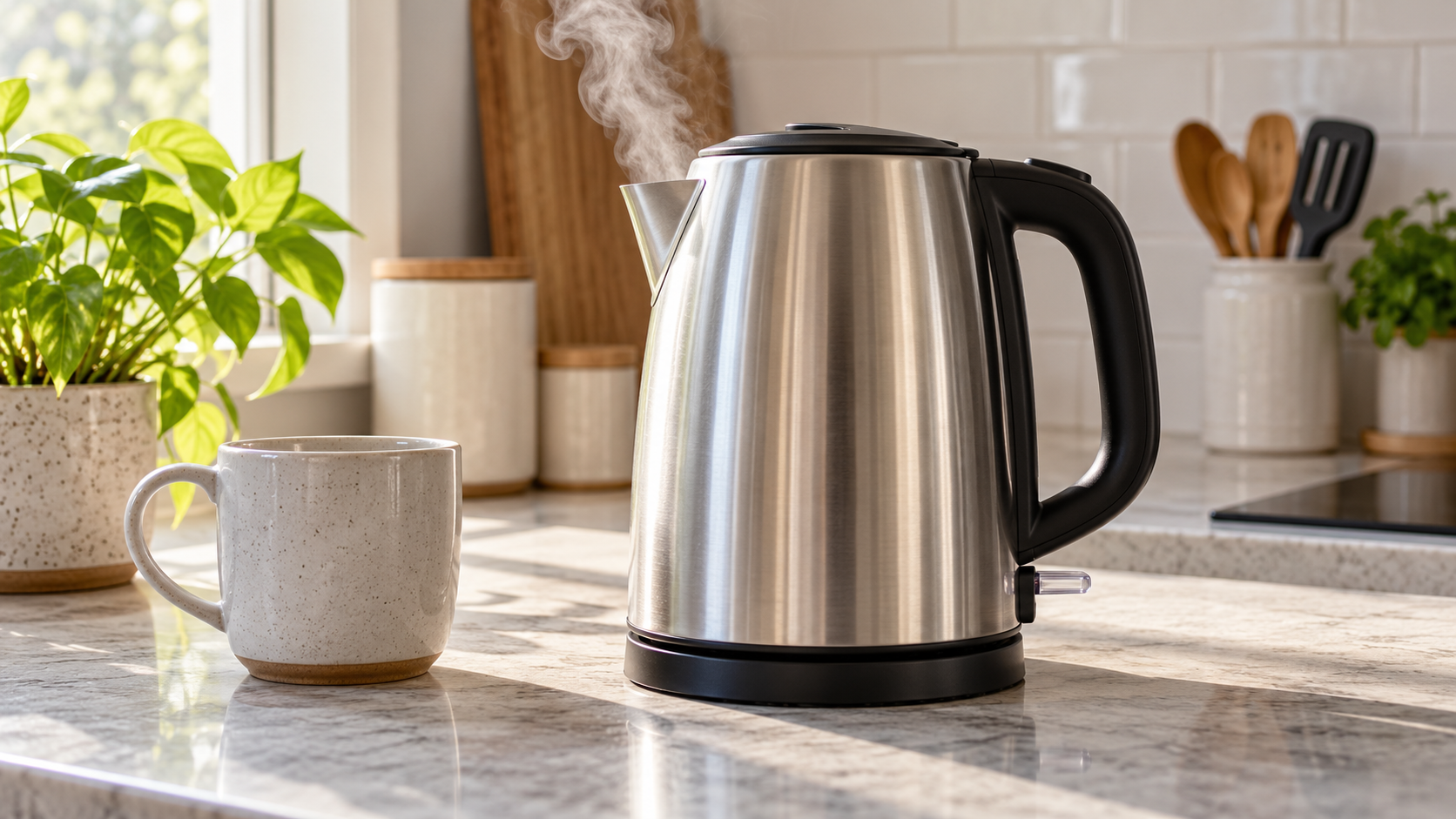
Electric Kettle Auto-Shutoff Explainer
An electric kettle heats water with a resistive element in its base or beneath a metal floor. Current passing through the element encounters electrical resistance and becomes heat, which conducts into the water. As the water approaches boiling, bubbles form throughout the liquid and steam collects above the surface. A small passage routes hot steam toward a thermostat near the handle or switch. The rapid temperature rise at that location triggers the mechanism that releases the power switch.
Many kettles use a bimetal disc made from two bonded metals that expand by different amounts. When heated to its designed temperature, the disc suddenly changes curvature with a snap. That motion trips a latch and opens the electrical contacts feeding the heater. Because the contacts are physically separated, the element stops receiving power even if the kettle remains on its base. As the thermostat cools, the disc returns, but the latch normally stays off until the user deliberately starts another cycle.
The steam path is important. A lid left open, an obstructed passage, or excessive scale can delay the thermostat’s exposure to steam. Boiling point also changes with atmospheric pressure, so water boils at a lower temperature at high elevation, yet the steam-heated switch can still respond to active boiling. Some variable-temperature kettles add an electronic sensor and controller that stop below boiling, but a separate mechanical safety cutoff may remain in the circuit.
A second protective device addresses dry boiling or overheating. If little or no water covers the heated surface, its temperature rises much faster than during normal boiling. A thermal cutoff or resettable thermostat opens before the surrounding materials reach a dangerous temperature. That protection is not intended for routine use. Repeated dry operation can damage the element, seals, finish, or cutoff, and a kettle that fails to switch off should be unplugged and removed from service.
Mineral scale acts as an insulating layer and can cause noise, slower heating, uneven hot spots, or inaccurate sensing. Descaling at the recommended interval restores heat transfer and keeps the steam route clear. The kettle should be filled between its marked minimum and maximum levels, placed on a dry stable base, and never immersed. Steam can burn even after the switch clicks off, so the lid stays closed and the spout points away from people while pouring.
The automatic action is a useful example of energy controlling its own shutoff. The heater produces boiling, boiling produces steam, and steam heats a mechanical sensor that opens the heater circuit. No timer needs to guess how much water was added or how cold it began. The system responds to the physical event itself. Reliable operation still depends on a closed lid, open steam passage, clean vessel, working thermostat, and prompt retirement of any kettle that continues heating after a boil.
Steam from boiling water travels to a thermostat, where a bimetal disc snaps and releases contacts that power the heating element. Key terms include resistance heater, boiling, steam passage, thermostat, bimetal disc, latch, contacts, and dry-boil cutoff.
The lid helps route steam through the intended passage to the thermostat. An open lid can let steam escape and delay automatic shutoff.
A separate thermal cutoff or thermostat responds to the rapid temperature rise during dry operation. It is an emergency layer, not a normal stopping method.
Explore more "Explainers"
Discover additional explainers across politics, science, business, technology, and other fields. Each explainer breaks down a complex idea into clear, everyday language—helping you better understand how major concepts, systems, and debates shape the world around us.