

Quartz Watch Timekeeping Explainer
A quartz watch keeps time with a crystal that vibrates at a predictable frequency when included in an electronic oscillator. Quartz is piezoelectric: applying voltage deforms it slightly, and mechanical deformation produces an electrical signal. A battery-powered circuit feeds back the signal so a specially cut crystal continues oscillating, commonly at 32,768 cycles per second. That frequency is high enough for stability yet convenient for low-power electronics.
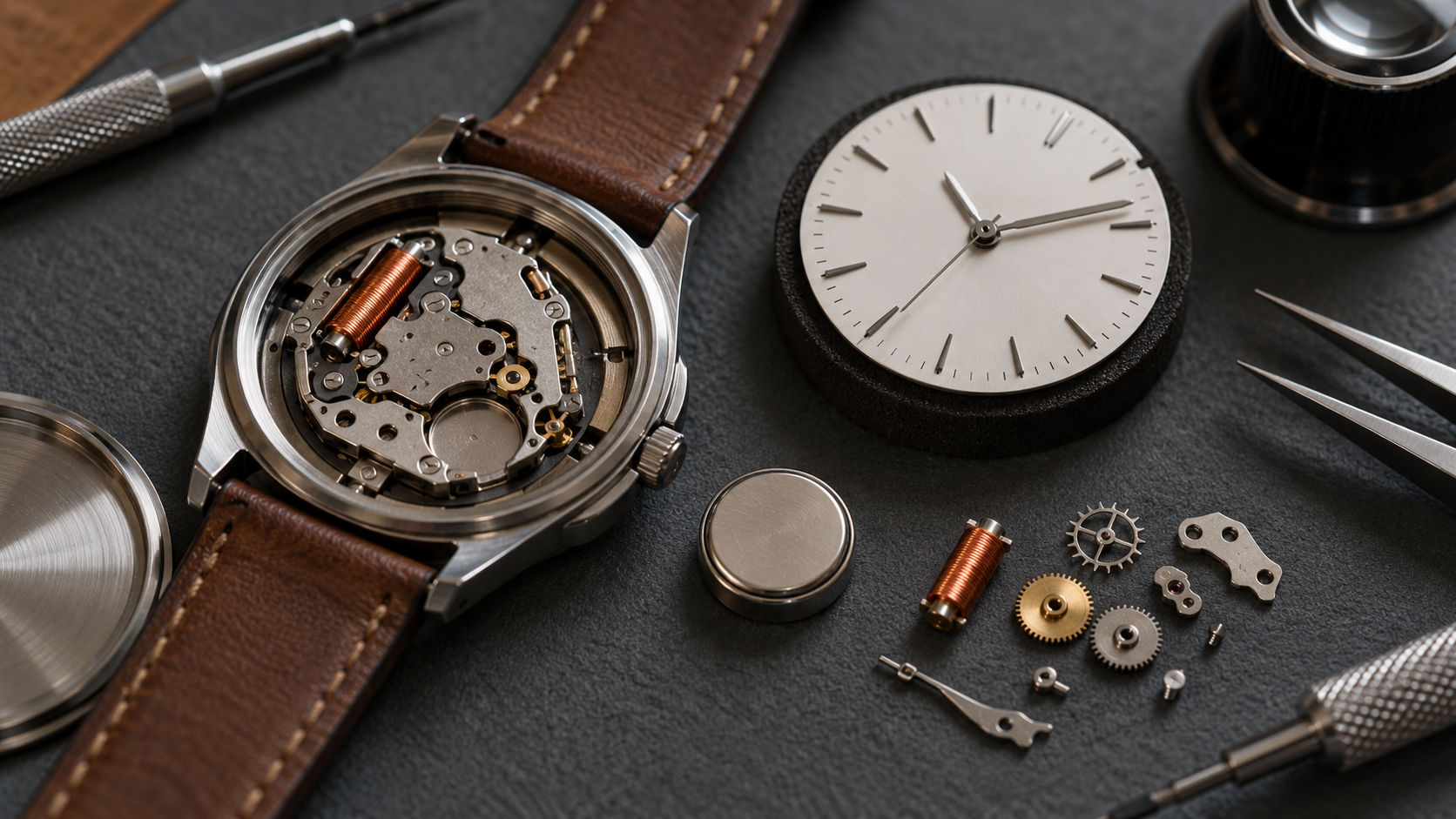
A chain of binary divider circuits repeatedly halves the oscillator frequency. Fifteen halvings turn 32,768 cycles per second into one pulse per second. In an analog watch, each pulse energizes a tiny coil and stepper motor, rotating the rotor by a fixed increment. Gears reduce and distribute that motion to the second, minute, and hour hands. In a digital watch, counted pulses advance electronic time registers that drive segments on the display.
The crystal is shaped like a very small tuning fork and sealed to protect it from contamination and mechanical damage. Its dimensions and material properties set the natural frequency. The oscillator circuit adds capacitive loading that fine-tunes operation. Manufacturing tolerances mean no two inexpensive crystals are exactly identical, so the watch can gain or lose seconds over time even though each individual vibration is extremely regular compared with the swing of a purely mechanical balance.
Temperature is a major source of error. A common watch crystal is cut so its frequency is closest to nominal near room temperature and changes in a curved pattern as conditions become hotter or colder. Wrist wear moderates some extremes, but storage in a cold car or hot window can alter rate. Higher-grade movements measure temperature and compensate electronically. Aging, shock, circuit tolerances, and battery voltage near end of life also contribute smaller effects.
The battery supplies very little continuous power, which is why a small cell can run a watch for years. The motor draws brief pulses rather than turning constantly, and complementary metal-oxide-semiconductor circuits consume little energy between transitions. A seconds hand that jumps several seconds at once may be an intentional low-battery warning in some models, not an oscillator suddenly counting incorrectly. Battery replacement also requires proper sealing when water resistance matters.
Quartz timekeeping is therefore a sequence of conversions: electro-mechanical feedback sustains a crystal vibration, digital logic divides it into human-scale intervals, and a display converts those intervals into visible time. The watch is not perfectly accurate, because the crystal’s frequency responds to environment and manufacture. It is nevertheless inexpensive, compact, and far more stable than most untuned mechanical oscillators, which explains its dominance in everyday clocks and watches.
A battery-powered circuit sustains a quartz crystal’s vibration, divider circuits reduce the frequency to timed pulses, and a motor or display shows the count. Key terms include piezoelectricity, oscillator, 32,768 hertz, divider, stepper motor, gear train, temperature compensation, and rate error.
It is 2 to the fifteenth power, so a compact chain of fifteen binary divide-by-two stages produces exactly one nominal pulse per second.
Crystal frequency changes with temperature and small manufacturing, aging, loading, and circuit differences. Compensation improves performance but does not make it absolute.
Explore more "Explainers"
Discover additional explainers across politics, science, business, technology, and other fields. Each explainer breaks down a complex idea into clear, everyday language—helping you better understand how major concepts, systems, and debates shape the world around us.