

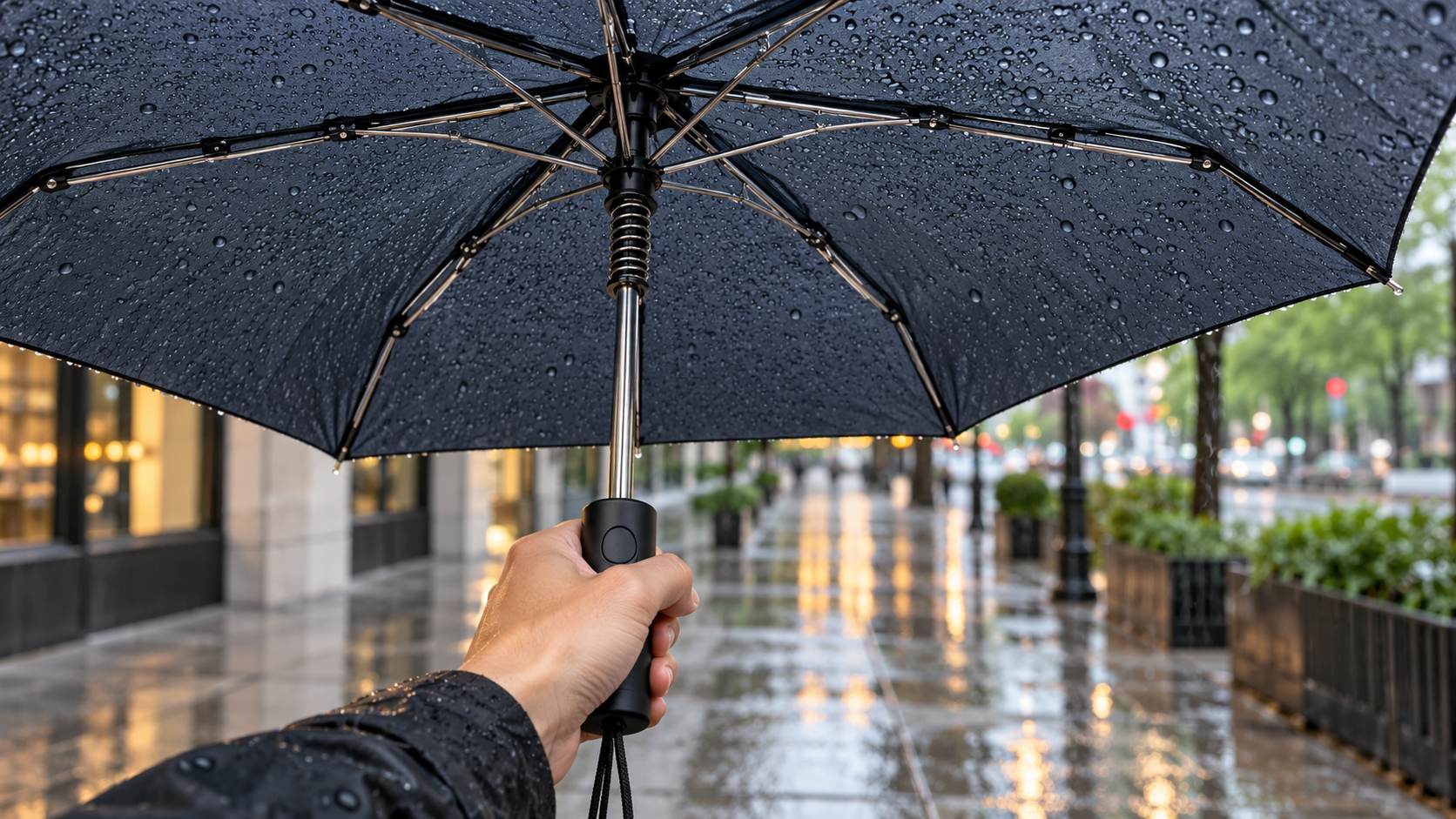
Automatic Umbrella Mechanism Explainer
An automatic umbrella stores mechanical energy in a compressed spring inside or around its telescoping shaft. Pressing the handle button moves a latch that has been holding the spring in its cocked position. The released spring rapidly extends the shaft or drives a sliding runner upward. Stretchers hinged to that runner push outward on the main ribs, and the ribs spread the attached canopy into its open dome. The user’s finger triggers the motion but does not supply the opening energy.
The rib assembly is a set of linked levers. Each stretcher pivots at the runner and at a point along a rib, converting the runner’s straight motion into outward rotation. Flexible ribs bow into the canopy’s curved profile and hold fabric under tension. Small joints let the system fold alongside the shaft when closed. Geometry matters: pivot positions determine the mechanical advantage, final diameter, and force needed to pull the canopy taut against wind and fabric resistance.
An auto-open umbrella still usually closes by hand. The user pulls the runner down until a latch catches and then collapses the telescoping shaft to recompress the spring. An auto-open/auto-close model adds a second controlled release that folds the canopy, often using cords and additional springs, but the shaft must still be pushed together to reset stored energy. Pressing the button again before a full reset may do nothing because the internal latch has not been re-cocked.
Opening is fast, so clearance matters. The umbrella should point away from faces, fragile objects, traffic, and low ceilings before the button is pressed. Fingers belong on the handle rather than around the sliding runner or telescoping joints. A bent rib, frayed internal cord, cracked handle, or latch that releases unexpectedly can create sharp or sudden movement. The spring housing should not be opened casually because stored force may eject parts.
Wind loads the canopy like a sail. Vented fabric and flexible ribs can reduce pressure or allow temporary inversion, but no compact mechanism is immune to strong gusts. Forcing an inverted canopy back while the ribs are twisted can break hinges. Moving to shelter, allowing pressure to ease, and following the product’s closing method is safer. Drying the umbrella open after use reduces corrosion and mildew, while grit should be kept out of the telescoping shaft.
The automatic feature is therefore a controlled release of energy previously supplied during closing. The compressed spring is the energy store, the latch is the gate, the runner is the linear driver, and the rib-stretcher network changes that motion into a broad circular opening. The mechanism saves a hand movement but does not eliminate the reset step or ordinary care. Its speed and convenience come from compact spring power, which also deserves deliberate handling.
Pressing the button releases a latch, allowing a compressed spring to extend the shaft or move a runner that pushes linked ribs outward. Key terms include spring, latch, telescoping shaft, runner, stretcher, rib, canopy, and reset.
Closing and compressing the shaft returns energy to the spring and re-engages the latch, preparing the mechanism for the next button press.
The spring drives the shaft and ribs outward quickly. Keeping the umbrella away from faces and objects prevents impact or pinching during deployment.
Explore more "Explainers"
Discover additional explainers across politics, science, business, technology, and other fields. Each explainer breaks down a complex idea into clear, everyday language—helping you better understand how major concepts, systems, and debates shape the world around us.