

Revolving Door Speed Control Explainer
A revolving door mounts several door wings to a central vertical shaft inside a circular enclosure. People push a manual wing or enter a compartment moved by a powered drive. Bearings at the top and bottom support the assembly and allow rotation with manageable friction. Flexible seals along the wing edges stay close to the curved walls, reducing air exchange while the compartments carry people through without creating a continuously open path between indoors and outdoors.
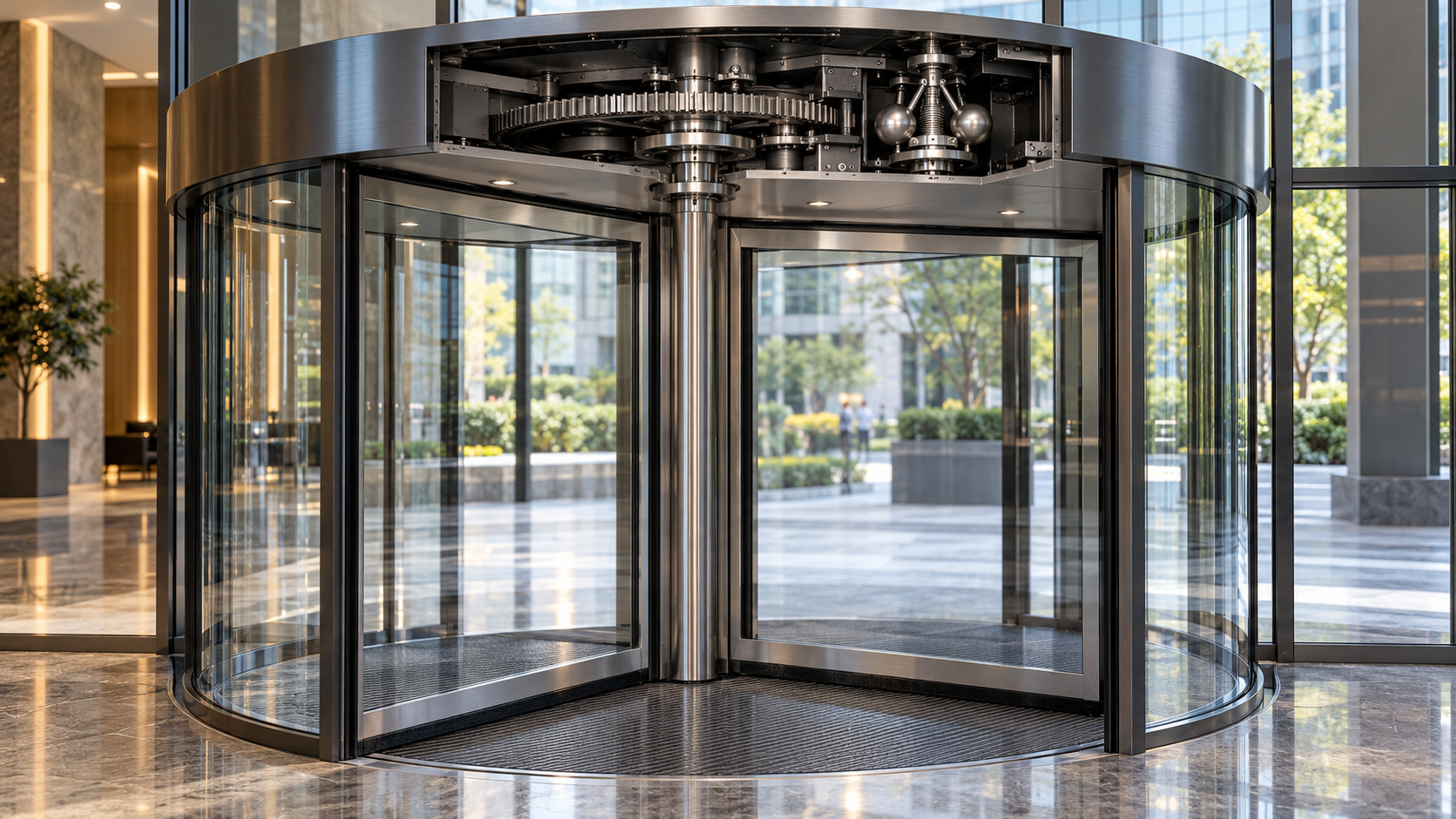
Speed control prevents the heavy rotating assembly from accelerating dangerously. Manual doors may use a governor connected to the shaft through gears. A centrifugal mechanism, hydraulic unit, or electromagnetic brake adds resistance as speed rises. Powered doors use a motor drive with feedback, programmed speed limits, and dynamic braking. In either case, the controller or governor absorbs excess energy so a strong push does not make the wings continue gaining speed.
The rotating mass has inertia, so stopping distance matters. Position cams, encoders, or switches tell an automatic system where the wings are. Sensors can slow or stop the drive when a person or object enters a protected area near a leading edge. Compressible safety edges and breakaway wings provide additional responses in some designs. The building also needs an accessible alternate entrance or an approved configuration because a revolving compartment does not suit every user or emergency.
The door’s energy-saving value comes from compartmentalization. Ordinary swinging or sliding doors briefly connect two large air volumes, allowing wind and stack pressure to exchange conditioned air. A revolving door always keeps at least one wing close to each side of the enclosure, so the opening is divided. Brush and rubber seals reduce leakage without creating excessive drag. Misaligned seals, dirty floors, or worn bearings can raise push force and interfere with controlled motion.
Users should enter a clear compartment, keep pace, avoid touching the center, and supervise children and animals. Luggage and mobility devices need sufficient space and may be better served by the adjacent accessible door. If a powered door behaves erratically, stops repeatedly, or has damaged safety edges, it should be reported rather than pushed through. Only trained technicians should adjust governors, sensors, brakes, or breakout hardware because speed and clearance settings are safety functions.
Controlled rotation comes from balancing easy movement with deliberate resistance. Bearings let the shaft turn, while the governor prevents speed from rising beyond the intended range. In a powered system, sensing and feedback add a managed start, cruise, slowdown, and stop. The wings simultaneously move people and preserve an air barrier. What feels like a simple rotating partition is a coordinated machine whose mass, clearances, seals, braking, and safety detection must remain correctly adjusted.
Bearings support the central shaft while a mechanical governor or controlled motor drive adds braking as speed rises. Key terms include wing, central shaft, enclosure, inertia, governor, dynamic braking, safety edge, and breakaway.
Its wings divide the opening into moving compartments, so the indoor and outdoor air volumes are not fully connected at one time.
No. A governor is intended to limit excessive speed, and forcing the wings can endanger other users or damage the control mechanism.
Explore more "Explainers"
Discover additional explainers across politics, science, business, technology, and other fields. Each explainer breaks down a complex idea into clear, everyday language—helping you better understand how major concepts, systems, and debates shape the world around us.