

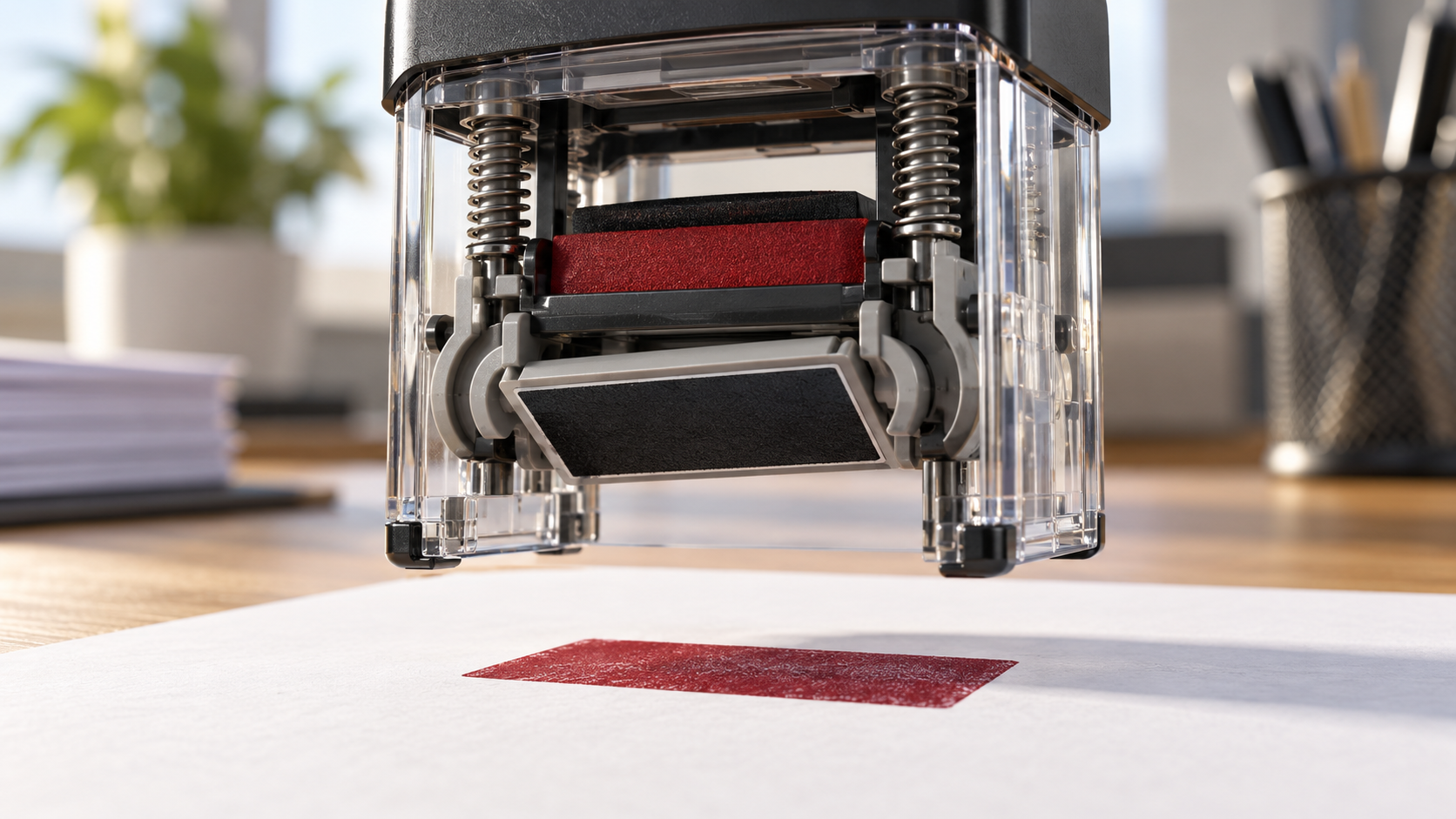
Self-Inking Stamp Mechanism Explainer
A self-inking stamp keeps its rubber die facing upward against an ink pad while the tool is at rest. Pressing the outer handle drives an inner frame downward against return springs. Guide pins attached to the die carrier travel through shaped slots in the housing. Those slots make the carrier rotate halfway around during its descent. By the time it reaches the bottom, the freshly inked die faces downward and presses evenly against the paper.
Releasing the handle reverses the path. The springs lift the frame, the guide pins follow the tracks upward, and the die rotates back toward the pad. At the top it touches the ink reservoir again, ready for the next impression. The mechanism coordinates translation and rotation with very few parts. A separate hand stamp needs an external pad and two actions; this design combines inking and printing into every controlled stroke.
The ink pad is porous and holds a measured supply of suitable ink. Light, even contact coats the raised printing surface without flooding recessed areas. The rubber or photopolymer die contains a mirror image, so the impression reads correctly after transfer. Replaceable pads often slide into the frame while the stamp is locked in a service position. Ink chemistry must match the pad, die material, and surface; ordinary office ink is mainly intended for absorbent paper.
Housing geometry sets impression pressure and alignment. If the die sits crooked, the print is uneven even when fully pressed. Excess force does not create more ink after the die has contacted the page; it can spread characters, damage the mechanism, or force ink into fine gaps. A smooth vertical stroke on a flat supported sheet produces the clearest result. Consecutive impressions may lighten if the die does not return fully to the pad between strokes.
Dried ink, paper fibers, worn springs, cracked guide pins, or a saturated pad can cause poor results. The die is cleaned only with a compatible method so fine relief is not swollen or torn. Fingers and clothing are kept away from the flipping carrier while servicing. Locking buttons are used according to the manufacturer rather than forcing the handle. When replacing a pad, the stamp remains upright and protected from uncontrolled spring movement.
The self-inking action is a compact mechanical cycle: rest against ink, move downward, rotate 180 degrees, print, rise, rotate back, and recoat. Tracks turn a straight hand press into a reversing motion, while springs reset the system automatically. Because the die receives a fresh thin film after every use, the device can make many consistent impressions quickly. Its reliability depends on correct ink, a clean die, an undamaged pad, and free movement through the full stroke.
Guide pins follow shaped tracks that make the die carrier flip 180 degrees between the internal ink pad and the page. Key terms include die, ink pad, carrier, guide pin, track, return spring, impression, and service lock.
Its printing face rests against the internal pad so raised characters receive fresh ink while protected inside the housing.
Once the die contacts the page, extra force can spread ink, distort fine characters, or strain the mechanism without adding useful coating.
Explore more "Explainers"
Discover additional explainers across politics, science, business, technology, and other fields. Each explainer breaks down a complex idea into clear, everyday language—helping you better understand how major concepts, systems, and debates shape the world around us.