

Correction Tape Dispenser Explainer
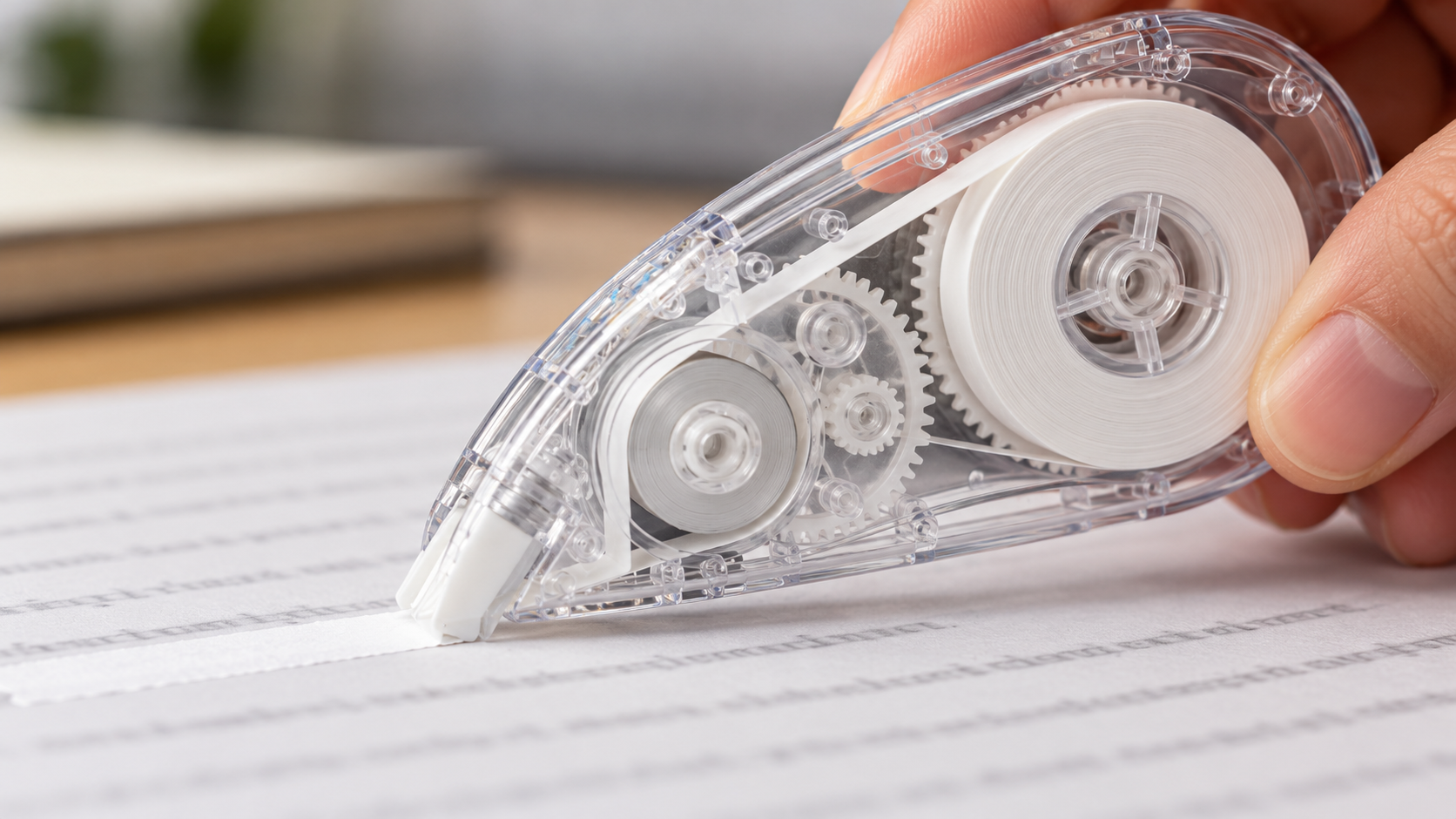
Correction tape is a thin carrier film coated with an opaque correction layer and release materials. Inside the dispenser, unused film unwinds from a supply spool and travels around a pointed application tip. When the tip is pressed against paper and pulled, friction holds the correction layer to the page while the carrier film bends sharply around the tip. That sharp turn helps the coating separate from the film, leaving a dry white strip over the writing.
The bare carrier must be collected so it does not trail behind the tool. A take-up spool winds it inside the case. Gears, belts, or friction clutches couple the supply and take-up reels while allowing their effective diameters to change throughout the roll. Early in use, the supply is large and the take-up is small; later the relationship reverses. A slipping element or carefully chosen gear path maintains useful tension without stretching or snapping the film.
The application tip controls angle and pressure. Its broad flat edge presses the full tape width to the paper, while small guides keep the film centered. Pulling in the designed direction holds the tape against the tip and lets the coating transfer continuously. Pushing the dispenser can buckle the film unless the model is built for both directions. Lifting cleanly at the end breaks the coating strip while the carrier continues around the tip.
Correction tape can be written over immediately because there is no wet solvent to evaporate. However, adhesion depends on paper texture, cleanliness, pressure, and the ink or toner underneath. A rough sheet may leave gaps, while oily or heavily raised marks reduce contact. The coating is thin and can be scraped by a hard pen point. Layering many passes creates a raised patch that may crack or feed poorly through copiers and scanners.
A loose loop often means the take-up spool has not advanced enough. Some dispensers allow gentle winding through an exposed hub; others are sealed and should not be opened. Pulling film out by hand can reverse the path or contaminate the coating. A cracked tip, stripped gear, dried transfer layer, or twisted carrier usually makes replacement more practical than repair. Small broken case parts and long strips of film should be kept away from children and pets.
The tool performs coating transfer and waste management in one hand motion. Paper friction receives the opaque layer, the tip creates the separation bend, and the take-up system stores the spent carrier under controlled tension. The visible gears do not erase ink; they synchronize two reels whose diameters constantly change. When angle, direction, and pressure are steady, the mechanism lays down a thin cover line that is clean, immediate, and more predictable than wet correction fluid.
A coated carrier film bends over a transfer tip, leaving the opaque layer on paper while gears wind the bare film onto a take-up spool. Key terms include carrier, coating, supply spool, take-up spool, transfer tip, release layer, clutch, and tension.
A geared or belt-driven take-up spool winds the bare carrier after its coating transfers, keeping waste controlled and maintaining film tension.
Pulling keeps the thin film tensioned against the application tip. Pushing can make it buckle, wrinkle, or leave the guide path.
Explore more "Explainers"
Discover additional explainers across politics, science, business, technology, and other fields. Each explainer breaks down a complex idea into clear, everyday language—helping you better understand how major concepts, systems, and debates shape the world around us.