

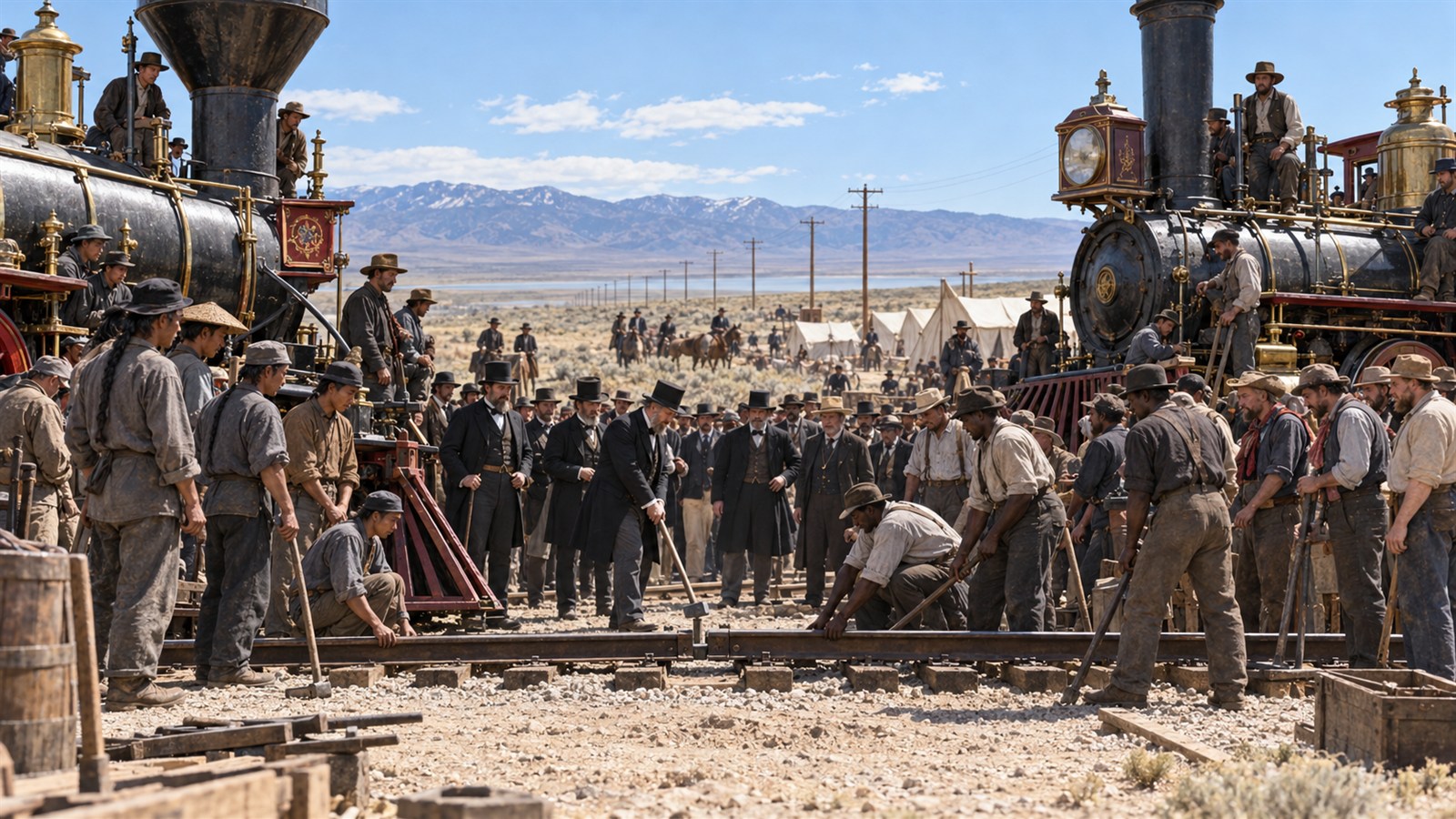
On This Day in Business: May 10, 1869
On May 10, 1869, the Central Pacific and Union Pacific railroads met at Promontory Summit in Utah Territory, completing the first transcontinental railroad. A ceremonial last spike marked the joining, and a telegraph connection carried the word “DONE” across the country. The line connected existing eastern rail networks with the Pacific coast, reducing a journey that had taken months to roughly a week. For passengers, mail, manufacturers, merchants, and investors, the railroad converted distance into scheduled service and created a national transportation market on a scale that wagon roads and coastal shipping could not match.
The enterprise depended heavily on federal policy. The Pacific Railway Acts provided land grants and government bonds, encouraging two private companies to build toward one another. That structure accelerated construction but also rewarded mileage and generated waste, rivalry, and corruption. Central Pacific recruited thousands of Chinese workers for the difficult western grades, while Union Pacific crews included many Civil War veterans and immigrants. Irish and other workers also contributed, and Black workers participated in parts of the effort. Their labor cut through mountains, bridged rivers, and crossed harsh plains under dangerous conditions.
The new line reorganized business geography. Freight rates and timetables linked western producers to eastern buyers, while towns grew or declined according to their place on the route. Railroads received enormous land holdings and sold parcels to finance expansion and encourage settlement. The same process intensified the displacement of Native nations, damaged bison herds, and extended federal and corporate power across Indigenous lands. Technical compatibility remained imperfect because rail gauges and transfers still varied, but the Promontory connection established the commercial principle of continuous transcontinental movement.
The completion matters because network value grows when isolated segments become one system. A mile of track served local traffic; a coast-to-coast chain changed inventory planning, migration, pricing, news, and investment. Yet the railroad’s gains and costs were distributed unequally. Public subsidies created private assets, workers absorbed grave hazards, and Native communities bore losses that the market did not price. The business lesson is therefore twofold: infrastructure can unlock enormous exchange by standardizing movement, and its financing rules determine who receives the upside. The golden spike celebrated connection, but the enduring economy emerged from daily operations, maintenance, terminals, schedules, and contested control over the land crossed. Standard time later became another railroad consequence. Coordinating trains across long distances made local solar time increasingly impractical, encouraging common time zones. The network thus changed information as well as movement. Large systems frequently create standards that reach beyond their original service because customers and partners need one shared way to plan around the infrastructure.
Federal land grants and bonds gave two private railroads incentives to build toward a common point.
Chinese, Irish, veteran, and other laborers completed dangerous work across mountains, deserts, rivers, and plains.
Central Pacific and Union Pacific joined at Promontory Summit on May 10, 1869, as a telegraph announced completion.
Faster travel integrated freight, mail, labor, and consumer markets across the continent.
Rail expansion also accelerated Native displacement, environmental change, land speculation, and corporate political power.
The railroad’s true value came from operating one connected network, not merely laying two separate stretches of track.
Explore more of "On This Day ..."
Discover more events from the same date across news, politics, technology, sports, and other fields. Each link highlights significant moments that shaped history on different fronts.