

On This Day in Business: May 12, 1937
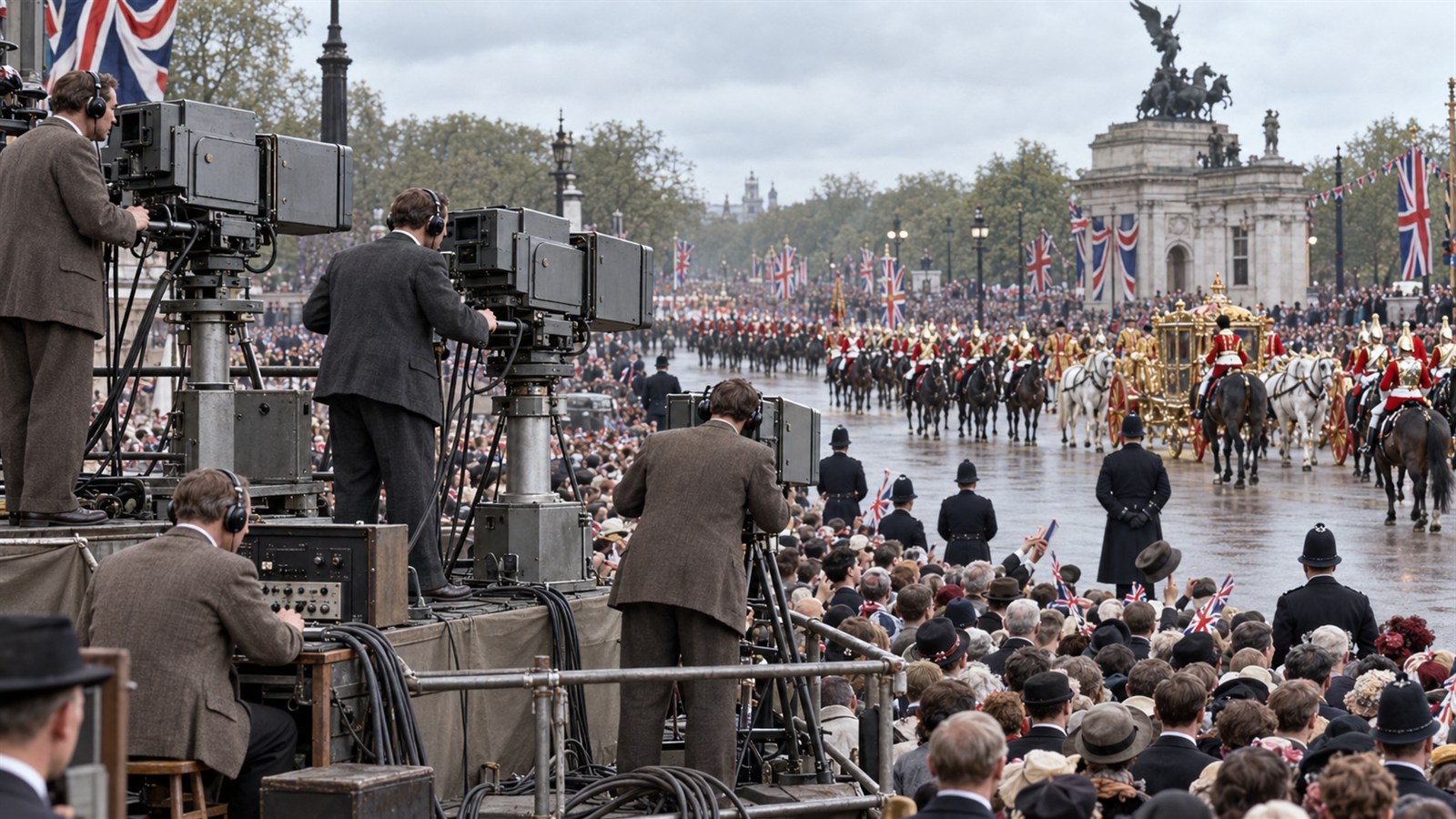
On May 12, 1937, the BBC televised the procession for the coronation of King George VI and Queen Elizabeth, its first major outside television broadcast. Cameras were not permitted inside Westminster Abbey, so the fledgling service showed outdoor scenes around Hyde Park Corner and the returning royal procession. Special cable carried the signal back toward Alexandra Palace. Only a limited London-area audience could receive television, and many viewers watched in public rooms, but the broadcast moved the medium beyond the studio and demonstrated that a live national event could become a shared visual experience.
Outside television required a new production system. Engineers had to place cameras where they could cover the route, run signal cable through the city, synchronize sound and vision, protect equipment from weather and crowds, and coordinate with police and ceremony planners. The BBC scheduled commentary and camera changes for an event that would not pause for technical problems. Radio still reached a vastly larger audience and carried the service from inside the Abbey, yet television offered something radio could not: the immediacy of watching procession, uniforms, vehicles, and crowds as they appeared.
Manufacturers and dealers used public viewing rooms to expose people to expensive receivers. The broadcast therefore served as programming, engineering trial, and market demonstration at once. It suggested that television sets could become household gateways to major events rather than curiosities for short studio programs. World War II soon interrupted the BBC television service, but the operating knowledge survived. The full television coverage of Elizabeth II’s coronation in 1953 would reach a mass audience and encourage receiver purchases on a scale only imagined in 1937.
The coronation broadcast matters because media markets grow when content gives consumers a reason to adopt hardware. The BBC could improve cameras and transmitters, but a ceremonial event converted those capabilities into a memorable benefit. It also showed how live production creates value through coordination rather than ownership of the underlying event. Broadcasters, network engineers, commentators, receiver makers, venues, and public authorities all contributed to one experience. Television would later become a dominant advertising and entertainment business, but its expansion depended on learning to take viewers beyond the studio. On this day, a royal procession became an early proof that distance could be turned into a live visual audience. Scarcity initially encouraged communal viewing. A receiver was expensive, but pubs, dealers, and public rooms could spread that cost across many spectators. Shared screens expanded the audience before household ownership was economical. Media businesses often grow through such transitional venues, where consumers experience a new format first and later decide that personal access is worth purchasing.
The BBC’s young television service needed compelling programs to prove that receivers offered more than laboratory novelty.
Permission excluded cameras from Westminster Abbey, so producers built coverage around the outdoor procession.
Special cables carried pictures from Hyde Park Corner during the May 12, 1937 coronation events.
Engineers coordinated cameras, sound, crowds, weather, and a fixed ceremony in the BBC’s first major outside broadcast.
Public viewing rooms let dealers demonstrate costly television sets to people who had never seen live moving pictures at a distance.
The experiment established the link between major live events, receiver demand, and the future economics of television.
Explore more of "On This Day ..."
Discover more events from the same date across news, politics, technology, sports, and other fields. Each link highlights significant moments that shaped history on different fronts.